
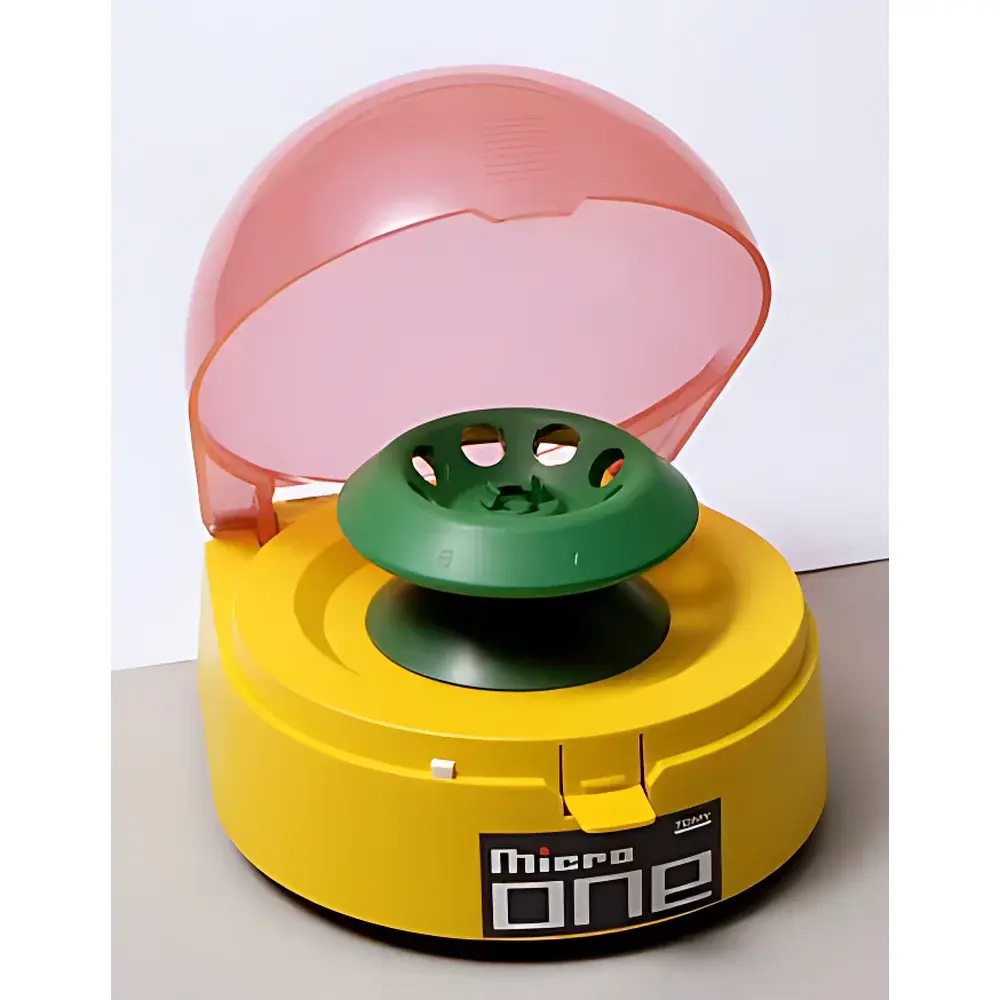
TOMY microONE Portable Centrifuge
| Brand | TOMY |
|---|---|
| Origin | Japan |
| Model | microONE |
| Max Speed | 6,000 rpm (±20%) / 6,200 rpm (±20%) |
| Relative Centrifugal Force (RCF) | 820–2,910 × g |
| Max Capacity | 8 × 1.5–2.2 mL tubes or 2 × 8 × 200 µL PCR strips |
| Power Supply | 230 V, 1 A, 50/60 Hz |
| Fuse | 250 V, 0.2 A |
| Dimensions (W × D × H) | 155 × 175 × 125 mm |
| Housing Material | UL94V-0 ABS |
| Lid Material | UL94V-0 Polycarbonate |
| Rotor Material | UL94V-0 ABS |
| Sealing Ring | NBR |
| Drive System | Direct-drive motor with vibration isolation |
| Acceleration Time | ≤5 s to 90% of set speed |
| Deceleration Time | ≤15 s (lid closed), ≤3 s (lid open) |
| Control Mode | Automatic / Constant-speed operation |
| Safety | Lid interlock, dynamic braking, automatic rotor recognition (mechanical) |
Overview
The TOMY microONE Portable Centrifuge is an engineered solution for rapid, low-force centrifugation in resource-constrained or space-limited laboratory environments. Designed around a brushless direct-drive motor architecture and integrated vibration-damping mechanics, it delivers consistent rotational performance without mechanical transmission losses or belt wear. Its operational principle relies on radial acceleration to separate suspended particles or immiscible phases based on density differentials—ideal for pelleting cellular debris, precipitating nucleic acids, or clarifying small-volume reagents. Unlike benchtop centrifuges requiring dedicated power circuits or cooling systems, the microONE operates efficiently within standard European mains specifications (230 V, 50/60 Hz) and meets IEC 61010-1 safety requirements for laboratory electrical equipment. Its compact footprint (155 × 175 × 125 mm) and lightweight construction (≈1.8 kg) enable seamless integration onto biosafety cabinets, laminar flow hoods, cold rooms, or mobile diagnostic carts—supporting decentralized workflows in clinical labs, field-deployed research units, and teaching facilities.
Key Features
- Tool-free rotor interchange system: Two interchangeable rotors—microtube rotor (8 × 1.5–2.2 mL) and dual-row PCR strip rotor (2 × 8 × 200 µL)—are secured via precision-machined snap-fit interfaces; no wrenches or alignment tools required.
- UL94V-0 certified materials throughout: Polycarbonate lid, ABS housing, rotor body, and control knob meet stringent flame-retardant standards essential for compliance with ISO 13849-1 functional safety assessments in shared lab environments.
- Dual-mode speed control: Select between constant-speed operation (maintains preset rpm across load variations) or automatic ramping (optimized for sensitive samples requiring gradual acceleration/deceleration).
- Lid-actuated dynamic braking: Motor deceleration initiates immediately upon lid opening (stopping in ≤3 s) or continues controlled coast-down when lid remains closed (≤15 s), minimizing sample resuspension and enhancing reproducibility.
- Vibration-isolated direct-drive motor: Eliminates gear train backlash and reduces acoustic noise to <45 dB(A) at 1 m—critical for quiet-zone applications such as core facilities adjacent to microscopy suites or student laboratories.
Sample Compatibility & Compliance
The microONE accommodates standard polypropylene microcentrifuge tubes (1.5–2.2 mL) and 200 µL PCR strips conforming to ANSI/SBS dimensional specifications. Rotors are statically balanced per ISO 1940-1 Grade G6.3 and validated for repeated autoclaving (121 °C, 20 min, 15 psi) without warpage or material degradation. Device certification includes CE marking under the EU Medical Devices Regulation (MDR 2017/745) Annex II Class I, RoHS 2011/65/EU, and WEEE 2012/19/EU directives. It supports GLP-compliant documentation through external logbook integration but does not include built-in audit trail functionality per FDA 21 CFR Part 11.
Software & Data Management
The microONE operates as a standalone instrument with no embedded firmware or digital interface—eliminating cybersecurity vulnerabilities associated with networked lab devices. All operational parameters (speed, run time, brake mode) are set manually via tactile rotary dial with LED-assisted feedback. This analog-first design ensures deterministic behavior, avoids software validation burdens, and complies with ISO/IEC 17025:2017 Clause 7.7.1 requirements for measurement traceability in accredited testing laboratories. For institutions requiring electronic record retention, optional third-party USB data loggers (e.g., HOBO UX120-018M) may be deployed externally to capture runtime events.
Applications
- Routine clarification of enzyme reaction mixtures, antibody dilutions, and cell lysates prior to electrophoresis or spectrophotometric analysis.
- Pre-analytical processing in point-of-care diagnostics—including capillary blood separation in hematocrit assays or plasma extraction from finger-prick samples.
- Teaching laboratories: Demonstrating sedimentation kinetics, Stokes’ law principles, and rotor radius–RCF relationships without high-speed safety enclosures.
- Field-based environmental microbiology: Concentrating waterborne pathogens (e.g., Legionella, Cryptosporidium) from 1–2 mL filtration eluates prior to qPCR amplification.
- QC/QA workflows in pharmaceutical manufacturing: Rapid spin-down of excipient suspensions or residual solvent removal from lyophilized intermediates.
FAQ
Is the microONE suitable for use with infectious or biohazardous samples?
Yes—when operated inside a certified biosafety cabinet (BSC Class II or higher) and paired with sealed tube caps meeting ISO 8573-1 purity class 4, the device supports BSL-2 containment protocols.
Can the rotor be sterilized using ethylene oxide (EtO)?
No—EtO exposure may compromise NBR gasket integrity and ABS rotor crystallinity; only steam autoclaving (121 °C, 20 min) or 70% ethanol wipe-down is recommended.
Does TOMY provide calibration certificates traceable to NIST or UKAS?
Calibration is performed at factory against metrologically verified tachometers (traceable to JCSS, Japan); users may request a Certificate of Conformance (CoC) at time of order.
What is the expected service life under continuous daily use?
Rated for ≥20,000 operational cycles (defined as one acceleration–deceleration sequence) with no scheduled maintenance beyond periodic visual inspection of lid latch and rotor seating.
Are replacement fuses user-serviceable?
Yes—the 250 V, 0.2 A ceramic fuse is accessible via a recessed panel on the rear housing and conforms to IEC 60127-1 standards.
Related Products



