
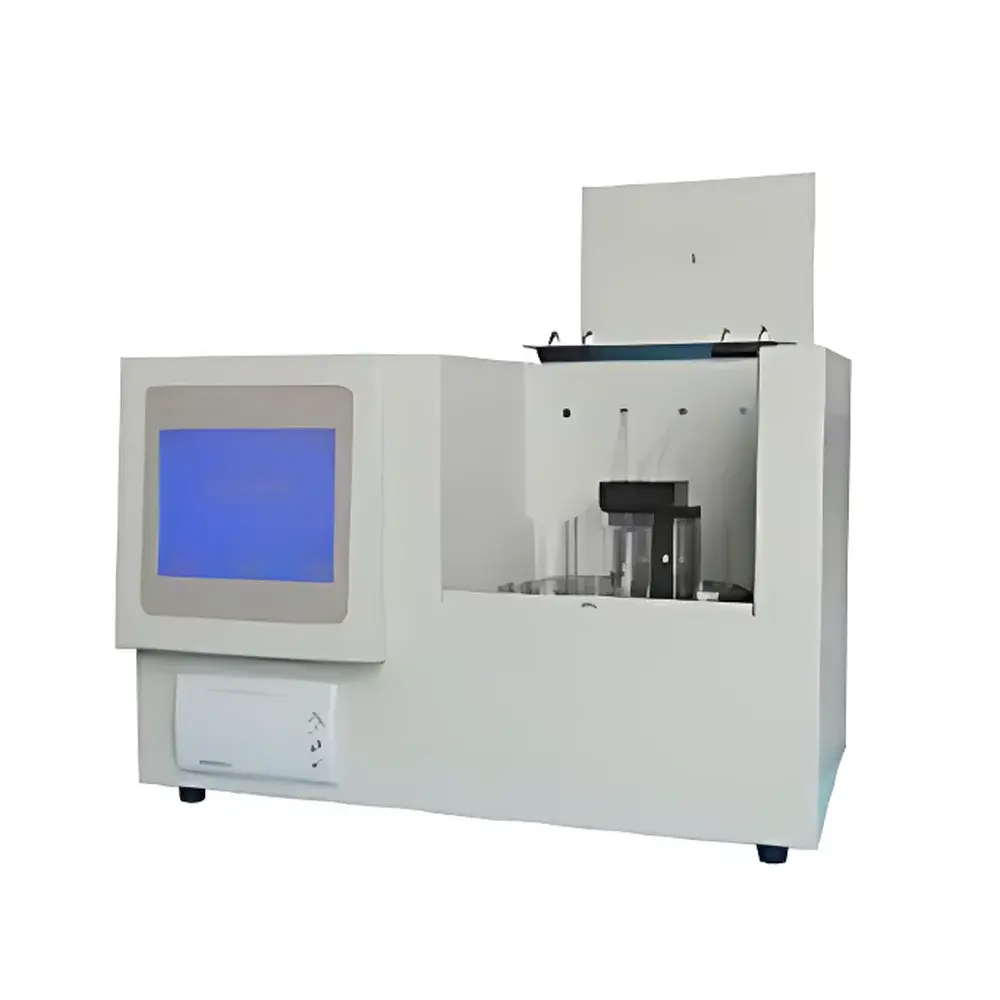
Tongfang ZFS100 Fully Automated Acid Number Analyzer for Turbine Oil
| Brand | Tongfang |
|---|---|
| Model | ZFS100 |
| Origin | Hebei, China |
| Manufacturer Type | Direct Manufacturer |
| Instrument Category | Domestic |
| Instrument Type | Water Bath Constant-Temperature Shaker |
| Timer Range | 0–120 min |
| Oscillation Frequency | 3000 cycles/min |
| Oscillation Amplitude | 6 mm |
| Temperature Control Range | 0–100 °C (with refrigeration) |
| Shelf Quantity | 1 |
| Measurement Principle | Potentiometric and Colorimetric Endpoint Detection via Acid Extraction + Neutralization Titration |
| Standards Compliance | GB/T 264–1983, GB/T 7599–1987, GB/T 258–1977 |
| Measurement Range | 0.001–1.000 mg KOH/g |
| Resolution | 0.0001 mg KOH/g |
| Accuracy | ±0.002 mg KOH/g (for acid number 0.001–0.100 mg KOH/g) |
| Data Storage | 500 test records |
| Interface | RS-232 |
| Power Supply | AC 220 V ±20%, 50 Hz ±10% |
| Operating Environment | 5–40 °C, ≤80% RH |
| Dimensions | 420 × 270 × 260 mm |
| Weight | ~9 kg |
Overview
The Tongfang ZFS100 Fully Automated Acid Number Analyzer for Turbine Oil is an integrated analytical platform engineered for precise, repeatable, and regulatory-compliant acid number determination in insulating oils—specifically turbine oil, transformer oil, and phosphate ester-based anti-wear hydraulic fluids. Designed in strict accordance with Chinese national standards GB/T 264–1983 (determination of acid number of petroleum products), GB/T 7599–1987 (acid number testing of transformer oil), and GB/T 258–1977 (gasoline and kerosene acid number), the system implements a dual-mode endpoint detection strategy: colorimetric recognition via high-stability optical sensors coupled with microprocessor-controlled potentiometric verification. This hybrid approach eliminates subjectivity inherent in manual titration while ensuring robustness across variable sample matrices—including oxidized or aged oils with elevated chromophore interference. The instrument integrates a thermostatically regulated shaking module (0–100 °C, refrigerated), enabling controlled solvent extraction under standardized temperature conditions prior to titration—a critical requirement for method reproducibility per ASTM D974 and ISO 661.
Key Features
- Simultaneous six-position sample processing with independent reaction cup control, minimizing batch analysis time without cross-contamination risk
- Automated reagent delivery via precision peristaltic pumps for both extraction solvent (e.g., isopropanol/toluene mixture) and titrant (KOH in isopropanol), calibrated to ±0.2% volumetric accuracy
- Optical endpoint detection using dual-wavelength photodiode array, validated against certified reference materials traceable to NIM (National Institute of Metrology, China)
- Full-touch 7-inch TFT-LCD interface supporting real-time titration curve visualization, manual override at any stage, and configurable alarm thresholds for out-of-spec results
- No dedicated waste reservoir required—integrated fluid path design directs spent reagents to sealed disposable collection bags, simplifying GLP-aligned disposal protocols
- Embedded thermal printer with automatic report generation including sample ID, date/time stamp, operator ID, raw titration data, and pass/fail flag per ASTM D974 Annex A1
- RS-232 serial interface compliant with LIMS integration frameworks; supports ASCII-based data export for traceability in FDA 21 CFR Part 11 environments when paired with validated software
Sample Compatibility & Compliance
The ZFS100 accommodates standard 50 mL glass sample vials conforming to IEC 60475 and ASTM D6138 specifications. It is validated for use with mineral-based turbine oils (ISO VG 32–68), synthetic ester fluids, and fire-resistant phosphate esters (e.g., Fyrquel™, Skydrol™). All wetted components—including tubing, valves, and sensor housings—are chemically resistant to alcohols, ketones, and aromatic hydrocarbons. The system meets electromagnetic compatibility requirements per GB/T 18268.1–2010 (IEC 61326-1) and safety standards GB 4793.1–2007 (IEC 61010-1). Its operational validation package includes documented IQ/OQ protocols aligned with ISO/IEC 17025:2017 clause 5.5 for testing and calibration laboratories.
Software & Data Management
Onboard firmware stores up to 500 complete test records with full metadata: sample identifier, ambient temperature/humidity, operator code, reagent lot numbers, titration volume curves, and final acid number with uncertainty estimation. Data export supports CSV and TXT formats via USB host port or RS-232. Audit trail functionality logs all user actions—including parameter changes, calibration events, and result deletions—with timestamp and login credentials. When connected to enterprise laboratory systems, the analyzer supports automated data ingestion into ELN platforms (e.g., LabWare LIMS, Thermo Fisher SampleManager) using HL7 or ASTM E1384 message structures.
Applications
- Condition monitoring of steam turbine lubricants in power generation facilities (per IEEE C57.106 and DL/T 706–2015)
- Quality release testing of new transformer oil batches prior to commissioning
- Root cause analysis of accelerated oxidation in wind turbine gearboxes
- Regulatory compliance reporting for ISO 55001 asset management systems
- Research-grade kinetics studies on antioxidant depletion rates under thermal stress
FAQ
Does the ZFS100 comply with ASTM D974 or IP 177?
Yes—the instrument’s titration methodology, reagent formulation, and endpoint criteria are fully compatible with ASTM D974–22 (Standard Test Method for Acid Number of Petroleum Products by Potentiometric Titration) and IP 177:2019, provided users follow the specified solvent ratio and electrode conditioning procedures.
Can it analyze dark-colored or highly oxidized oils?
Yes—its dual-mode (colorimetric + potentiometric) endpoint detection significantly improves reliability over single-sensor systems when analyzing samples with high absorbance above 450 nm.
Is calibration traceable to national standards?
All factory calibrations are performed using NIM-certified potassium hydrogen phthalate (KHP) reference standards (GBW(E) 060019), with certificate of analysis supplied with each unit.
What maintenance intervals are recommended?
Peristaltic pump tubing should be replaced every 6 months or after 5000 cycles; optical sensor windows require cleaning with lint-free isopropanol wipes weekly; annual verification of temperature uniformity across the bath chamber is advised per ISO/IEC 17025.
Is remote diagnostics supported?
Firmware version 2.4+ enables secure SSH-based remote access for technical support personnel, subject to customer-configured firewall rules and TLS 1.2 encryption.



