
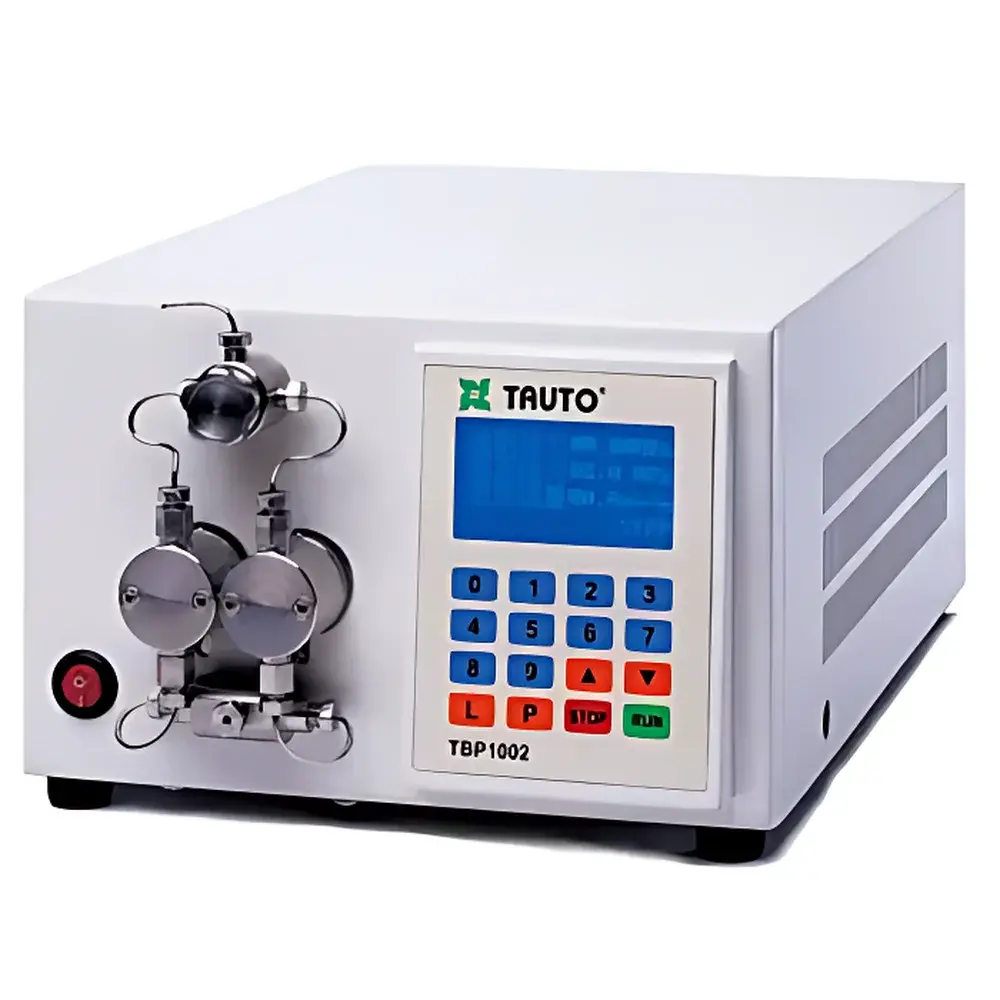
Tongtian TBP1002 Medium-Pressure Constant Flow Pump
| Brand | Tongtian |
|---|---|
| Origin | Shanghai, China |
| Model | TBP1002 |
| Pressure Range | 0–2.0 MPa |
| Flow Rate Range | 0.1–10.0 mL/min |
| Pressure Pulsation | ≤ 0.08 MPa |
| Pressure Accuracy | ≤ 0.05 MPa |
| Flow Setting Error | ≤ 1% |
| Flow Precision (RSD) | ≤ 1% |
| Wetted Materials | Sapphire, 316L Stainless Steel, Zirconia Ceramic |
| Power Supply | 220 V ±10%, 50/60 Hz |
| Power Consumption | 75 W |
| Dimensions | 360 mm × 255 mm × 160 mm |
| Weight | 12 kg |
| Communication Interface | RS232 |
| Display | LCD screen |
| Overpressure Protection | Integrated |
| Air Elimination | Built-in degassing mechanism |
Overview
The Tongtian TBP1002 Medium-Pressure Constant Flow Pump is a dual-piston, microprocessor-controlled precision fluid delivery system engineered for laboratory-scale chromatography, synthesis, and continuous process applications requiring stable, pulse-free flow under moderate pressure. Operating on positive displacement principle, the pump delivers highly reproducible volumetric flow rates by synchronizing two opposing sapphire-tipped pistons—minimizing hydraulic pulsation and maximizing long-term stability. Its design adheres to fundamental principles of reciprocating positive displacement pumping, where flow rate is directly proportional to piston cross-sectional area, stroke length, and cycle frequency—enabling predictable, calibration-based operation without reliance on feedback loops alone. The TBP1002 is not a variable-speed peristaltic or diaphragm pump; rather, it belongs to the class of high-fidelity analytical-grade constant-flow systems used where flow accuracy, chemical resistance, and pressure integrity are critical—particularly in preparative HPLC, solvent delivery for reaction monitoring, and controlled reagent infusion in automated synthesis platforms.
Key Features
- Dual-piston architecture with sapphire balls and rods ensures extended service life, low wear, and exceptional flow linearity across the full operating range (0.1–10.0 mL/min).
- Wetted path constructed from chemically inert materials: sapphire (for valve seats and plungers), 316L stainless steel (pump head and tubing), and zirconia ceramic (seals)—validated for compatibility with organic solvents (e.g., acetonitrile, THF, DCM), aqueous buffers, and moderately aggressive acids/bases.
- Pressure pulsation ≤ 0.08 MPa at maximum flow and pressure, achieved via phase-shifted piston actuation and optimized check valve dynamics—critical for minimizing baseline noise in UV detection and preventing column bed disturbance.
- Integrated overpressure protection circuitry automatically halts operation if system pressure exceeds 2.0 MPa, safeguarding columns, detectors, and downstream instrumentation.
- RS232 serial interface enables bidirectional communication with host PCs or PLCs (custom firmware available), supporting remote parameter setting, real-time pressure/flow telemetry, and event-triggered logging.
- Backlit LCD display provides simultaneous readout of setpoint and actual values for pressure (MPa), flow rate (mL/min), and elapsed runtime—alongside graphical pressure trend visualization over user-defined time windows.
Sample Compatibility & Compliance
The TBP1002 is designed for use with liquid-phase samples and mobile phases common in analytical and preparative workflows. Its wetted material set complies with ISO 8504-2 for corrosion resistance classification and meets USP Class VI biocompatibility requirements when configured with PEEK-compatible variants (e.g., TBP-K series). While not certified to FDA 21 CFR Part 11 out-of-the-box, the pump’s firmware supports audit-trail-capable data logging when integrated into validated software environments compliant with GLP/GMP documentation standards. It is routinely deployed in laboratories adhering to ASTM D3417 (thermal analysis solvent delivery), ISO 13877 (liquid chromatography system performance testing), and ICH Q2(R2) method validation guidelines—where consistent flow delivery directly impacts retention time precision and peak area reproducibility.
Software & Data Management
The embedded control firmware supports two operational modes: manual keypad input and PC-driven automation. Local operation allows independent configuration of flow rate, pressure limit, run duration, and hold-to-start delay. When connected via RS232, third-party software (e.g., LabVIEW, Python-based control scripts, or custom SCADA interfaces) can access real-time telemetry—including current pressure (±0.01 MPa resolution), flow deviation (±0.01 mL/min), and fault codes. All settings—including flow calibration offsets—are non-volatile and retained after power cycling. The system logs timestamped pressure snapshots at user-selectable intervals (1–60 s), exportable as CSV for post-acquisition analysis. Optional firmware upgrades support MODBUS RTU protocol for integration into industrial control networks.
Applications
- Preparative liquid chromatography (prep-LC) requiring precise isocratic elution between 0.1–10 mL/min at up to 20 bar.
- Solvent delivery in continuous-flow chemical synthesis reactors, especially where stoichiometric control of reagent addition is essential.
- Calibration fluid dispensing in metrology labs performing gravimetric flow verification per ISO/IEC 17025.
- Mobile phase supply for benchtop LC-MS systems where low pulsation reduces ion source instability.
- Controlled infusion of biological buffers in protein purification setups—when paired with bio-inert TBP-K variants featuring PEEK fluid paths.
- Environmental sample extraction workflows (e.g., solid-phase extraction manifolds) demanding repeatable, pulse-free aspiration.
FAQ
What distinguishes the TBP1002 from low-pressure peristaltic pumps?
Unlike peristaltic systems, the TBP1002 uses positive displacement via dual sapphire pistons—delivering superior flow accuracy (RSD ≤ 1%), lower pulsation, and higher pressure capability (up to 2.0 MPa), making it suitable for backpressured chromatographic columns.
Can the TBP1002 be integrated into an existing HPLC system?
Yes—it features standard 1/4″-28 UNF inlet/outlet ports and RS232 connectivity, enabling drop-in replacement for legacy isocratic pumps in systems lacking gradient capability.
Is flow calibration traceable to national standards?
The pump includes a built-in flow calibration routine; users may perform gravimetric verification using NIST-traceable balances and certified volumetric flasks per ISO 4064-2.
Does the pump support gradient formation?
No—the TBP1002 is an isocratic (single-solvent) constant-flow device. For gradient applications, Tongtian offers the Grad series dual-pump systems.
What maintenance intervals are recommended for optimal performance?
Sapphire components require no scheduled replacement under normal use; however, pump seals should be inspected every 6 months or after 500 hours of operation—especially when handling abrasive or high-salinity solutions.



