
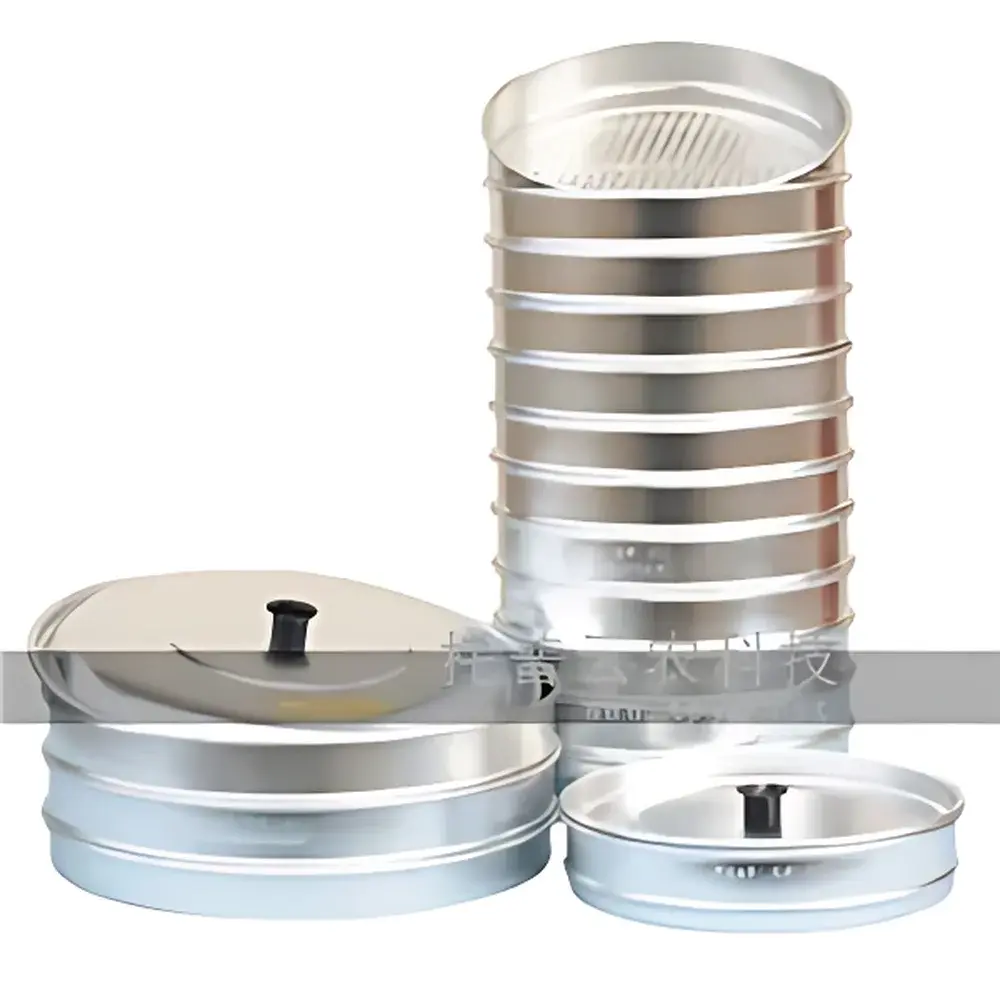
Top Cloud-agri Grain Sieve Analyzer for Corn
| Brand | Top Cloud-agri |
|---|---|
| Origin | Zhejiang, China |
| Manufacturer Type | Direct Producer |
| Country of Origin | China |
| Principle | Vibration-Based Sieve Separation |
| Sieve Stack | 10-layer (including bottom pan and cover) |
| Standard Diameter | Φ200 mm |
| Height per Layer | 50 mm |
| Aperture Set | 6.0, 6.5, 7.0, 7.5, 8.0, 8.5, 9.0, 9.5 mm |
| Compliance | Designed per GB/T 5494–2019 (Grain and Oilseed—Determination of Impurities and Damaged Kernels), ISO 7971-2:2017 (Cereals—Sampling—Part 2: Guidance on sampling of cereals and cereal products) |
Overview
The Top Cloud-agri Grain Sieve Analyzer for Corn is a mechanically driven, vibration-based particle size separation instrument engineered for standardized impurity assessment and kernel size distribution analysis in coarse granular agricultural commodities. It operates on the principle of controlled mechanical oscillation—utilizing vertical reciprocating motion to induce stratification and progressive passage of particles through a vertically stacked series of precision-machined sieve decks. Each deck features laser-cut, stainless-steel apertures with strict dimensional tolerances, ensuring reproducible separation based on geometric grain dimensions rather than aerodynamic or density-dependent behavior. This makes the system particularly suitable for regulatory-grade evaluation of corn lots in compliance with national and international grain grading protocols—including GB/T 5494–2019 and ISO 7971-2:2017—where physical impurity content (e.g., broken kernels, foreign material, dust, and undersized/oversized fractions) directly determines commercial grade assignment and pricing.
Key Features
- Robust 10-layer sieve stack configuration (8 active sieves + bottom pan + cover), optimized specifically for corn kernel sizing and impurity quantification.
- Standardized Φ200 mm sieve diameter and uniform 50 mm deck height—fully compatible with Chinese national standard test procedures and widely adopted laboratory workflows.
- High-strength stainless-steel wire mesh with calibrated aperture diameters (6.0–9.5 mm in 0.5 mm increments), manufactured to maintain structural rigidity under repeated vibrational loading.
- Vibration mechanism engineered for consistent amplitude and frequency control, minimizing inter-run variability and enabling high repeatability across operators and shifts.
- Modular design allows rapid reconfiguration: individual sieve layers can be reordered, substituted, or removed to adapt to alternate grain types (e.g., wheat, soybean, barley) or custom specification requirements.
- No electronic controls or software dependency—designed for durability, ease of maintenance, and operation in ambient storage, procurement, or field-lab environments where power stability or IT infrastructure is limited.
Sample Compatibility & Compliance
This analyzer is validated for use with dry, free-flowing cereal grains and oilseeds including Zea mays (corn), Triticum aestivum (wheat), Glycine max (soybean), Oryza sativa (paddy rice and milled rice), Brassica napus (rapeseed), and Phaseolus vulgaris (kidney beans). It supports both whole-kernel and milled-product assessments—such as bran and husk fraction quantification in rice milling quality control. All sieve dimensions conform to GB/T 5494–2019 Annex A specifications for grain impurity testing apparatus, and the mechanical design aligns with ISO 7971-2’s requirements for representative sampling and particle segregation fidelity. While not an automated digital system, its manual operation mode satisfies GLP-aligned documentation practices when paired with standardized weighing protocols and chain-of-custody log sheets.
Software & Data Management
This is a standalone mechanical instrument without embedded firmware, touchscreen interface, or data export capability. Quantitative results are derived via manual mass measurement before and after sieving using calibrated analytical balances (not included). Users record retained mass per fraction, calculate cumulative pass/fail percentages, and generate reports in accordance with institutional SOPs or regulatory submission templates (e.g., CNAS-accredited lab report formats). For laboratories requiring electronic audit trails, integration with LIMS platforms is achieved externally via spreadsheet-based data entry or barcode-scanned sample ID logging—fully compliant with FDA 21 CFR Part 11 when implemented with appropriate access controls and versioned SOP documentation.
Applications
- Commercial grain receiving: Rapid determination of foreign material and oversized/undersized kernel fractions prior to silo intake.
- Storage quality monitoring: Tracking changes in breakage index or fines generation during long-term warehouse holding.
- Milling process validation: Assessing degermination efficiency and germ separation yield in wet/dry corn milling lines.
- Seed certification labs: Verifying varietal purity and seed size uniformity for certified maize seed lots.
- Research agronomy: Correlating sieve-derived particle size distributions with drying kinetics, bulk density, and pneumatic conveying behavior.
- Export compliance: Generating test reports acceptable to CIQ (China Inspection and Quarantine) and overseas import authorities requiring ISO/GB traceable impurity data.
FAQ
Is this instrument suitable for moisture-sensitive samples?
Yes—provided samples are pre-conditioned to equilibrium moisture content (typically ≤14% w.b. for corn), as excessive moisture may cause agglomeration and clogging. Pre-drying at 45°C for 30 min is recommended for high-humidity lots.
Can I replace individual sieve layers with custom apertures?
Yes—the unit accepts standard Φ200 mm × 50 mm deep stainless-steel sieves; users may procure additional decks from Top Cloud-agri or third-party suppliers meeting GB/T 6003.1 tolerances.
Does it comply with USDA or Canadian Grain Commission standards?
While not certified for official U.S. or Canadian grade designation, its dimensional and operational parameters meet the functional equivalence criteria outlined in FGIS Directive 9180.82 and CGC Method GR-117 for mechanical sieve analysis.
What maintenance is required?
Routine cleaning with soft brushes and compressed air; periodic inspection of vibration motor mounting bolts and sieve frame alignment—no lubrication or calibration certification required.
Related Products



