Top Cloud-agri JWY-III-C Accumulated Temperature & Photosynthetic Photon Flux Density (PPFD) Logger
| Brand | Top Cloud-agri |
|---|---|
| Origin | Zhejiang, China |
| Manufacturer Type | Direct Manufacturer |
| Product Category | Domestic |
| Model | JWY-III-C |
| Channel Count | Single-Channel |
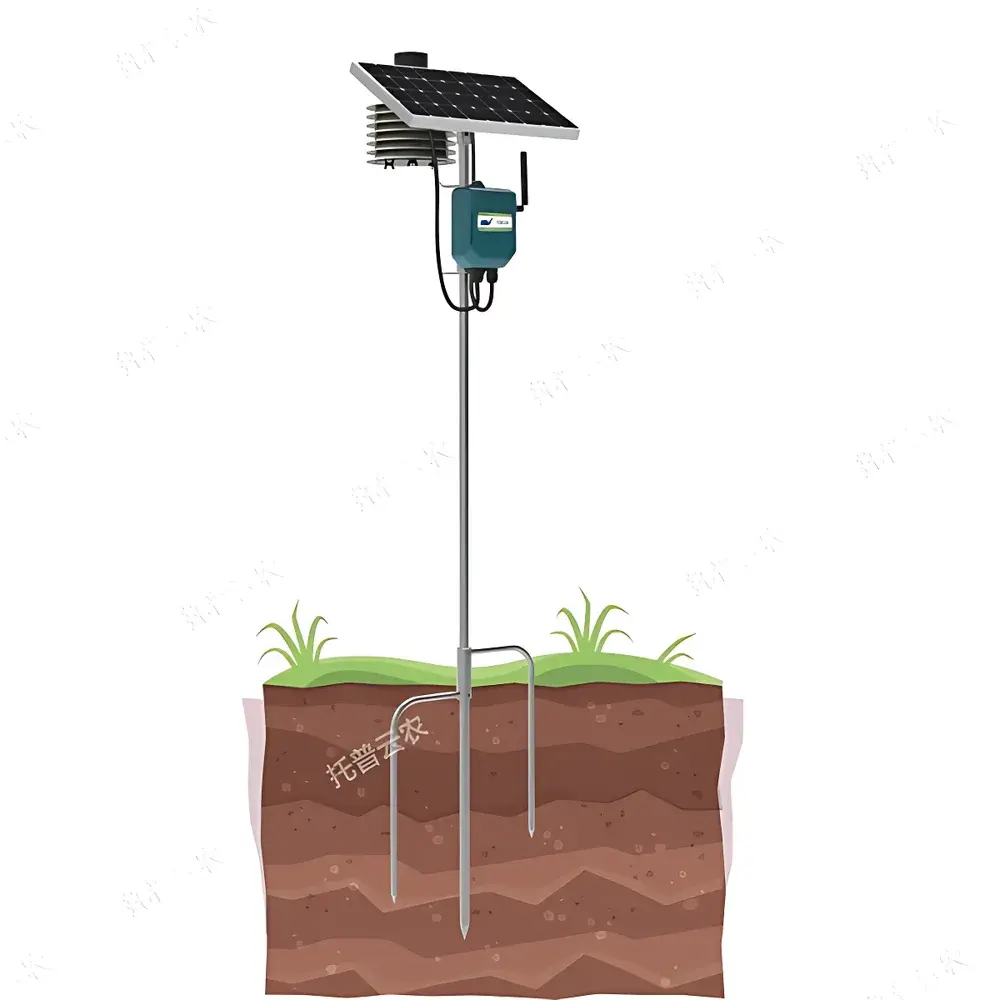
| Power Supply | Integrated Solar Panel |
| Operating Temperature Range | -10°C to 70°C |
| Temperature Measurement Range | -40°C to 120°C |
| Temperature Accuracy | ±0.4°C |
| Temperature Resolution | 0.1°C |
| Temperature Sampling Interval | 5 min to 12 h (user-configurable) |
| PPFD Spectral Response | 400–700 nm |
| PPFD Measurement Range | 0–2700 µmol·s⁻¹·m⁻² |
| PPFD Resolution | 1 µmol·s⁻¹·m⁻² |
| PPFD Accuracy | ±0.5% of reading ±1 µmol·s⁻¹·m⁻² |
| PPFD Linearity | ±1% across full scale |
| PPFD Long-term Drift | <±2% per year |
| Data Storage | MicroSD card (user-replaceable) |
| Communication | Wireless (GPRS/NB-IoT optional), Web & Mobile App Access |
| Software | B/S Architecture Cloud Platform with Audit-Ready Data Logging |
Overview
The Top Cloud-agri JWY-III-C Accumulated Temperature & Photosynthetic Photon Flux Density (PPFD) Logger is an agricultural microclimate monitoring instrument engineered for long-term, unattended field deployment in agroecological research and precision farming applications. It operates on the principle of continuous environmental time-series acquisition—measuring ambient air temperature and photosynthetically active radiation (PAR) at user-defined intervals—and computing biologically meaningful integrals: accumulated temperature (degree-days) and accumulated photon flux (mol·m⁻²). Unlike generic data loggers, this device implements crop-specific thermal and photobiological thresholds—such as base temperature (Tb) and biological zero—to calculate both active accumulation (above Tb) and effective accumulation (above species-specific developmental thresholds). Its solar-powered architecture enables autonomous operation in remote farmland, orchards, or experimental stations without grid access, satisfying requirements for GLP-compliant phenological monitoring under ISO 18436-3 and FAO agrometeorological guidelines.
Key Features
- Single-channel dual-sensor architecture: Simultaneous high-fidelity measurement of air temperature (PT100-grade thermistor) and PAR (quantum sensor calibrated to NIST-traceable standards)
- Solar-rechargeable power system with low-power sleep mode, enabling >12 months of continuous logging in mid-latitude temperate zones
- Configurable accumulation logic: Supports custom base temperatures (e.g., 10°C for maize, 0°C for winter wheat) and dynamic PPFD integration windows aligned with daylight hours
- On-device SD card storage (up to 32 GB) with timestamped binary logging; supports FAT32 formatting and CRC-16 error checking
- Wireless telemetry via GPRS or NB-IoT modules (optional), compliant with 3GPP Release 13/14 for narrowband IoT deployments
- Voice output interface (built-in speaker) for real-time audible reporting of current accumulation values—designed for field technicians without visual access to display
- Built-in real-time clock (RTC) with temperature-compensated crystal oscillator (±2 ppm accuracy over -20°C to +70°C)
Sample Compatibility & Compliance
The JWY-III-C is validated for outdoor exposure in open-field, greenhouse, and orchard environments per IEC 60529 IP65 enclosure rating. Its temperature sensor conforms to ASTM E2251-22 (Standard Specification for Liquid-in-Glass Thermometers) for resolution and repeatability, while the quantum sensor meets ISO 17123-9:2021 (Optics and optical instruments — Field procedures for testing geodetic and surveying instruments — Part 9: Spectroradiometers) for spectral responsivity uniformity. Data outputs are structured in CSV and JSON formats compatible with FAO’s WaPOR database ingestion protocols and CIMMYT’s AgMIP modeling frameworks. The embedded firmware implements secure boot and signed firmware updates, supporting traceability requirements under ISO/IEC 17025:2017 Clause 7.7 (Sampling) and GLP Principle 5 (Equipment Calibration and Maintenance Records).
Software & Data Management
The integrated cloud platform operates on a B/S architecture with TLS 1.2+ encrypted communication and role-based access control (RBAC). Each device registers a unique UUID and generates time-stamped audit logs for all configuration changes—including sensor calibration events, sampling interval modifications, and alarm threshold adjustments—meeting FDA 21 CFR Part 11 electronic record integrity criteria. The platform computes derived metrics including daily reference evapotranspiration (ET0) using the FAO-56 Penman-Monteith equation, with automatic atmospheric pressure and humidity compensation where co-deployed sensors are available. Historical datasets support export in NetCDF-4 format for interoperability with R (agriEco package), Python (xarray, pandas), and GIS platforms (QGIS, ArcGIS Pro). Alarm conditions can be configured per crop type (e.g., “rice tillering stage: cumulative PPFD < 80 mol·m⁻² over 7 days”) with SMS/email notifications routed via SMTP or RESTful webhook integrations.
Applications
- Phenological modeling: Quantifying thermal time to key growth stages (e.g., flowering, grain filling) across cultivars and climate zones
- Light-use efficiency (LUE) analysis: Correlating accumulated PPFD with biomass gain in controlled-environment trials
- Agroclimatic zoning: Mapping spatial-temporal patterns of heat units and PAR availability for crop suitability assessment
- Protected cultivation management: Optimizing greenhouse heating/cooling setpoints and supplemental lighting schedules based on real-time accumulation rates
- Climate change impact studies: Detecting interannual shifts in growing degree-day accumulation and photoperiod-effective radiation totals
- Extension service dashboards: Delivering localized accumulation reports to farmers via WeChat Mini Programs or SMS gateways
FAQ
What base temperature values are preloaded in the firmware?
The device ships with default base temperatures for 12 major crops (e.g., 10°C for maize, 12°C for rice, 0°C for barley), editable via the web interface or mobile app.
Can the PPFD sensor be recalibrated in-field?
Yes—using the two-point calibration routine accessible through the maintenance menu, referencing certified light sources traceable to NIM (China National Institute of Metrology).
Is historical data retained if the SIM card fails in wireless mode?
Yes—local SD card storage operates independently of telemetry; all measurements are buffered and uploaded upon network recovery.
Does the platform support multi-device synchronization for regional networks?
Yes—the cloud backend aggregates time-aligned datasets from up to 500 devices with automatic timezone-aware timestamp normalization.
How is data integrity verified during transmission?
Each data packet includes SHA-256 hash signatures and sequence numbers; the server performs end-to-end validation before ingestion into the time-series database.