
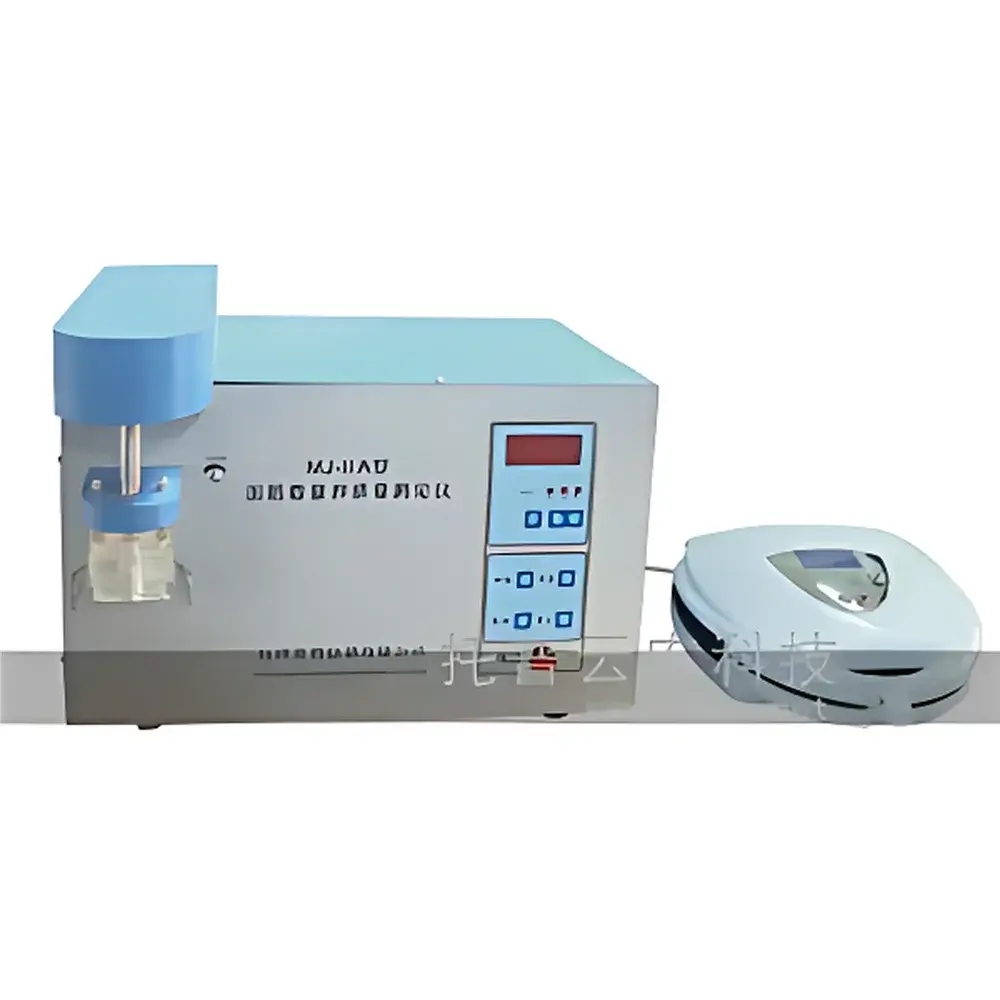
Top Cloud-agri MJ-IIA Gluten Index Analyzer
| Brand | Top Cloud-agri |
|---|---|
| Origin | Zhejiang, China |
| Manufacturer Type | Direct Manufacturer |
| Country of Origin | China |
| Model | MJ-IIA |
| Price | USD 1,100 (FOB) |
Overview
The Top Cloud-agri MJ-IIA Gluten Index Analyzer is a dedicated benchtop system engineered for standardized quantitative determination of gluten quality and quantity in wheat flour and whole wheat flour. It operates on the principle of wet gluten isolation via controlled saline buffer (NaCl solution) washing, followed by centrifugal separation and index calculation—fully compliant with Chinese national standards GB/T 14608–1993 (“Method for Determination of Wet Gluten in Wheat Flour”) and SB/T 10248–1995 (“Technical Specification for Gluten Index Determination”). The instrument quantifies three critical functional parameters: wet gluten content (%), gluten index (a dimensionless ratio reflecting gluten strength and elasticity), and gluten water absorption capacity (also termed gluten hydration or water retention). These metrics are essential for evaluating dough handling properties, baking performance, and end-product texture in industrial milling, noodle production, bakery R&D, and grain quality assurance programs.
Key Features
- Integrated three-module architecture: independent Gluten Washing Unit, Gluten Index Centrifuge, and Hot-Air Drying Oven—each calibrated and validated per GB/T 14608–1993 requirements.
- Microprocessor-controlled automation: single-button initiation of full sequence—kneading, washing, centrifugation, and drying—with programmable timing resolution down to 1 second for kneading (1–59 s), washing (1 s–9 min), and centrifugation (1 s–9 min).
- Precision mechanical design: stainless-steel 200-mesh (80 µm) fine-wire washing sieve and 26-mesh (500 µm) centrifuge sieve box; dual-speed centrifuge rotor (3000 rpm ±5 rpm and 6000 rpm ±5 rpm) delivering up to 2000 × g acceleration.
- Consistent fluid delivery: regulated NaCl buffer flow rate of 50–56 mL/min, ensuring reproducible starch removal and minimizing protein denaturation during washing.
- Human-centered HMI: tactile membrane keypad interface with dual digital displays (minutes/seconds), corrosion-resistant housing, and silent operation—designed for high-throughput QC labs requiring minimal operator intervention and long-term reliability.
Sample Compatibility & Compliance
The MJ-IIA is validated for use with refined wheat flour and whole wheat flour samples conforming to ISO 27971:2012 (Cereal and cereal products — Determination of wet gluten content and gluten index) methodology principles. It supports routine testing in accredited food quality laboratories operating under GLP (Good Laboratory Practice) frameworks. While not certified to FDA 21 CFR Part 11 out-of-the-box, its deterministic, non-software-dependent workflow—including manual mass measurements post-centrifugation and post-drying—ensures audit-ready traceability when integrated into documented SOPs. Data recording complies with ISO/IEC 17025:2017 clause 7.7 (Ensuring validity of results) through defined calibration intervals for balance, timer, and centrifuge speed verification.
Software & Data Management
The MJ-IIA operates without embedded data logging or proprietary software—intentionally designed to minimize validation burden in regulated environments. All operational parameters (kneading time, wash duration, centrifuge speed/duration) are set manually via front-panel controls and retained only as physical lab notebook entries or LIMS-integrated manual input. This architecture eliminates cybersecurity risks, firmware update dependencies, and electronic record integrity concerns. Users perform final calculations externally: gluten index = (mass of gluten retained on 500 µm sieve after 6000 rpm centrifugation / total wet gluten mass) × 100; dry gluten % = (mass after 105°C drying / original flour mass) × 100; water absorption = [(wet gluten mass − dry gluten mass) / dry gluten mass] × 100.
Applications
- Flour mill quality control: real-time monitoring of gluten strength variation across wheat lots and blending batches.
- Bakery ingredient specification: verification of supplier compliance with contractual gluten index thresholds (e.g., ≥70 for strong bread flour; ≤40 for cake flour).
- Grain breeding programs: phenotypic screening of wheat cultivars for gluten rheology traits correlated with loaf volume and crumb structure.
- Regulatory inspection: official testing by grain inspection agencies and provincial CDCs under China’s Grain Quality Supervision System.
- Academic research: fundamental studies on gluten polymer network formation, enzyme modification effects (e.g., transglutaminase), and thermal stability during drying.
FAQ
What standards does the MJ-IIA comply with?
It is engineered to execute test procedures defined in GB/T 14608–1993 and SB/T 10248–1995. Its mechanical specifications align with the physical requirements of ISO 27971:2012 for gluten index determination.
Can the instrument be used for durum semolina or rye flour?
No. The MJ-IIA is validated exclusively for wheat-based flours (Triticum aestivum) per national standard scope. Durum and rye require modified washing protocols and are outside its certified operating range.
Is calibration certification provided with shipment?
Yes—each unit ships with a factory calibration report covering centrifuge speed accuracy (verified with optical tachometer), timer deviation (<±0.2 s over 60 s), and sieve mesh certification (microscopic verification of 80 µm and 500 µm apertures).
What maintenance is required?
Routine cleaning of sieves and centrifuge chamber with deionized water; annual verification of motor torque and temperature uniformity in the drying oven using NIST-traceable thermocouples.
Does the system support LIMS integration?
Not natively—but all output values (wet mass, dry mass, centrifuge retention mass) are recorded manually and can be entered into LIMS via structured templates compatible with ISO/IEC 17025 documentation workflows.





