
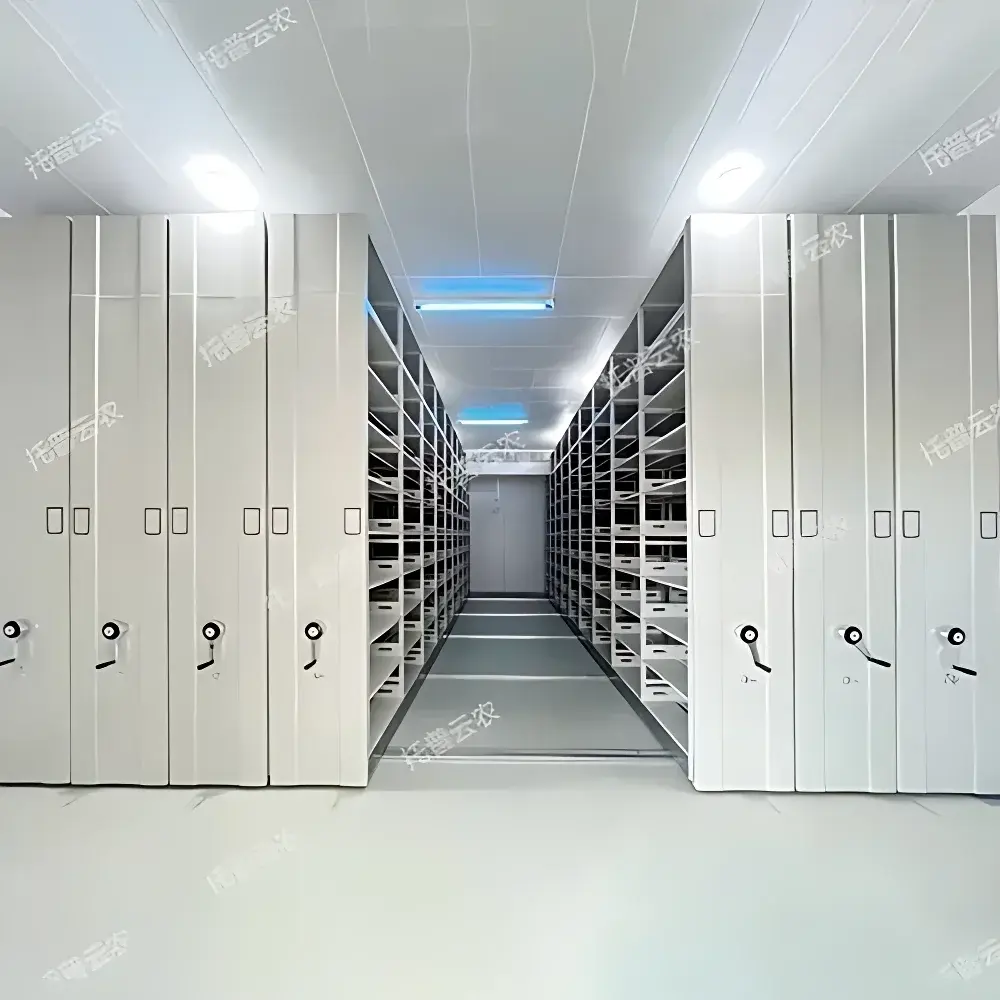
Top Cloud-agri Short-term Germplasm Storage Incubator
| Brand | Top Cloud-agri |
|---|---|
| Model | Short-term Germplasm Storage Incubator |
| Temperature Range | 0–4°C / 4–12°C |
| Relative Humidity Control | ≤60% RH |
| Storage Duration | 3–5 years |
| Construction | Six-sided double-skin color-coated steel / stainless steel with B1-grade polyurethane insulation (density ≥40 kg/m³) |
| Refrigeration System | Dual imported compressors (N+1 redundancy) with intelligent switchover logic |
| Dehumidification | Independent low-temperature dehumidifier (operational down to –10°C) |
| Air Distribution | Ceiling-mounted cold air fan + uniform airflow diffuser plate |
| Entry Isolation | Electrically heated air curtain |
| Control System | PLC-based central controller with full-color HMI touchscreen |
| Connectivity | Wi-Fi / 4G / 5G cloud upload, MQTT/HTTPS protocol support |
| Remote Access | Web portal + native iOS/Android app with real-time monitoring, parameter adjustment, alarm push (SMS/email/app), and audit-trail-enabled operation log |
| Video Surveillance | Low-condensation IP camera (–20°C rated), RTSP streaming, local SD + cloud video storage |
| Power Recovery | Auto-restart with state retention after power interruption |
| Compliance Ready | Supports GLP-compliant data integrity (21 CFR Part 11–compatible audit trail, electronic signature, and user role management) |
Overview
The Top Cloud-agri Short-term Germplasm Storage Incubator is a purpose-engineered environmental control system designed for the secure, standardized, and traceable short-to-medium term preservation of plant genetic resources. It operates on the principle of precisely regulated low-temperature, low-humidity storage—leveraging thermodynamic stability and moisture suppression to minimize metabolic activity and oxidative degradation in seed and vegetative tissues. Unlike general-purpose incubators, this unit meets the functional requirements defined by international germplasm conservation frameworks, including FAO’s Genebank Standards and the International Treaty on Plant Genetic Resources for Food and Agriculture. It serves as a critical transitional infrastructure between field collection and long-term cryogenic or base collection storage—supporting pre-characterization workflows, viability testing, duplication for safety backup, and active research access without compromising genetic integrity.
Key Features
- Dual-redundant refrigeration architecture: Two independent, high-efficiency compressors with automatic failover logic ensure uninterrupted temperature maintenance—even during compressor replacement or service. Each unit employs low-noise EC fans with dynamic pressure compensation to sustain laminar airflow and ±0.5°C uniformity across all shelf levels.
- Low-temperature-capable dehumidification: A dedicated desiccant-assisted dehumidifier remains fully operational at sub-zero ambient conditions, maintaining ≤60% RH without icing or performance decay—critical for preventing seed hygroscopic aging and fungal proliferation.
- B1-grade thermal envelope: All six walls, ceiling, and floor incorporate ≥100 mm thick, closed-cell polyurethane foam (λ ≤ 0.022 W/m·K) sandwiched between food-grade stainless steel panels. Floor assembly includes vapor barrier membrane and anti-mold epoxy coating to eliminate condensation pathways.
- Intelligent air isolation: An electronically modulated air curtain at the entry threshold reduces external heat/moisture infiltration by >85%, validated per ISO 16745:2019 methodology for cold room boundary integrity.
- Cloud-integrated PLC control: Industrial-grade programmable logic controller (IEC 61131-3 compliant) manages setpoint regulation, alarm escalation, and event logging with millisecond timestamp resolution. All operations are digitally signed and cryptographically hashed for forensic auditability.
Sample Compatibility & Compliance
The incubator accommodates standard germplasm packaging formats—including aluminum foil-laminated moisture-barrier envelopes (ASTM F1249), hermetically sealed glass vials (ISO 7218), and ventilated polypropylene boxes—without airflow obstruction. Internal shelving is height-adjustable and mobile, enabling configurable load density while preserving minimum clearance for convective exchange. The system supports compliance with national and international seed storage protocols: GB/T 3543.4–1995 (China), ISTA Rules Section 5B (Moisture Content & Storage), and CGRFA Technical Bulletin No. 12 (Monitoring of Seed Viability). Data export formats (CSV, PDF, XML) conform to ISO/IEC 17025:2017 documentation requirements for accredited repositories.
Software & Data Management
The embedded HMI interface provides real-time visualization of temperature/humidity trends, historical curves (up to 10-year retention), alarm logs with root-cause tags, and equipment health diagnostics. All data is synchronized via TLS 1.3–encrypted channels to a hosted cloud platform compliant with GDPR and ISO 27001. Role-based access control (RBAC) enforces separation of duties: operators adjust setpoints; supervisors approve deviations; QA personnel review audit trails. Electronic signatures follow NIST SP 800-63B Level 3 criteria. Video streams are archived with SHA-256 checksums and time-stamped metadata for chain-of-custody verification—fully compatible with GLP/GMP inspection readiness.
Applications
- Preliminary storage of newly collected accessions prior to morphological and molecular characterization
- Holding working collections for recurrent breeding programs requiring frequent sample withdrawal
- Backup storage for regional genebanks undergoing infrastructure upgrades or relocation
- Controlled deterioration trials (CDT) under standardized humidity-temperature matrices (ISTA Protocol 5.3)
- Pre-acclimatization staging for germplasm destined for cryopreservation or in vitro culture
- Seed health testing laboratories requiring stable environmental baselines for pathogen isolation assays
FAQ
What is the maximum allowable door-open duration without compromising internal stability?
Based on thermal inertia modeling and empirical validation, the system tolerates ≤90 seconds of cumulative door opening per hour while maintaining ≤±1.0°C deviation from setpoint—provided the air curtain remains energized.
Does the system support integration with LIMS or enterprise ERP platforms?
Yes. RESTful API endpoints (JSON/XML) and OPC UA server capability enable bidirectional synchronization with major laboratory information management systems (e.g., LabVantage, STARLIMS) and SAP S/4HANA via certified middleware.
How is calibration traceability maintained?
Each unit ships with NIST-traceable temperature/humidity sensor certificates (ISO/IEC 17025 accredited lab). Onboard sensors undergo automated self-diagnostic cycles every 24 hours, with drift alerts triggered at ±0.3°C or ±3% RH deviation.
Can humidity be controlled independently of temperature?
Yes. The dual-loop control architecture decouples refrigeration (temperature) and desiccant regeneration (humidity), allowing independent setpoint programming within the specified operating envelope.
Is remote firmware update supported?
Firmware updates are delivered over-the-air (OTA) with cryptographic signature verification, rollback capability, and pre-update compatibility validation—executed only during scheduled maintenance windows defined in the system scheduler.
Related Products



