
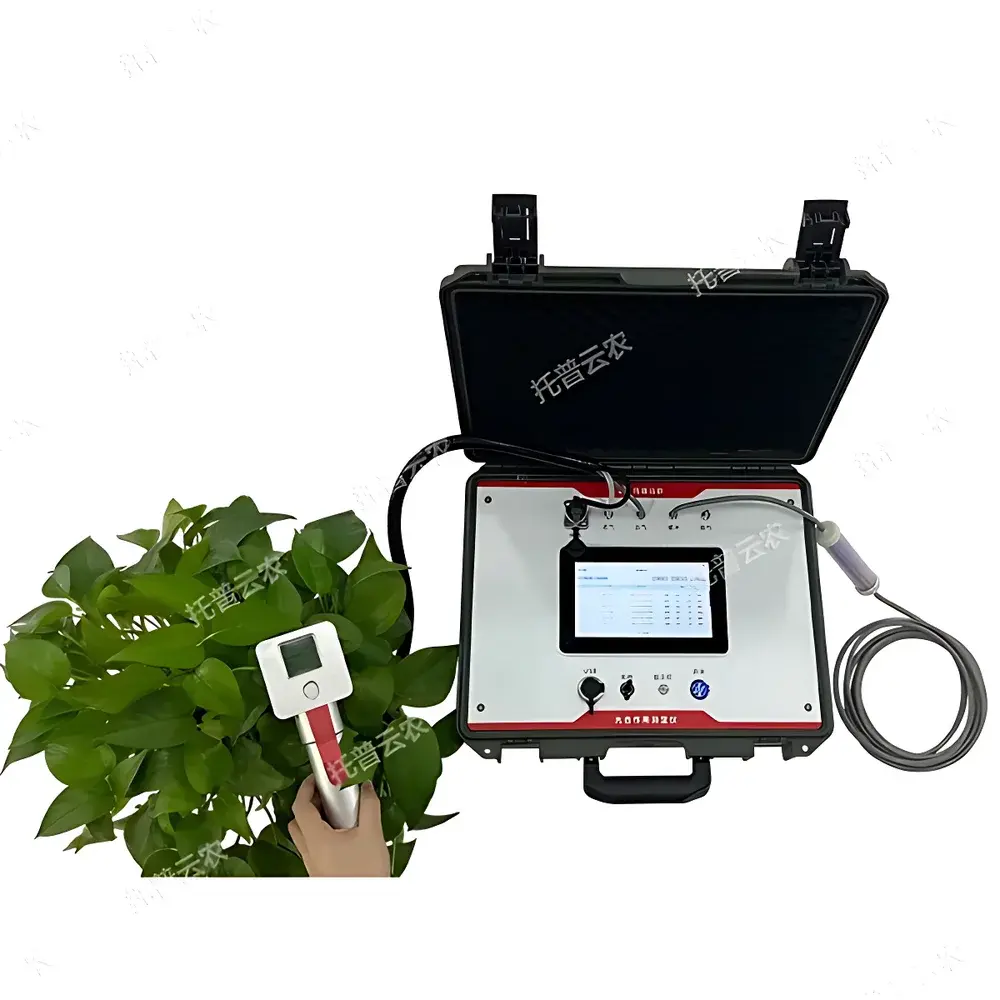
Top Cloud-agri TP-3051D Portable Photosynthesis Measurement System
| Brand | Top Cloud-agri |
|---|---|
| Origin | Zhejiang, China |
| Manufacturer Type | Direct Manufacturer |
| Model | TP-3051D |
| CO₂ Concentration Range | 0–2000 µmol/mol (ppm), Resolution: 0.01 µmol/mol, Accuracy: ≤±3% FS |
| Ambient Temperature Range | 0–50 °C, Resolution: 0.01 °C, Accuracy: ≤±0.3 °C |
| Leaf Chamber Temperature Range | 0–50 °C, Resolution: 0.01 °C, Accuracy: ≤±0.3 °C |
| Ambient Humidity Range | 0–100% RH, Resolution: 0.01% RH, Accuracy: ≤±5% RH |
| Leaf Chamber Humidity Range | 0–100% RH, Resolution: 0.01% RH, Accuracy: ≤±5% RH |
| Leaf Surface Temperature Range | 0–50 °C, Resolution: 0.01 °C, Accuracy: ≤±0.2 °C |
| PAR (Photosynthetically Active Radiation) Range | 0–2500 µmol·m⁻²·s⁻¹, Resolution: 0.01 µmol·m⁻²·s⁻¹, Accuracy: ≤±5 µmol·m⁻²·s⁻¹ |
| Net Photosynthetic Rate (Pn), Stomatal Conductance (Gs), Transpiration Rate (Tr), Intercellular CO₂ Concentration (Ci), Instantaneous Water Use Efficiency (WUE) | All with 0.01 resolution |
| Operating Environment | 0–40 °C (optimal precision at 15–35 °C), ≤75% RH (non-condensing) |
| Power Supply | DC 8.4 V Li-ion battery, 7–9 h continuous operation |
| Data Storage | 2 GB SD card |
| Dimensions | 260 × 260 × 130 mm |
| Display | 320 × 240 pixel monochrome LCD with Chinese menu interface |
| Measurement Modes | Open-system and closed-system gas exchange |
| Flow Control | Integrated electronic mass flow meter |
Overview
The Top Cloud-agri TP-3051D Portable Photosynthesis Measurement System is a field-deployable, open- or closed-path gas exchange instrument engineered for quantitative assessment of plant physiological performance under natural or controlled conditions. It operates on the principle of infrared gas analysis (IRGA) for real-time, non-destructive measurement of CO₂ assimilation kinetics, coupled with concurrent high-resolution monitoring of environmental and leaf-level microclimatic variables—including ambient and chamber temperature/humidity, leaf surface temperature, and photosynthetically active radiation (PAR). By integrating these physical parameters with stomatal and biochemical response models, the system calculates key ecophysiological indices: net photosynthetic rate (Pn), stomatal conductance (Gs), transpiration rate (Tr), intercellular CO₂ concentration (Ci), and instantaneous water use efficiency (WUE). Designed for ecological realism and experimental flexibility, the TP-3051D supports both in situ measurements on intact plants and ex situ assays on detached leaves, seeds, or small organisms—enabling rigorous investigation of photosynthetic acclimation, drought stress responses, light saturation kinetics, and carbon–water coupling across species and environments.
Key Features
- Compact, handheld form factor (260 × 260 × 130 mm) with integrated rechargeable 8.4 V Li-ion battery, enabling up to 9 hours of continuous field operation without external power.
- Dual-mode gas exchange architecture: configurable as either an open-system (flow-through) or closed-system (recirculating) setup, accommodating diverse experimental designs including light-response curves, A/Ci response protocols, and diurnal monitoring.
- High-fidelity IRGA sensor with ±3% full-scale accuracy for CO₂ (0–2000 µmol/mol), complemented by calibrated thermistors and capacitive humidity sensors meeting ISO 7726 and ASTM E104 standards for microclimate metrology.
- PAR sensor traceable to NIST-calibrated silicon photodiodes, delivering linear response across 0–2500 µmol·m⁻²·s⁻¹ with ±5 µmol·m⁻²·s⁻¹ absolute error—critical for accurate quantum yield estimation.
- Modular leaf chamber design supporting interchangeable chamber types (e.g., standard broadleaf, narrow-leaf, conifer, seed, and insect chambers), ensuring compatibility with angiosperms, gymnosperms, bryophytes, and non-photosynthetic biological samples.
- Onboard 2 GB SD card storage with timestamped, multi-parameter datasets; user-configurable sampling intervals, leaf area input, chamber volume, operator ID, and date/time settings.
- Monochrome 320 × 240 LCD display with intuitive Chinese-language menu navigation and real-time graphical overlay of Pn, Gs, Tr, Ci, and WUE—no external computer required for field acquisition.
Sample Compatibility & Compliance
The TP-3051D accommodates a broad spectrum of biological specimens without tissue disruption: intact attached leaves (monocot and dicot), excised leaves, moss gametophytes, lichen thalli, germinating seeds, and small arthropods (e.g., aphids, mites) for respiration studies. Its sealed chamber architecture minimizes boundary layer effects, while thermal equilibration algorithms compensate for leaf-to-chamber temperature differentials—ensuring compliance with FAO and IUPAC guidelines for plant gas exchange standardization. Although not certified for GLP/GMP-regulated trials, the instrument’s data logging structure supports audit-ready metadata tagging (operator, location, time, calibration status), facilitating alignment with ISO 17025 documentation requirements for environmental physiology laboratories.
Software & Data Management
Data export is performed via standard USB 2.0 interface to Windows-based PCs using proprietary Top Cloud-agri PC software (v3.2+), which provides post-acquisition processing including automatic A/Ci curve fitting (Farquhar–von Caemmerer–Berry model), light-response parameter derivation (ΦPSII, Jmax, Vcmax), and statistical summary reports. Raw CSV files are fully compatible with R (photosynthesis package), Python (SciPy, Pandas), and MATLAB for advanced modeling. The system does not implement FDA 21 CFR Part 11 electronic signature or audit trail functionality; however, all stored records include immutable timestamps and sequential file naming, satisfying basic data integrity requirements for academic publication and peer-reviewed ecological research.
Applications
- Field-based screening of crop cultivars for photosynthetic efficiency and drought resilience under variable soil moisture and atmospheric CO₂ scenarios.
- Long-term monitoring of forest understory species’ acclimation to canopy gap dynamics and light heterogeneity.
- Evaluation of urban tree species’ physiological tolerance to heat island effects and air pollution stressors.
- Physiological phenotyping in functional genomics studies—correlating mutant phenotypes with gas exchange traits across developmental stages.
- Ecological education: hands-on demonstration of light saturation, CO₂ compensation point, and stomatal limitation analysis in undergraduate plant physiology labs.
- Post-harvest physiology: quantifying respiratory CO₂ evolution and water loss kinetics in horticultural commodities during storage.
FAQ
What calibration procedures are required before field deployment?
Users must perform zero/span calibration using certified CO₂ gas standards (0 ppm and 1000 ppm) and verify PAR sensor output against a reference quantum sensor prior to each intensive measurement campaign. Factory calibration certificates are provided with each unit.
Can the TP-3051D operate in high-humidity tropical environments?
Yes—however, sustained operation above 75% RH without condensation is advised. The instrument includes anti-condensation heating elements in the leaf chamber and desiccant-integrated sample air path to maintain optical path integrity.
Is leaf area measurement automated or manual?
Leaf area must be entered manually by the user prior to measurement. Compatible accessories include digital leaf area meters (e.g., LI-3100C) for pre-scanned calibration.
Does the system support automated light intensity ramping?
No—light intensity is controlled externally via programmable LED arrays or sunlight filters. The TP-3051D synchronously logs PAR values at user-defined intervals but does not modulate illumination sources.
What is the minimum detectable change in net photosynthesis (Pn)?
With a resolution of 0.01 µmol CO₂·m⁻²·s⁻¹ and typical noise floor <0.05 µmol CO₂·m⁻²·s⁻¹ under stable conditions, the system reliably resolves physiological differences ≥0.1 µmol CO₂·m⁻²·s⁻¹ at 95% confidence (n=5).





