
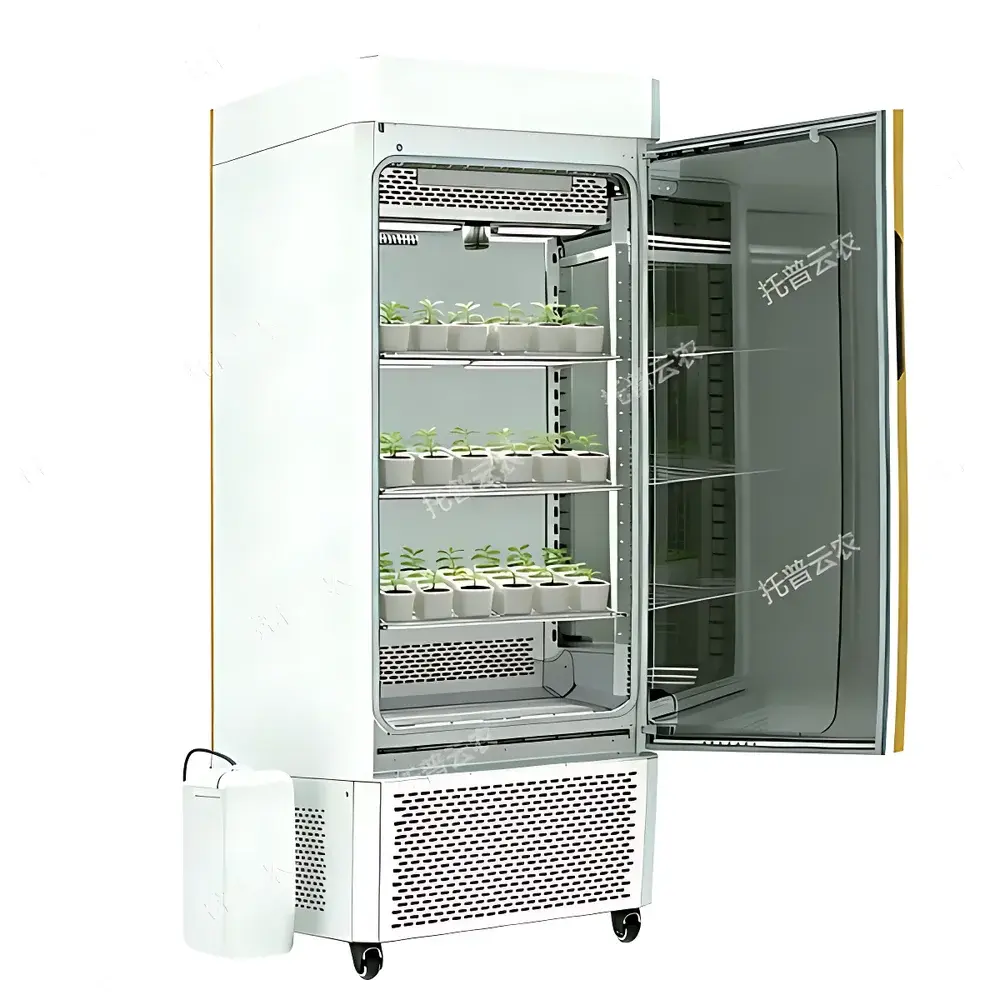
Top Cloud-agri TP-R-DK-NJV Series Artificial Climate Incubator for Plant Stress Simulation and Growth Monitoring
| Brand | Top Cloud-agri |
|---|---|
| Model | TP-R-DK-NJV Series |
| Origin | China |
| Manufacturer Type | Direct Manufacturer |
| Temperature Range | 0–65 °C (±0.1 °C stability at 25 °C/50% RH) |
| Humidity Range | 50–95% RH (±2% RH stability at 25 °C/50% RH) |
| Illumination | 0–22,000 lx, full-spectrum tunable LED (white/red/blue/IR), 1004 spectral combinations |
| CO₂ Control | Ambient–5% (0–50,000 ppm, ±1 ppm precision) |
| Airflow | 30–100% adjustable, matrix rear ventilation + internal circulation |
| Imaging | Integrated visible-light multi-angle imaging unit |
| Sensors | Soil temperature/moisture/salinity/pH |
| Data Interface | USB, Ethernet, QR-coded experiment logging, OTA firmware update |
| Compliance | Designed for GLP-aligned workflows, supports audit-ready data export (CSV, PDF), time-stamped operator logs, and 30 programmable protocols (99 segments each) |
Overview
The Top Cloud-agri TP-R-DK-NJV Series Artificial Climate Incubator is an engineered platform for controlled-environment plant phenotyping and abiotic stress simulation. It operates on a closed-loop environmental control architecture integrating precise thermoregulation, dynamic humidity modulation, spectrally resolved illumination, CO₂ dosing, and non-invasive physiological monitoring. Unlike conventional growth chambers, this system embeds real-time optical phenotyping—using synchronized top- and side-view visible-light imaging—within the incubation environment, enabling longitudinal tracking of morphological, textural, and chromatic traits without manual intervention. Its design conforms to fundamental requirements for reproducible plant science: ISO 17025-aligned environmental stability, traceable sensor calibration paths, and deterministic program execution for multi-stage experimental protocols. The system serves as both a stress induction platform (e.g., drought, heat, hypoxia, photoinhibitory regimes) and a quantitative growth observatory, supporting hypothesis-driven research in crop resilience, functional genomics, and translational physiology.
Key Features
- Precision climate control: Dual-stage refrigeration/heating with PID feedback, achieving ±0.1 °C temperature stability (at 25 °C/50% RH) and ±2% RH humidity consistency across working volume.
- Tunable photosynthetic photon flux: Four-channel LED array (white, red, blue, near-infrared) enables user-defined spectral power distribution (SPD) profiles; 1004 discrete combinations support stage-specific light recipes aligned with PAR, R:FR, and phytochrome photoequilibrium models.
- Multi-modal phenotypic imaging: Fixed-position visible-light cameras capture high-resolution (≥1920×1080) time-series imagery from orthogonal axes; AI-accelerated segmentation reconstructs canopy architecture, leaf area index (LAI), chlorophyll index, and senescence progression.
- Integrated physiological sensing: Optional modules include capacitive soil moisture probes (EC & θv), leaf surface hygrometry, infrared leaf thermometry, linear variable differential transformers (LVDTs) for stem diameter variation, and piezoresistive load cells for fruit expansion kinetics.
- Modular structural design: Double-wall insulation with cyclopentane-blown polyurethane (R-value ≥ 3.2 m²·K/W); tempered glass inner door (6 mm) with anti-fog coating; stainless steel (304) interior with radius-corner welds for cleanability and corrosion resistance.
- Operational integrity safeguards: Power-loss recovery with state retention; electromagnetic door lock + touchscreen password protection; UV-C sterilization cycle (254 nm, 30 min auto-timed); thermal bypass defrost preserving chamber continuity during frost accumulation.
Sample Compatibility & Compliance
The TP-R-DK-NJV accommodates diverse biological specimens—from Petri-dish-based seed germination assays and tissue culture vessels to potted seedlings (up to 1.2 m height in 1000 L configuration) and small-model organisms (e.g., Drosophila, Caenorhabditis). Its environmental uniformity (±0.5 °C horizontal gradient, ±3% RH vertical deviation per ICH Q5C Annex 2 methodology) ensures statistical comparability across replicate zones. Sensor outputs comply with NIST-traceable calibration standards; all environmental parameters are timestamped and logged with microsecond resolution. Data export formats (CSV, JSON) support integration into LIMS and ELN systems. While not certified under FDA 21 CFR Part 11 by default, the system’s audit trail functionality—including immutable operator ID tagging, parameter change history, and electronic signature readiness—enables validation for GLP/GMP-regulated studies upon site-specific qualification.
Software & Data Management
The embedded 10-inch capacitive touchscreen (1024×600) runs a deterministic real-time OS with deterministic scheduling for concurrent sensor polling, image acquisition, and actuator control. Each experiment generates a unique alphanumeric ID and scannable QR code linking to cloud-synced metadata. Local storage retains ≥12 months of high-frequency sensor logs (1 Hz sampling) and daily composite images. Web-based dashboard (accessible via Chrome/Firefox) provides interactive time-series plots, comparative cohort analysis, and automated report generation (PDF/Excel). Remote operation—via authenticated HTTPS API or WeChat Mini Program—permits protocol initiation, setpoint adjustment, and alarm acknowledgment from off-site locations. Firmware updates deploy over-the-air (OTA) with SHA-256 signature verification and rollback capability.
Applications
- Abiotic stress phenotyping: Controlled imposition of drought (via soil moisture feedback), heat shock (ramp-and-hold thermal profiles), elevated CO₂ (growth stimulation assays), or spectral stress (e.g., UV-B supplementation).
- Germination dynamics: Automated quantification of radicle emergence, coleoptile elongation, and cotyledon opening using edge-detection algorithms trained on species-specific seed morphology.
- Cultivar screening: High-throughput comparison of growth rate, biomass allocation, and stress recovery indices across genetically diverse lines under identical environmental trajectories.
- Pre-breeding trait validation: Correlation of non-destructive imaging metrics (e.g., green pixel ratio, fractal dimension) with destructive endpoints (dry weight, metabolite concentration, gene expression).
- Microbiome–host interaction studies: Co-cultivation of plants with rhizobacteria/fungi under defined atmospheric conditions, with concurrent root exudate collection ports (optional).
- Educational use: Standardized curriculum modules for plant physiology labs, emphasizing experimental design, environmental variable isolation, and quantitative trait analysis.
FAQ
What validation documentation is provided with the system?
Factory calibration certificates for temperature, humidity, and CO₂ sensors are included. Optional IQ/OQ documentation packages (per ASTM E2500-13) are available upon request.
Can third-party sensors be integrated into the control loop?
Yes—the system exposes Modbus RTU/TCP and analog 4–20 mA inputs; custom sensor drivers may be commissioned via Top Cloud-agri’s SDK.
Is remote data access compliant with institutional cybersecurity policies?
All remote connections use TLS 1.2+ encryption; no inbound ports are opened by default—cloud sync occurs via outbound HTTPS only.
How is lighting uniformity verified across shelf levels?
Each unit ships with a PAR map report (measured using calibrated quantum sensor grid at 5 cm intervals) confirming ≥90% irradiance homogeneity at working plane.
What maintenance intervals are recommended for long-term stability?
Compressor oil inspection every 24 months; LED driver recalibration every 36 months; UV-C lamp replacement every 8,000 hours of cumulative operation.




