Top Cloud-agri TP-plant-VL3 3D Plant Phenotyping Imaging System
| Brand | Top Cloud-agri |
|---|---|
| Origin | Zhejiang, China |
| Manufacturer Type | OEM/ODM Manufacturer |
| Region of Origin | Domestic (China) |
| Model | TP-plant-VL3 |
| Pricing | Upon Request |
Overview
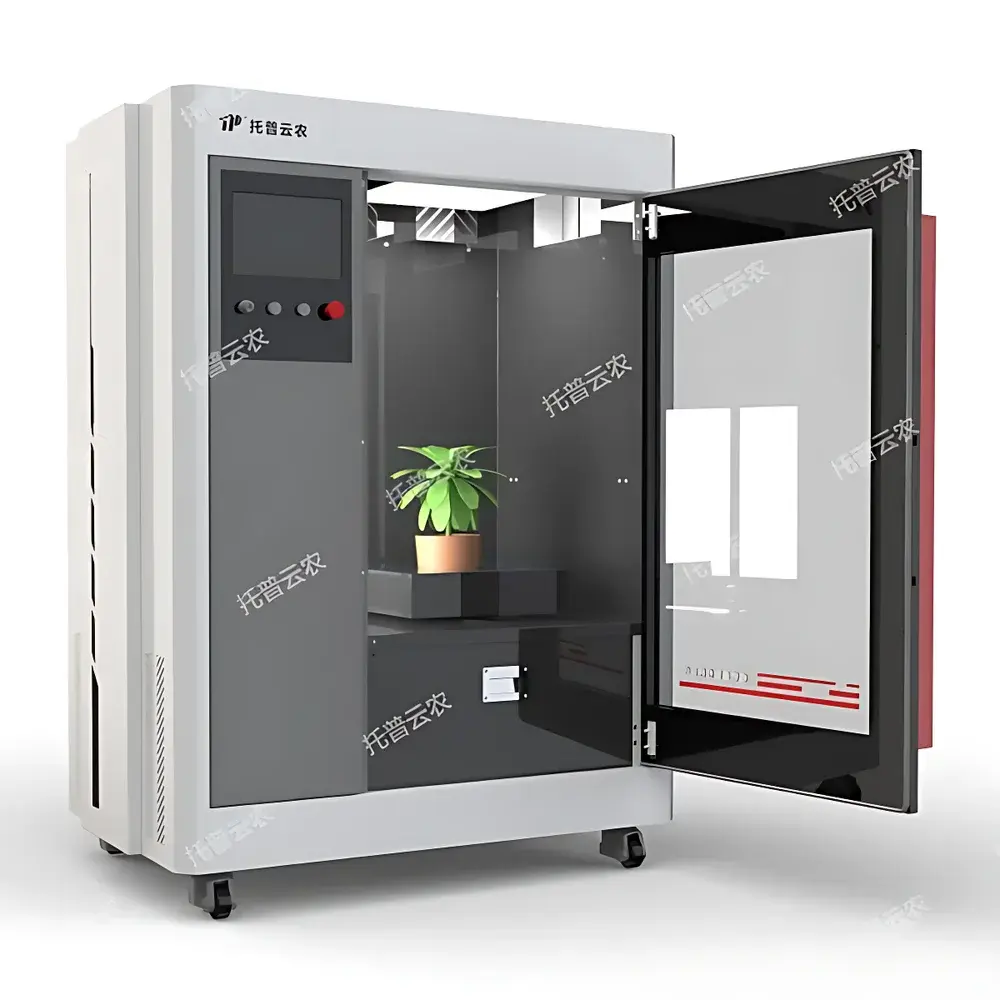
The Top Cloud-agri TP-plant-VL3 3D Plant Phenotyping Imaging System is a laboratory-grade, non-invasive phenotyping platform engineered for high-throughput, quantitative analysis of plant morphology, architecture, and surface-level physiological traits under controlled environments—including growth chambers, climate rooms, and phytotrons. It operates on the principle of multi-view stereo (MVS) photogrammetry, integrating synchronized visible-light imaging from top and side perspectives with precise rotational positioning to reconstruct geometrically accurate, texture-mapped 3D plant models. Unlike laser-based or structured-light systems, the TP-plant-VL3 relies exclusively on passive, calibrated visible-spectrum imaging—ensuring compatibility with photosensitive genotypes and eliminating phototoxicity risks during longitudinal monitoring. Its core output includes volumetric biomass proxies, canopy structural metrics (e.g., height, spread, compactness), colorimetric indices (e.g., greenness, senescence, chlorosis), and dynamic morphological descriptors—all traceable to SI-aligned pixel-to-real-world scaling derived from embedded calibration targets.
Key Features
- Multi-Angle Visible-Light Acquisition: Dual-axis imaging rig comprising four industrial-grade 5120 × 5120-pixel CMOS cameras—two overhead (top-view), two lateral (side-view)—mounted on rigid optical rails with motorized focus and exposure control.
- 360° Precision Rotation Stage: Stepper-driven turntable with ±0.1° angular repeatability, enabling full circumferential coverage without manual repositioning; compatible with standard 10–18 cm diameter pots.
- Uniform Diffuse Illumination: Integrated LED panel array delivering spectrally neutral, shadow-free illumination (CRI >95, correlated color temperature 5500 K), minimizing specular reflection and ensuring consistent color fidelity across acquisition sessions.
- Automated Pipeline Execution: One-click workflow spanning image capture → feature correspondence matching → depth map fusion → mesh generation → trait quantification—completed in ≤3 minutes per plant after 40-second acquisition.
- QR-Code Sample Traceability: Integrated barcode scanner links physical samples to digital phenotypic records, supporting experimental metadata tagging (e.g., genotype, treatment, timepoint) and enabling GLP-compliant audit trails.
- Modular Enclosure Design: Self-contained 1400 × 935 × 1840 mm chassis with casters, lockable leveling feet, and EMI-shielded internal wiring—designed for flexible deployment within biosafety level 1 (BSL-1) laboratories.
- Touch-Optimized Human Interface: 10.1-inch capacitive touchscreen with real-time preview, adjustable LED intensity control, stage position override, and live progress indicators for each pipeline stage.
Sample Compatibility & Compliance
The TP-plant-VL3 supports phenotyping of intact potted plants across diverse botanical families—including Poaceae (rice, wheat, maize), Solanaceae (tomato, tobacco), Brassicaceae (Arabidopsis, cabbage), and Fabaceae (soybean, pea)—with stem heights ranging from 5 cm to 120 cm and canopy diameters up to 45 cm. All hardware and software components comply with IEC 61000-6-3 (EMC emission limits) and IEC 61000-6-2 (immunity requirements). Data handling protocols align with ISO/IEC 17025:2017 clause 7.5.2 (control of data integrity) and support optional integration with LIMS platforms via RESTful API. While not FDA 21 CFR Part 11-certified out-of-the-box, the system’s software architecture permits configuration for electronic signature enforcement and audit-log retention required under GLP/GMP frameworks.
Software & Data Management
Built on a Python-based computational stack (OpenCV 4.x, Open3D 0.18+, scikit-image 0.21+), the proprietary Phenolink™ v3.2 software delivers reproducible trait extraction using validated computer vision pipelines. Outputs include standardized CSV/TSV tables compliant with MIAPPE (Minimum Information About a Plant Phenotyping Experiment) v1.1 metadata schemas, as well as OBJ/GLB-format 3D meshes with embedded UV texture maps. Time-series datasets are stored in HDF5 containers with hierarchical group organization (e.g., /experiment_001/plant_A01/t0072h), enabling efficient random-access querying. Batch processing supports parallel execution across multi-core CPUs, and raw image archives are checksummed (SHA-256) upon ingestion to guarantee data provenance. Optional cloud synchronization enables secure off-site backup and cross-laboratory collaboration via role-based access control (RBAC).
Applications
- Mutant Screening & Validation: Quantitative discrimination of morphological outliers (e.g., dwarfism, leaf curling, altered branching angles) across TILLING or CRISPR-Cas9 populations using multivariate statistical clustering (PCA, t-SNE) on 30+ extracted traits.
- Abiotic Stress Phenotyping: Temporal tracking of drought-induced wilting (via projected area decay rate), salt-stress chlorosis (RGB channel decomposition + CIELAB ΔE* calculation), and heat-induced epinasty (stem curvature coefficient derived from skeletonized 3D centerline fitting).
- Growth Kinetics Modeling: Derivation of logistic growth parameters (e.g., inflection point, maximum relative growth rate) from daily volumetric biomass trajectories, enabling genotype-by-environment interaction analysis.
- Canopy Architecture Analysis: Extraction of light interception potential via ray-casting simulations on reconstructed meshes, supporting breeding decisions for shade-tolerant cultivars.
- Eco-Physiological Correlation Studies: Integration of 3D-derived traits (e.g., leaf angle distribution, porosity index) with gas exchange or chlorophyll fluorescence measurements to identify structural determinants of photosynthetic efficiency.
FAQ
What lighting conditions are required for optimal image acquisition?
The system provides fully integrated, spectrally stable LED illumination—no external darkroom or ambient light control is needed. Operation in standard laboratory lighting (≤300 lux ambient) does not compromise reconstruction fidelity.
Can the system be used for root phenotyping?
No—the TP-plant-VL3 is designed exclusively for above-ground plant structures. Root imaging requires complementary platforms such as rhizotrons or X-ray CT systems.
Is the 3D model export compatible with third-party modeling software?
Yes—models are exported in industry-standard OBJ and GLB formats, fully importable into Blender, MeshLab, CloudCompare, and MATLAB’s PDE Toolbox for downstream geometric analysis.
How is measurement accuracy validated?
Each system undergoes factory calibration using NIST-traceable ceramic checkerboard targets and certified dimension standards; users receive a calibration certificate documenting spatial resolution (≤0.15 mm/pixel at pot center) and volumetric repeatability (CV ≤2.3% across 10 repeated scans of reference phantoms).
Does the software support batch processing of historical image sets?
Yes—Phenolink™ accepts pre-captured multi-view image sequences (JPEG/TIFF) organized in defined folder hierarchies, enabling retrospective analysis without hardware connection.