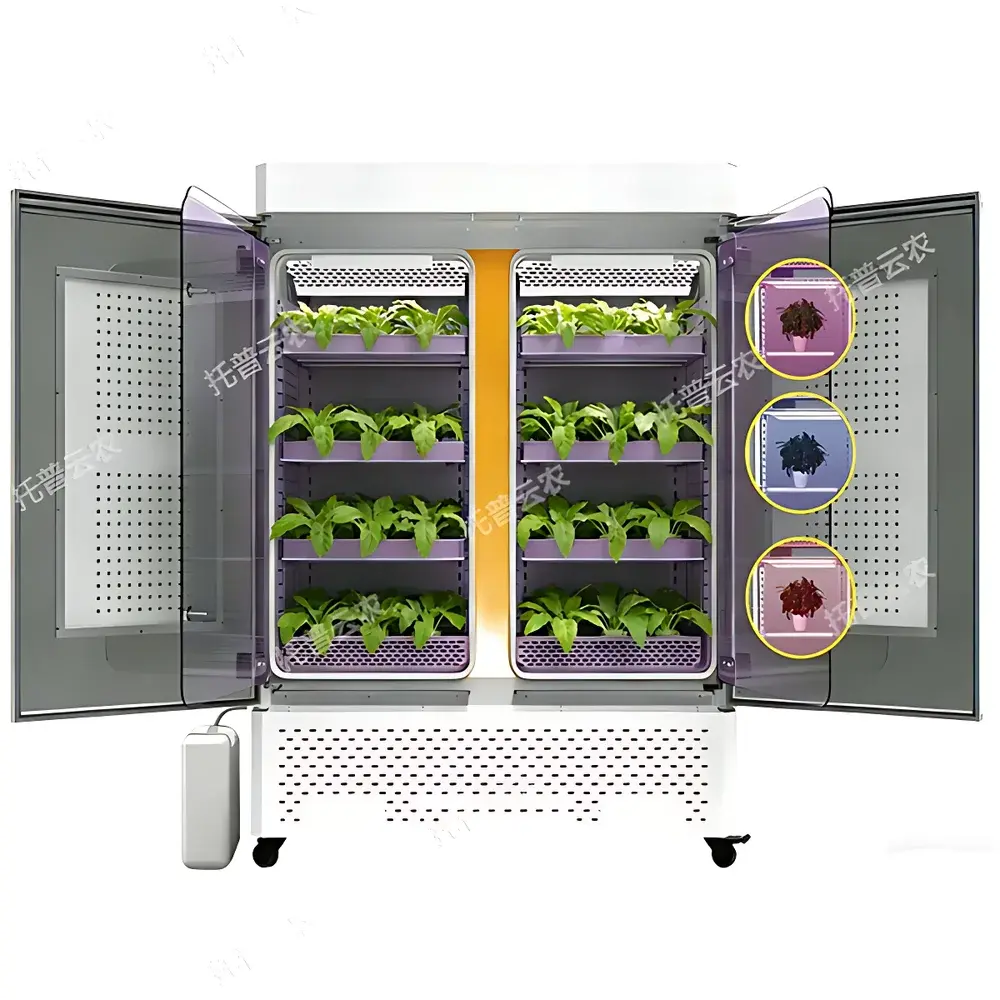
Top Cloud-agri TP-R420DK / TP-R1000DK Adjustable-Spectrum Plant Growth Incubator
| Brand | Top Cloud-agri |
|---|---|
| Origin | Zhejiang, China |
| Manufacturer Type | OEM/ODM Producer |
| Country of Origin | China |
| Model | TP-R420DK / TP-R1000DK |
| Capacity | 420 L / 1000 L |
| Temperature Range | 0–65 °C (light off) |
| Temperature Uniformity | ±0.1 °C (420 L) |
| Humidity Uniformity | ±2 %RH (420 L) |
| Illumination Intensity Range | 0–22,000 lux |
| Dimensions (W×D×H, mm) | 762×765×1900 (TP-R420DK) |
| Internal Dimensions (W×D×H, mm) | 635×560×1165 (TP-R420DK) |
| Power Consumption | 1200 W / 2500 W |
| Input Voltage | AC 220 V, 50 Hz, 10 A / 16 A |
| Light Source | Quad-channel LED array (450 nm blue, 660 nm red, 730 nm far-red, 400–700 nm white) |
| Spectral Tuning | Independent intensity control per channel |
| Airflow Control | 30–100% stepwise adjustable internal circulation fan |
| Humidity Control Range | 50–95 %RH (at 10–50 °C) |
| Defrost Method | Hot-gas bypass with concurrent temperature/humidity compensation |
| Communication Interfaces | RJ45 Ethernet, USB 2.0, Wi-Fi 802.11 b/g/n |
| Data Logging | Local SD/U-disk + cloud platform sync (web & mobile app) |
| Compliance | Designed to support GLP-compliant environmental simulation workflows |
Overview
The Top Cloud-agri TP-R420DK and TP-R1000DK Adjustable-Spectrum Plant Growth Incubators are precision-engineered environmental simulation systems designed for controlled-conditions plant physiology research, seed germination studies, tissue culture, and photobiological experimentation. Unlike conventional growth chambers, these incubators integrate quad-channel tunable LED illumination—comprising discrete 450 nm (blue), 660 nm (red), 730 nm (far-red), and broad-spectrum 400–700 nm (white) emitters—enabling quantitative manipulation of photosynthetically active radiation (PAR) and phytochrome-regulated spectral cues. Coupled with high-fidelity thermal and hygric control (±0.1 °C uniformity in the 420 L model), intelligent airflow modulation, and integrated environmental sensing, the system supports reproducible simulation of diurnal cycles, stress regimes, and developmental stage-specific lighting profiles. Its architecture is purpose-built for long-term unattended operation in academic laboratories, agricultural biotechnology facilities, and pharmaceutical stability testing environments where spectral fidelity, parameter traceability, and environmental stability are critical.
Key Features
- Quad-spectral LED lighting system with independent digital dimming per channel (0–100%), enabling precise recreation of natural or experimental light quality—up to 1004 unique spectral combinations for photomorphogenesis, photoperiodism, and shade-avoidance studies.
- 7-inch full-color capacitive touchscreen interface with intuitive icon-based navigation, real-time multi-parameter visualization, and contextual alarm logging.
- Modular top-mounted LED arrays with vertically adjustable mounting rails—allowing dynamic reconfiguration of light plane height to accommodate variable plant canopy development across growth stages.
- Integrated humidity management via recirculating ultrasonic humidification, minimizing water consumption while maintaining ±2 %RH uniformity (420 L) under stable thermal conditions.
- Programmable air exchange system with manual or automated ventilation rate control, supporting CO2 enrichment compatibility and volatile organic compound (VOC) mitigation in closed-loop assays.
- Intelligent hot-gas bypass defrost technology that maintains setpoint continuity during defrost cycles—eliminating thermal transients that compromise physiological consistency in extended-duration experiments.
- Dual-layer door construction featuring tempered glass inner door and insulated outer panel; reduces radiant heat loss and enables non-intrusive observation without compromising environmental integrity.
- Electromagnetic door lock with configurable access codes and automatic illumination dimming upon door opening—ensuring personnel safety and experimental continuity.
- Onboard UV-C sterilization cycle (254 nm) with timer-based activation and auto-shutoff, validated for surface decontamination of interior surfaces between runs.
- Embedded PID temperature/humidity algorithms calibrated against NIST-traceable reference sensors, delivering long-term stability (<0.1 °C drift over 72 h at 25 °C/50 %RH).
Sample Compatibility & Compliance
The TP-R series accommodates a wide range of biological samples—from Petri dishes and Magenta boxes to multi-tier hydroponic trays and insect rearing cages—within its stainless-steel, large-radius corner interior. Its modular shelving system (≥3 pull-out 304 stainless steel trays, height-adjustable) supports ISO-standard container formats and custom mounting fixtures. The system meets structural and operational criteria referenced in ASTM E1826 (Standard Practice for Environmental Chambers Used in Testing), ISO 17025:2017 (for calibration traceability of onboard sensors), and EU Directive 2014/30/EU (EMC compliance). While not certified as medical devices, its data logging architecture—including time-stamped parameter history, user authentication logs, and immutable audit trails—supports alignment with GLP and GMP documentation practices. All firmware and cloud data handling adhere to GDPR-compliant encryption standards (AES-256) and TLS 1.2+ transmission protocols.
Software & Data Management
The incubator operates on embedded Linux-based firmware with dual-mode connectivity: local network (RJ45) and wireless (Wi-Fi 802.11 b/g/n). Configuration, monitoring, and historical review are accessible via three synchronized interfaces: (1) web-based dashboard (HTTPS-secured), (2) native iOS/Android application with push notifications for threshold breaches, and (3) WeChat Mini Program for QR-code-initiated remote access. Environmental data—including temperature, relative humidity, PAR irradiance (µmol·m−2·s−1 calculated from lux), fan speed, and door status—is sampled at 10-second intervals and stored locally on microSD (up to 32 GB) with automatic rollover. Cloud synchronization occurs every 5 minutes; all datasets include metadata fields for experiment ID, operator name, protocol version, and annotation tags. Export options include CSV (with ISO 8601 timestamps), PDF reports (with embedded trend charts), and direct integration with LabArchives or ELN platforms via RESTful API. Firmware updates are delivered OTA using signed packages verified via SHA-256 checksums.
Applications
These incubators serve as core infrastructure in diverse research domains requiring photobiologically resolved environmental control. In crop science, they enable genotype-by-light interaction studies—e.g., screening for red/far-red ratio responsiveness in brassica flowering time or blue-light-mediated stomatal conductance in drought-tolerant maize lines. In plant tissue culture labs, the precise spectral tuning supports callus induction, shoot proliferation, and root elongation phase optimization without hormone supplementation. For pharmaceutical botany, the system facilitates controlled degradation studies of light-sensitive phytochemicals (e.g., anthocyanins, curcuminoids) under standardized photostress regimens. In entomology, it replicates seasonal photoperiods for diapause induction in lepidopteran models. Additional validated use cases include algal photobioreactor pre-conditioning, fungal sporulation kinetics under defined light quality, and circadian rhythm entrainment assays in Arabidopsis thaliana ecotypes.
FAQ
What spectral bands are independently controllable?
The system provides four discrete, digitally addressable LED channels: 450 nm (blue), 660 nm (red), 730 nm (far-red), and 400–700 nm (white phosphor-converted). Each channel supports 0.1% resolution intensity adjustment.
Does the system support PAR quantification?
Yes—lux readings are internally converted to photosynthetic photon flux density (PPFD, µmol·m−2·s−1) using spectrally weighted calibration curves traceable to NIST SRM 2253.
Can humidity be maintained above 95% RH?
No—the maximum specified humidity range is 95% RH, constrained by condensation risk and sensor accuracy limits at saturation. Operation above this level is not recommended.
Is remote firmware update capability available out-of-the-box?
Yes—OTA updates are enabled by default and require only authenticated network access and valid digital signatures.
Are validation documents (IQ/OQ/PQ) provided?
Factory-issued IQ/OQ test reports are available upon request; PQ protocols must be executed on-site by qualified users per ISO/IEC 17025 guidelines.
What is the mean time between failures (MTBF) for the LED array?
Rated MTBF exceeds 50,000 hours at 70% nominal drive current, based on LM-80 accelerated life testing per IESNA standards.