
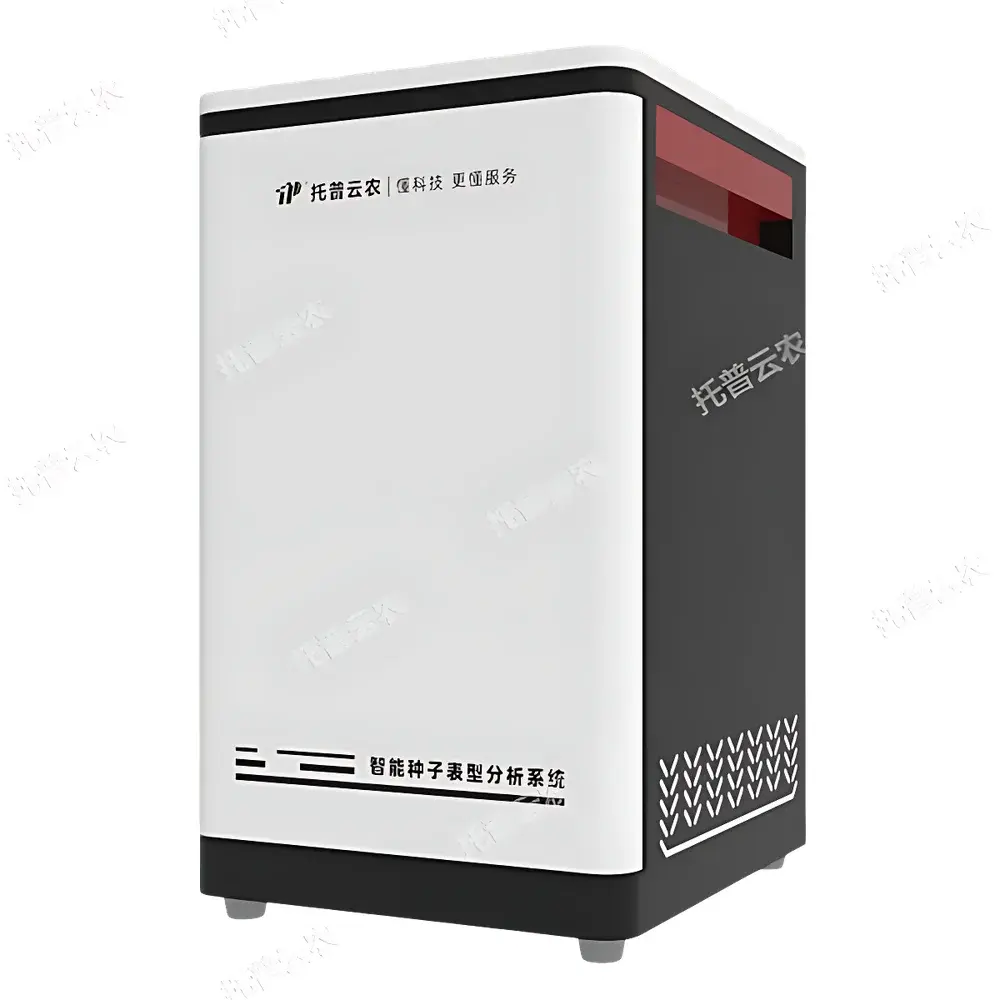
Top Cloud-agri TP-Seed-2D & TPN-Seed-G High-Throughput Seed Phenotyping System
| Brand | Top Cloud-agri |
|---|---|
| Origin | Zhejiang, China |
| Manufacturer Type | Direct Manufacturer |
| Region of Origin | Domestic (China) |
| Model | TP-Seed-2D / TPN-Seed-G |
| Price | Upon Request |
| Visible Light Imaging | 26 MP industrial RGB sensor with uniform diffused LED illumination |
| Hyperspectral Imaging Range | 400–1000 nm (TPN-Seed-G only) |
| Weight Measurement Accuracy | ±0.1 g, Max Capacity: 1 kg |
| Dimensions | 400 × 350 × 600 mm (L×W×H) |
| Operating Temperature | 0–40 °C |
| Relative Humidity | ≤90% RH |
| Power Consumption | <100 W |
Overview
The Top Cloud-agri TP-Seed-2D and TPN-Seed-G High-Throughput Seed Phenotyping Systems are benchtop, vertically integrated instrumentation platforms engineered for non-destructive, multi-modal seed characterization in controlled laboratory and breeding environments. These systems operate on a dual-sensing architecture combining visible-light morphometric imaging with precision gravimetric measurement—and, in the case of the TPN-Seed-G variant, extended-range hyperspectral reflectance spectroscopy (400–1000 nm). The integrated dark chamber eliminates ambient light interference, ensuring consistent illumination geometry and spectral fidelity across repeated measurements. Designed for seed-level phenomics workflows, the platform captures quantitative traits including geometric dimensions (length, width, aspect ratio, area, perimeter), chromatic properties (RGB-derived hue, saturation, brightness), mass, and—via calibrated spectral models—biochemical proxies such as moisture content, protein concentration, oil fraction, and spatially resolved mold distribution. Its modular enclosure supports deployment in diverse operational settings: germplasm banks, climate-controlled growth chambers, breeding stations, seed quality control labs, processing facilities, and long-term storage monitoring sites.
Key Features
- Integrated multimodal sensing: Co-registered visible-light imaging (26 MP RGB sensor), electronic weighing (±0.1 g accuracy, 1 kg capacity), and optional hyperspectral acquisition (TPN-Seed-G) within a single optomechanical enclosure.
- Controlled imaging environment: Built-in light-tight chamber with uniform diffused LED illumination ensures reproducible reflectance conditions and eliminates variability from ambient lighting or operator handling.
- Automated image management: Timestamped, sequentially numbered image files stored locally; metadata embedded directly into file headers (EXIF-compatible).
- Batch-processing workflow: Software-controlled image capture and folder-based batch import enable high-throughput analysis of hundreds of seed samples per session.
- AI-powered trait extraction: Deep learning–assisted segmentation isolates individual seeds from background; morphometric algorithms compute >20 standardized phenotypic descriptors—including length, width, aspect ratio, convex area, solidity, and color histograms.
- Cloud-enabled data synchronization: Secure, encrypted upload of images and derived metrics to a web-accessible platform; no manual export/import required for cross-device or team-wide access.
- Traceable experimental annotation: Customizable text fields for origin, harvest year, treatment group, accession ID, and other GLP-aligned metadata—automatically appended to output reports and database records.
- Statistical reporting engine: On-the-fly computation of descriptive statistics (mean, SD, min/max) across user-defined sample groups; export-ready charts (bar, scatter, box plots) generated directly from analytical results.
Sample Compatibility & Compliance
The system accommodates a broad spectrum of botanical seed types, including but not limited to rice, wheat, maize, soybean, rapeseed, cotton, peanut, vegetable crops, ornamental species, forage grasses, and forest tree seeds—both naked and film-coated. With optimized focus and illumination, it extends reliable performance to small-seeded species such as quinoa, sesame, and tobacco. All hardware and software components comply with IEC 61000-4 electromagnetic compatibility standards and meet CE marking requirements for laboratory equipment safety. Data integrity protocols align with principles outlined in ISO/IEC 17025 for testing laboratories, supporting audit readiness in regulated breeding programs. While not FDA 21 CFR Part 11–certified out-of-the-box, the system’s timestamped, immutable data logs and user-authenticated operations provide foundational traceability suitable for GLP/GMP-aligned internal quality systems.
Software & Data Management
The proprietary SeedPheno™ software suite provides a unified interface for instrument control, image acquisition, spectral preprocessing (for TPN-Seed-G), trait quantification, and report generation. Raw image data are stored in lossless TIFF format; processed metrics are exported in CSV and Excel-compatible XLSX formats. Spectral libraries and calibration models for moisture, protein, and oil prediction are built using partial least squares regression (PLSR) against reference wet-chemistry measurements—models may be refined by users using their own ground-truth datasets. Audit trails record all user actions, parameter changes, and software version history. Integration with institutional LIMS is supported via RESTful API endpoints for automated ingestion into centralized seed databases.
Applications
- High-resolution seed morphometry for varietal identification and purity assessment
- Non-invasive screening of seed viability and vigor indices under abiotic stress treatments
- Quantitative evaluation of coating uniformity and thickness in pelleted or treated seeds
- Longitudinal monitoring of seed deterioration during storage (moisture migration, discoloration, surface degradation)
- QTL mapping support through high-density phenotypic profiling of segregating populations
- Pre-breeding selection based on correlated biochemical traits (e.g., oil-to-protein ratios in oilseed crops)
- Regulatory compliance documentation for seed certification and phytosanitary reporting
FAQ
What is the difference between TP-Seed-2D and TPN-Seed-G?
The TP-Seed-2D integrates visible-light imaging and electronic weighing for morphometric and color-based phenotyping. The TPN-Seed-G adds hyperspectral imaging (400–1000 nm), enabling quantitative estimation of moisture, protein, oil, and spatial fungal colonization.
Can the system analyze seeds smaller than 1 mm?
Yes—optimized optical configuration and sub-pixel interpolation allow reliable segmentation and measurement of seeds down to ~0.5 mm (e.g., sesame, tobacco), provided sufficient contrast against the imaging background.
Is spectral calibration required before each use?
A daily white-reference scan is recommended for optimal radiometric stability; factory-calibrated wavelength and intensity response curves are embedded in firmware and do not require user recalibration.
How is data security handled for cloud synchronization?
All data transmissions use TLS 1.2+ encryption; user accounts enforce role-based access control; raw image archives are retained for ≥90 days and may be configured for automatic purge or long-term archival per institutional policy.
Does the system support third-party spectral modeling tools?
Yes—hyperspectral data cubes (ENVI .hdr/.bin format) and extracted ROI spectra are exportable for offline analysis in MATLAB, Python (scikit-learn, hylite), or commercial chemometrics packages.



