
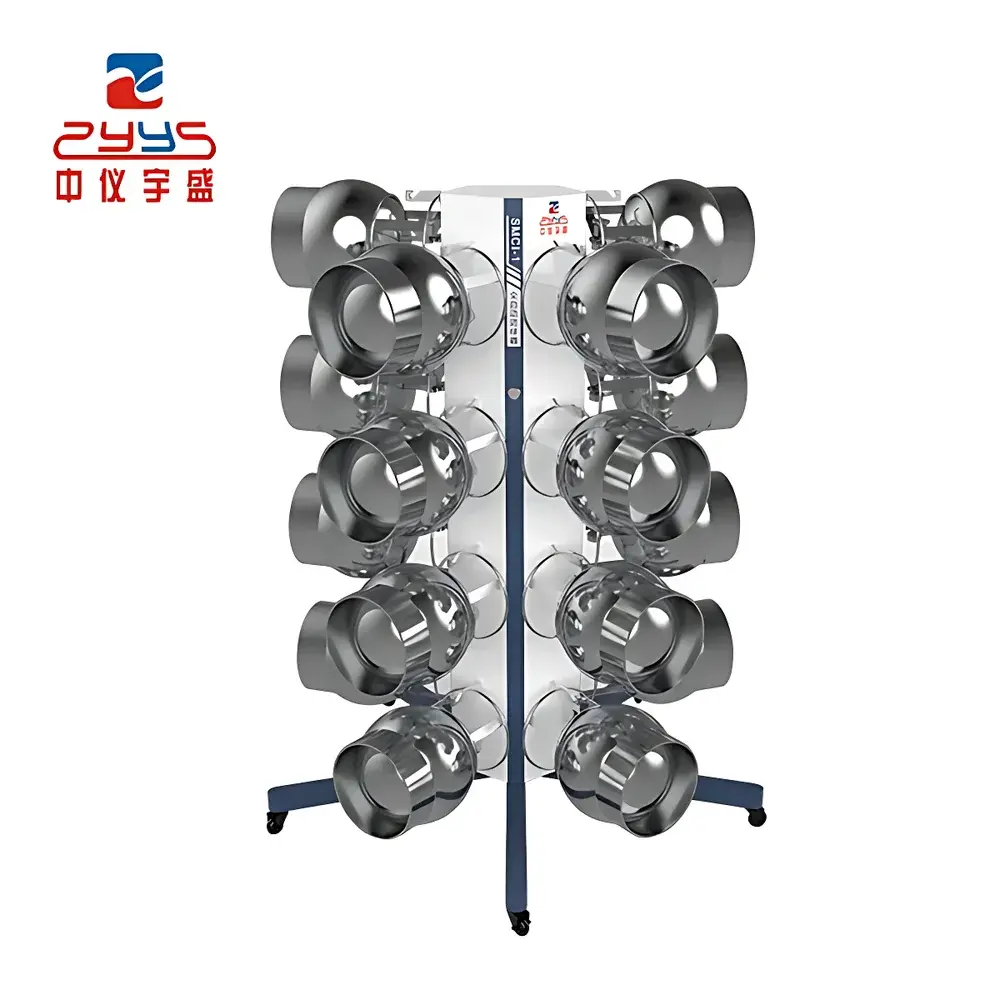
Zhongyi Yusheng SMCI-1 Multifunctional Autosampler
| Brand | Zhongyi Yusheng |
|---|---|
| Origin | Beijing, China |
| Manufacturer Type | Direct Manufacturer |
| Instrument Type | Multifunctional Autosampler |
| Maximum Sample Positions | 16 |
| Standard Quantitative Loop Volume | 100 µL (customizable) |
| Leak Detection | Pre-valve-opening automated leak check |
| Flow Path Treatment | Passivated (inertized) tubing and valves |
| Cleaning Protocol | Software-controlled reverse-flush for all flow paths |
| Valve Architecture | Multi-position rotary valve |
| Control Interface | PC-based method programming with unattended operation (scheduled, repetitive, continuous injection) |
Overview
The Zhongyi Yusheng SMCI-1 Multifunctional Autosampler is an engineered solution for unattended, high-integrity sample introduction in gas-phase chromatographic analysis—specifically designed for environmental air, industrial emission, and occupational hygiene monitoring applications. It operates on a robust pneumatic and electromechanical architecture, integrating automated leak verification prior to valve actuation, inertized fluidic pathways, and programmable reverse-flush cleaning cycles to ensure analytical reproducibility across volatile organic compounds (VOCs), sulfur-containing species (e.g., H2S, methanethiol, dimethyl sulfide), and other reactive gaseous analytes. Unlike basic syringe-based autosamplers, the SMCI-1 employs a multi-position rotary valve manifold coupled with fixed-volume quantitative loops—enabling precise, pressure-stable sample metering without syringe plunger wear or carryover-induced bias. Its design aligns with fundamental requirements for trace-level gas analysis: minimal surface adsorption, thermal stability of critical components, and deterministic timing control over injection events.
Key Features
- Pre-injection automated leak detection: Verifies system integrity before each valve rotation, reducing false positives from ambient infiltration or seal degradation.
- Fully inertized flow path: All wetted surfaces—including stainless-steel tubing, PTFE-lined valves, and fused-silica or SilcoNert®-treated fittings—are chemically passivated to suppress adsorption/desorption hysteresis of polar or reactive analytes.
- Programmable reverse-flush protocol: Each individual flow path undergoes dedicated backflushing with carrier gas or purge gas post-injection, eliminating cross-contamination between sequential samples.
- Multi-position rotary valve architecture: Enables rapid, repeatable switching among 16 sample positions while maintaining consistent dead volume and minimizing dispersion during transfer.
- Flexible loop configuration: Standard 100 µL stainless-steel quantitative loop; optional volumes (e.g., 25 µL, 250 µL, 500 µL) available to match concentration ranges and detector sensitivity requirements.
- Full PC-based method control: Supports scheduled injections, repeated sequence runs, and continuous unattended operation over extended periods (e.g., 24–72 h campaigns).
Sample Compatibility & Compliance
The SMCI-1 is validated for use with pressurized sampling cylinders (e.g., SUMMA®-treated canisters), Tedlar® gas bags, and evacuated stainless-steel canisters—compatible with both ambient air and stack emission matrices. Its operational parameters satisfy methodological prerequisites outlined in key Chinese environmental standards, including GB/T 14678–1993 (H2S and organosulfur compounds), HJ 759–2023 (65 VOCs by canister/GC–MS), and HJ 1078–2019 (8 sulfur organics by bag/preconcentrator/GC–MS). While not certified to ISO/IEC 17025 or FDA 21 CFR Part 11 out-of-the-box, the instrument’s deterministic execution logic, audit-ready log files (timestamped injection records, leak test outcomes, flush cycle triggers), and method parameter immutability support GLP-compliant workflows when integrated into validated laboratory information management systems (LIMS).
Software & Data Management
Control is executed via Windows-compatible software offering method editor, sequence scheduler, real-time status dashboard, and event logging. Each injection generates a timestamped record containing: sample ID, position number, loop fill pressure, leak test result (pass/fail with delta-P value), valve actuation count, and flush initiation flag. Export formats include CSV and XML for integration with third-party data analysis platforms or LIMS. No proprietary drivers are required; communication occurs over standard USB 2.0 or RS-232 interfaces. Firmware updates are delivered as signed binary packages with version rollback capability.
Applications
- Regulatory compliance monitoring of ambient air VOCs and odorants per national emission inventories.
- Source apportionment studies requiring high-throughput analysis of time-resolved canister samples.
- Method development for reactive sulfur compound quantification where surface-catalyzed decomposition must be minimized.
- Long-term unattended monitoring at remote sites using solar-powered GC systems interfaced via dry-contact relay outputs.
- Quality control of industrial gas streams (e.g., biogas upgrading, semiconductor process gases) where repeatability across shifts is critical.
FAQ
Does the SMCI-1 support internal standard addition?
No—the SMCI-1 is a dedicated sample introduction device and does not integrate liquid or gaseous internal standard spiking. External standard addition must be performed upstream or via GC inlet configuration.
Can the quantitative loop volume be changed in-field?
Yes—loop replacement requires mechanical disassembly and recalibration verification; recommended only by qualified service personnel to maintain volumetric accuracy.
Is the system compatible with cryogenic preconcentrators?
Yes—its output port is rated for ≤100 psi and interfaces directly with commercial multi-stage preconcentrators (e.g., Markes UNITY-xr, Tekmar Atomx) via standard 1/8″ VCR fittings.
What maintenance intervals are recommended?
Valve rotor seal inspection every 5,000 injections; full inertization revalidation annually or after any wetted component replacement.
Does the software support networked deployment across multiple instruments?
No—each SMCI-1 operates as an independent node; centralized scheduling requires external orchestration via Python API scripts or LIMS middleware integration.




