
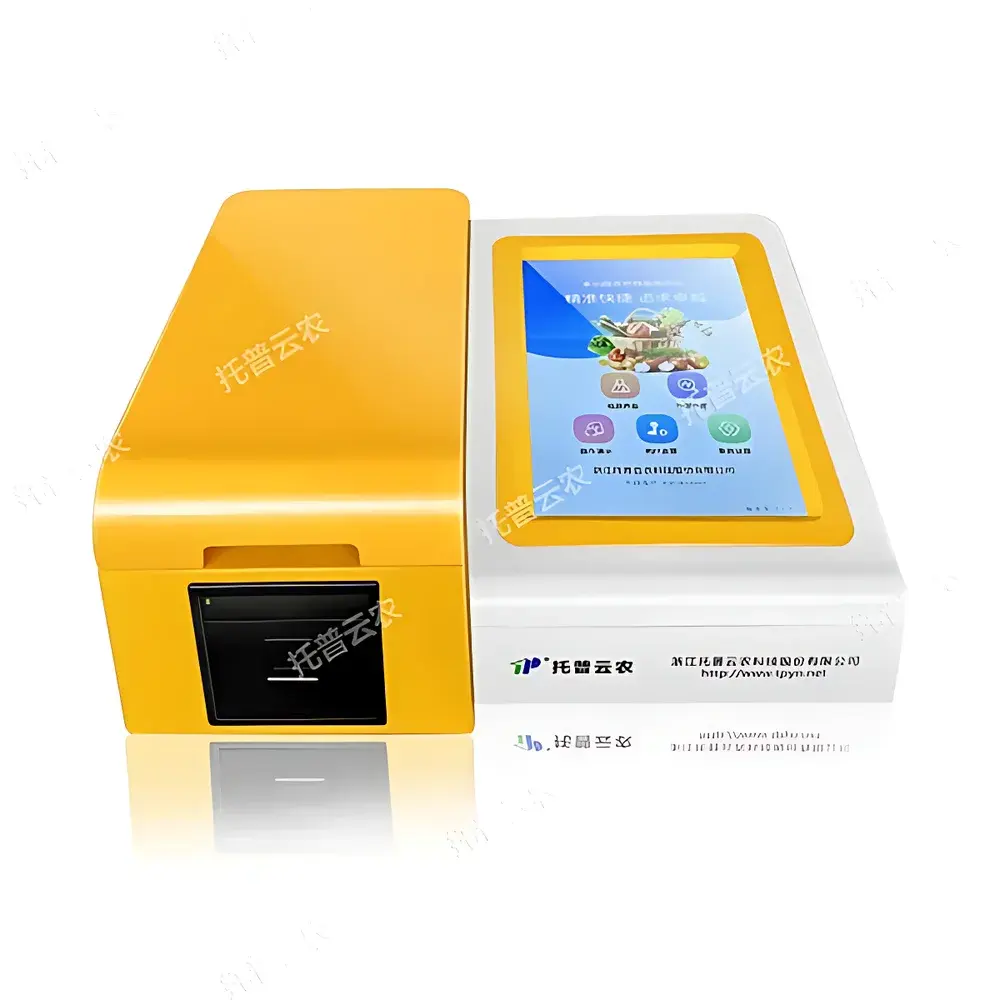
Top Cloud-agri TP-SJ-12L Enzyme Inhibition-Based Pesticide Residue Rapid Tester
| Brand | Top Cloud-agri |
|---|---|
| Origin | Zhejiang, China |
| Manufacturer Type | Direct Manufacturer |
| Country of Origin | China |
| Model | TP-SJ-12L |
| Detection Method | Enzyme Inhibition Assay (Spectrophotometric) |
| Number of Detection Channels | 12 |
| Display | 10.1-inch Capacitive Touch LCD |
| Absorbance Range | 0.000–4.000 A |
| Transmittance Range | 0.00–100.00% T |
| Transmittance Resolution | 0.01% T |
| Absorbance Resolution | 0.001 A |
| Photometric Accuracy (T) | ±2% |
| Photometric Repeatability (T) | ≤0.2% |
| Photocurrent Drift | ≤0.2% (3 min) |
| Measurement Accuracy | ±5% |
| USB Ports | 2 |
| Communication Interfaces | Wi-Fi, RJ45 Ethernet, Optional 3G/4G Module |
| Power Supply | 220 V ±10% |
Overview
The Top Cloud-agri TP-SJ-12L Enzyme Inhibition-Based Pesticide Residue Rapid Tester is a dedicated benchtop spectrophotometric analyzer engineered for the quantitative screening of organophosphorus and carbamate pesticide residues in fresh agricultural commodities—including fruits, vegetables, tea, and edible fungi. It operates on the internationally recognized enzyme inhibition principle: acetylcholinesterase (AChE) or butyrylcholinesterase (BChE) activity is reversibly inhibited by target pesticides; the degree of inhibition correlates with residue concentration. The instrument measures the enzymatic hydrolysis rate of chromogenic substrates (e.g., indoxyl acetate or acetylthiocholine iodide) via absorbance change at defined wavelengths (typically 405 nm or 412 nm), delivering semi-quantitative results within 10–15 minutes per batch. Designed for high-throughput field and laboratory use, it complies with national standard GB/T 5009.199–2003 and aligns with AOAC Official Method 2007.01 for rapid cholinesterase inhibition assays.
Key Features
- Twelve independent optical detection channels enable parallel analysis of up to 12 samples per run—significantly increasing throughput without cross-contamination risk.
- 10.1-inch capacitive multi-touch LCD running Android OS provides intuitive, icon-driven workflow navigation; supports gesture-based calibration, result review, and report generation.
- Integrated intelligent sample presence detection eliminates manual channel initialization—optical sensors automatically confirm tube placement before measurement initiation.
- Onboard data management includes local storage (internal eMMC + expandable microSD card), automatic pass/fail classification against regulatory thresholds (e.g., 50% inhibition cutoff per Chinese MRL guidelines), and thermal printer output with time-stamped, traceable reports.
- Real-time cloud synchronization via dual-network redundancy: built-in Wi-Fi and Gigabit Ethernet (RJ45); optional 3G/4G LTE module ensures continuous connectivity in remote agro-logistics hubs or mobile inspection vehicles.
- Self-diagnostic firmware continuously monitors LED stability, photodetector linearity, and temperature-controlled incubation integrity; embedded video tutorials guide users through routine maintenance and error resolution.
Sample Compatibility & Compliance
The TP-SJ-12L accepts standard 12-mm round glass or plastic cuvettes and accommodates homogenized extracts prepared from raw produce using standardized extraction protocols (e.g., QuEChERS pre-treatment or aqueous acetonitrile extraction). Sample volume per channel is 200–300 µL. The system meets essential metrological requirements for rapid food safety screening under China’s NY/T 448–2021 (Pesticide Residue Rapid Detection Technical Specification) and supports audit-ready documentation aligned with GLP principles. While not certified for regulatory submission under ISO/IEC 17025, its performance parameters—including ±2% transmittance accuracy and ≤0.2% repeatability—are validated per internal QC protocols traceable to NIM (National Institute of Metrology, China) reference standards.
Software & Data Management
Embedded firmware supports CSV export, barcode-assisted sample logging, and hierarchical database indexing by commodity type, origin, operator ID, and testing date. Cloud platform integration enables role-based access control, geographic heat mapping of contamination hotspots, and automated generation of summary dashboards compliant with provincial food safety surveillance reporting templates. All data transactions are timestamped and cryptographically signed; audit trails record user actions, calibration events, and instrument status changes—supporting basic 21 CFR Part 11 readiness for internal QA review. No proprietary software installation is required on client workstations; web-based portal access is enabled via HTTPS-secured TLS 1.2+ connections.
Applications
- Routine screening at farm gate collection centers, wholesale markets, and supermarket quality control labs.
- Mobile food safety enforcement during regulatory inspections (e.g., provincial Market Supervision Bureaus).
- Pre-harvest scouting and post-harvest residue monitoring for integrated pest management (IPM) validation.
- Training and capacity building in agricultural extension services and vocational colleges.
- Supplemental verification testing alongside confirmatory methods such as GC-MS or LC-MS/MS in accredited laboratories.
FAQ
What types of pesticides does this instrument detect?
It quantitatively screens for organophosphorus (e.g., chlorpyrifos, dimethoate) and carbamate (e.g., carbaryl, methomyl) compounds based on their reversible inhibition of cholinesterase enzymes. It does not detect neonicotinoids, pyrethroids, or glyphosate.
Is external calibration required before each test?
No. The instrument performs automatic zeroing and blank correction using reagent-only controls loaded into designated reference channels. Factory calibration is stable for ≥6 months under normal operating conditions.
Can test results be exported to LIMS systems?
Yes. Structured CSV files containing sample IDs, inhibition rates (%), calculated concentrations (µg/kg), operator metadata, and timestamps can be manually downloaded or pushed via SFTP to compatible LIMS environments.
What is the minimum detectable inhibition level?
The system reliably resolves inhibition differences ≥5%, corresponding to typical detection limits of 0.01–0.1 mg/kg depending on matrix and extraction efficiency—consistent with national rapid screening thresholds.
Does the device require consumables beyond standard assay kits?
Only commercially available, CE-marked enzyme-substrate reagent kits (e.g., AChE + DTNB) are needed. No proprietary cartridges or single-use optics are used; all optical components are sealed and maintenance-free.



