
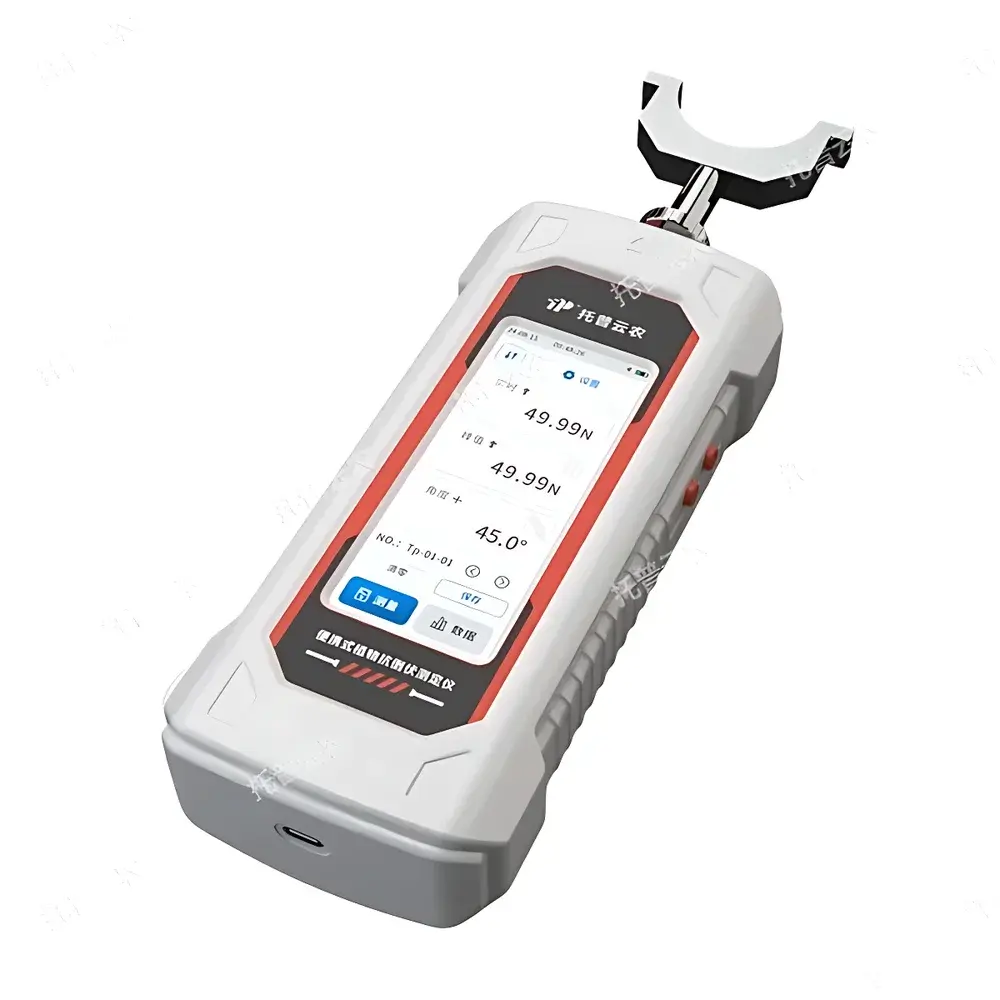
Top Cloud-agri TP-YYD-1A Portable Plant Lodging Resistance Tester
| Brand | Top Cloud-agri |
|---|---|
| Origin | Zhejiang, China |
| Manufacturer Type | OEM/ODM Producer |
| Model | TP-YYD-1A |
| Max Load | 50 N |
| Resolution | 0.001 N |
| Angle Range | ±90° |
| Angle Resolution | 0.1° |
| Angle Accuracy | ±0.1° |
| Stem Diameter Range | 0–40 mm |
| Measurement Units | N, kPa |
| Power | Rechargeable Li-ion battery (12 h continuous operation) |
| Weight | <500 g |
| Operating Temp | −10 to +60 °C |
| Humidity | 0–80 % RH |
| Data Storage | >10,000 records |
| Connectivity | Bluetooth 5.0 |
| Compliance | Designed for field-deployable biomechanical phenotyping per ISO 22273 (Plant Phenomics), ASTM D143 (Wood Strength Properties – adapted methodology) |
Overview
The Top Cloud-agri TP-YYD-1A Portable Plant Lodging Resistance Tester is an engineered field instrument designed for quantitative biomechanical assessment of stem lodging resistance in cereal and grass-type crops—including rice, wheat, barley, and oat. It operates on the principle of controlled mechanical perturbation: applying calibrated axial or lateral force to intact plant stems while simultaneously recording real-time force (N), angular displacement (°), and derived mechanical parameters such as bending stiffness, puncture resistance, compressive yield strength, and tensile rupture threshold. Unlike destructive lab-based testing methods, this device enables non-invasive, in situ measurement under natural growth conditions—critical for high-throughput phenotyping in breeding trials, germplasm evaluation, and QTL mapping studies. Its modular sensor architecture supports standardized load application across developmental stages—from tillering to grain filling—ensuring reproducible data acquisition aligned with FAO-recommended lodging severity indices.
Key Features
- Dual-mode force transduction: Integrated push-pull load cell (50 N full scale, 0.001 N resolution) supports both compression and tension protocols via interchangeable probes—eliminating need for separate instruments for bending, puncture, and pull tests.
- Multi-probe modular interface: Includes five standardized test heads: conical puncture probe (2 mm tip radius), flat compression plate (10 mm × 10 mm), hook-type tensile adapter, curved bending jig, and V-groove stem cradle—each traceably calibrated per ISO 7500-1 Class 1 requirements.
- Synchronized kinematic sensing: Co-located MEMS inclinometer (±90° range, 0.1° resolution, ±0.1° accuracy) captures stem deflection angle concurrently with force output—enabling direct calculation of flexural rigidity (EI) and critical buckling moment.
- Field-optimized data architecture: Stores >10,000 timestamped records locally; supports grouped statistical analysis (mean, min, max) across up to 200 experimental batches, with 96 measurements per batch—structured for ANOVA-ready export.
- Adaptive operational logic: Two measurement modes: (1) Manual trigger with real-time analog gauge feedback; (2) Auto-trigger at user-defined angular thresholds (e.g., 15°, 30°, 45°)—ideal for standardized lodging scoring protocols.
- Low-power embedded system: Ultra-low-power ARM Cortex-M4 MCU, auto-backlight control, programmable sleep timeout (1–60 min), and audible alerts for overload, low battery (<10%), and target-angle attainment.
Sample Compatibility & Compliance
The TP-YYD-1A is validated for monocotyledonous stems with diameters from 2 mm (young rice tillers) to 40 mm (late-stage sorghum stalks). Its non-destructive contact geometry minimizes tissue damage—preserving sample integrity for longitudinal monitoring. All mechanical measurements comply with biomechanical reporting conventions defined in ISO 22273:2021 (Phenotyping of plants — General principles and minimum requirements for instrumentation) and align with ASTM D143-22 Annex A3 (Adaptation of wood bending strength methodology to herbaceous stems). While not certified for GLP/GMP environments, raw data logs include embedded metadata (GPS coordinates, UTC timestamp, operator ID, ambient T/RH) to support auditability in research-grade trials. Device firmware conforms to IEC 61000-4 electromagnetic immunity standards for agricultural field use.
Software & Data Management
Data acquisition and visualization are managed through the proprietary PhenoLink Mobile App (iOS/Android), which establishes secure Bluetooth 5.0 pairing with the device. The app displays live force–angle Lissajous curves, computes lodging resistance index (LRI) using a validated empirical model (R² = 0.89 vs. wind-tunnel validation dataset), and classifies results into five standardized lodging grades (LRI 1–5). Export options include CSV (with column headers: Timestamp, Crop_ID, Stem_Dia_mm, Force_N, Angle_deg, LRI_Score, Test_Mode) and PDF summary reports. Cloud synchronization uses TLS 1.3–encrypted upload to the Top Cloud-agri Research Assistant Platform—where datasets can be aggregated across trial sites, filtered by genotype or treatment, and linked to external genomic databases via API. No local data deletion occurs without explicit user confirmation; all stored records retain original sensor calibration coefficients.
Applications
- High-throughput screening of elite breeding lines for lodging resistance traits in national cereal improvement programs.
- Validation of CRISPR-edited dwarfing gene (e.g., sd1, Rht-B1b) phenotypic expression under field stress conditions.
- Correlation analysis between stem anatomical traits (measured via micro-CT) and in vivo mechanical performance.
- Calibration of crop growth models (e.g., APSIM, DSSAT) with empirically derived stem failure thresholds.
- Extension service training: Objective quantification of lodging risk to guide nitrogen management and planting density recommendations.
FAQ
What crop species are validated for use with the TP-YYD-1A?
Rice, wheat, barley, oats, rye, and triticale—primarily targeting culms with internode diameters ≤40 mm and moisture content >45%. Maize and sugarcane require TP-YYD-1B (500 N model).
Does the device meet international calibration traceability standards?
Yes—load cell calibration certificates reference NIST-traceable deadweight standards (±0.1% FS uncertainty); angular sensor calibration follows ISO 22273 Annex B procedures.
Can data be integrated into LIS or ELN systems?
Raw CSV exports are compatible with LabArchives, Benchling, and OpenLab ELN via manual import; API access to cloud platform requires institutional licensing agreement.
Is firmware update supported in remote field locations?
Yes—OTA updates via mobile hotspot connection; each release includes changelog, calibration verification routine, and backward-compatible data schema.
How is sensor drift compensated during extended field deployments?
Auto-zero function executed before each measurement cycle; optional daily reference-load check (10 N standard weight) triggers recalibration alert if deviation exceeds ±0.5% FS.




