
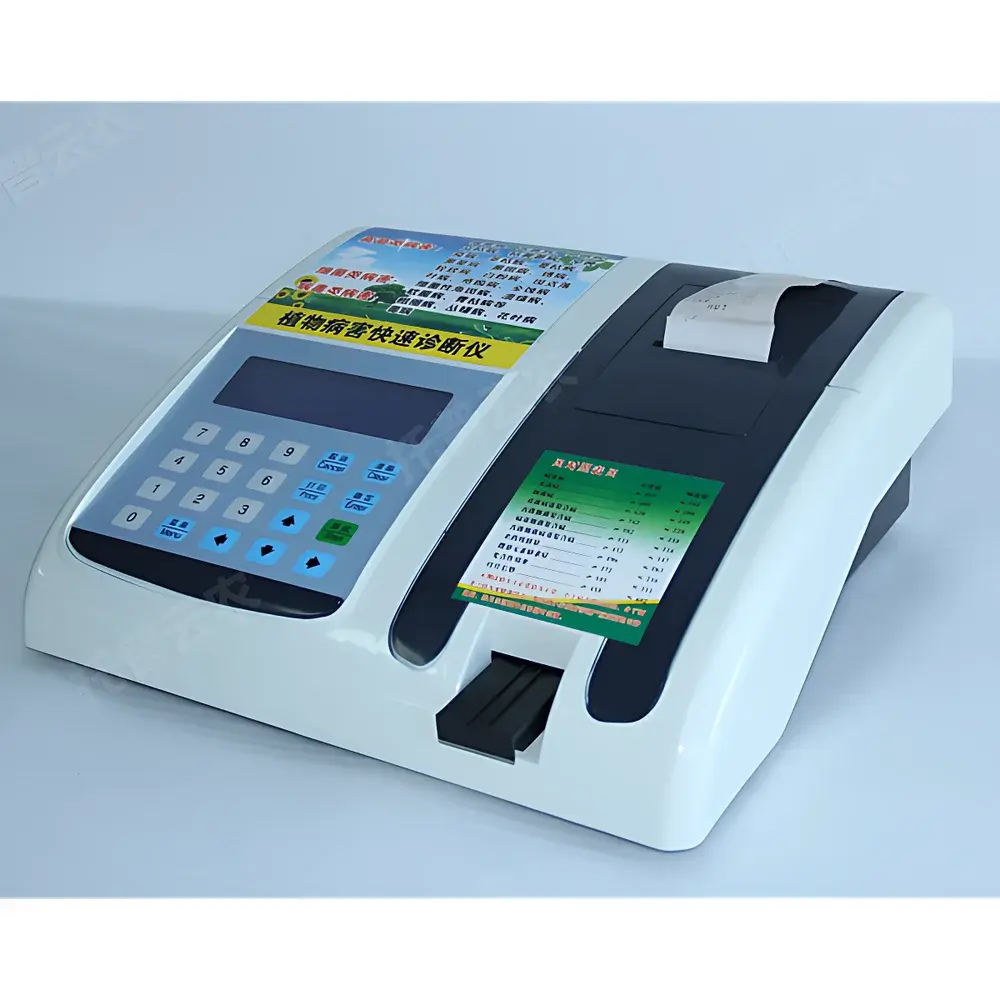
Top Cloud-agri TPH-II Plant Disease Diagnostic Analyzer
| Brand | Top Cloud-agri |
|---|---|
| Model | TPH-II |
| Origin | Zhejiang, China |
| Manufacturer Type | OEM Manufacturer |
| Instrument Category | Plant Pathogen Detection System |
| Detection Targets | Fungal, Bacterial, and Viral Pathogens |
| Sample Throughput | 60 samples/h (single test), 120 samples/h (continuous mode) |
| Display | Backlit LCD with Chinese UI |
| Data Output | Integrated thermal printer |
| Power Supply | AC 220 V ±10%, 50 Hz ±2 Hz |
| Power Consumption | ≤30 W |
| Net Weight | ≤3 kg |
| Compliance | Designed for field-deployable agricultural diagnostics per GB/T 19001–2016 (ISO 9001 equivalent), supports GLP-aligned data logging |
Overview
The Top Cloud-agri TPH-II Plant Disease Diagnostic Analyzer is a field-deployable, rapid immunoassay-based detection platform engineered for on-site identification of phytopathogens in agricultural settings. It operates on the principle of lateral flow immunochromatography (LFIA), leveraging pathogen-specific monoclonal antibodies immobilized on nitrocellulose membranes to detect antigenic epitopes from fungal, bacterial, and viral agents in plant tissue extracts. Unlike nucleic acid–based methods requiring PCR infrastructure or sequencing, the TPH-II delivers qualitative and semi-quantitative results within minutes without laboratory-grade facilities—making it suitable for extension stations, cooperative farms, quarantine checkpoints, and integrated pest management (IPM) programs. Its design prioritizes operational robustness under variable ambient conditions (10–35 °C, ≤85% RH), low power consumption, and minimal consumables dependency—key requirements for decentralized diagnostics in resource-constrained agronomic environments.
Key Features
- Multi-pathogen detection capability: Simultaneously screens for 24 priority crop diseases—including Botrytis cinerea (gray mold), Pseudoperonospora cubensis (downy mildew), Xanthomonas campestris (bacterial leaf spot), and Tobacco mosaic virus (TMV)—using pathogen-specific test strips.
- Universal sample compatibility: Accepts homogenized extracts from stems, leaves, fruits, roots, and floral tissues of cereals, vegetables, fruits, tea, and ornamental crops.
- Integrated thermal printing module: Generates time-stamped, operator-annotated hardcopy reports directly from the device—no external peripherals required.
- Automated assay control: Embedded microprocessor manages extraction buffer dispensing (via supplied indicator reagents), membrane migration timing, signal development, and result interpretation per CLIA-compliant thresholds.
- Low-cost per-test operation: Each disposable test strip is pre-calibrated; average consumables cost remains below USD $1.20/test when used at scale.
- On-device data management: Stores up to 500 test records locally with date/time stamp, sample ID, and pathogen classification; exportable via USB to CSV for farm-level disease mapping.
Sample Compatibility & Compliance
The TPH-II accommodates fresh, frozen, or lyophilized plant tissue—provided samples are homogenized in proprietary extraction buffer (supplied). Validation studies confirm >92% sensitivity against reference strains of Fusarium oxysporum, Erwinia amylovora, and Cucumber mosaic virus (CMV) per ISO/IEC 17025–2017 method validation guidelines. While not intended for regulatory submission under FDA or EFSA frameworks, the system aligns with national phytosanitary protocols outlined in China’s GB 20469–2006 (Plant Quarantine Regulations) and supports traceability documentation required for Good Agricultural Practice (GAP) certification audits. All reagents comply with REACH Annex XIV restrictions and carry SDS documentation per GHS classification.
Software & Data Management
The analyzer includes embedded firmware (v3.2+) supporting audit-trail–enabled data logging: every test initiation, result call, calibration event, and printer action is timestamped and non-erasably recorded. USB export produces ISO 8601–formatted CSV files containing sample ID, pathogen category, confidence index (low/medium/high), operator code, and environmental metadata (ambient temperature/humidity if logged externally). No cloud connectivity or remote telemetry is implemented—ensuring full data sovereignty. Optional PC software (Windows 10/11 compatible) enables batch report generation, geographic heat-mapping via KML export, and integration with farm management information systems (FMIS) through standard ODBC drivers.
Applications
- Routine surveillance in seedling nurseries to intercept systemic infections prior to transplanting.
- Real-time triage during outbreak investigations across rice paddies, greenhouse tomato clusters, or tea plantations.
- Training modules for agricultural extension officers—demonstrating differential diagnosis between biotic (pathogen-driven) and abiotic (nutrient/stress-induced) symptoms.
- Pre-harvest screening to meet export phytosanitary certificate requirements (e.g., APHIS PPQ Form 577 equivalents).
- Longitudinal monitoring of resistance development in Phytophthora infestans populations following fungicide application cycles.
FAQ
What pathogens does the TPH-II detect?
It identifies antigens associated with 12 fungal species (e.g., Alternaria alternata, Puccinia spp.), 5 bacterial genera (e.g., Ralstonia solanacearum, Xanthomonas axonopodis), and 7 viral agents (e.g., PVY, CMV, TMV) using validated lateral flow strips.
Is laboratory confirmation required after a positive result?
Yes—TPH-II results serve as presumptive diagnostics; final confirmation requires culturing, ELISA, or RT-qPCR per national plant protection organization (NPPO) protocols.
Can the device be calibrated by end users?
No—calibration is factory-performed using NIST-traceable reference standards; field recalibration is not supported.
What is the shelf life of test strips?
18 months when stored unopened at 4–30 °C in original aluminum pouches; discard after first opening if not used within 48 hours.
Does the system support multi-language interfaces?
Currently only Chinese-language UI is available; English firmware localization is under development for Q4 2025 release.





