
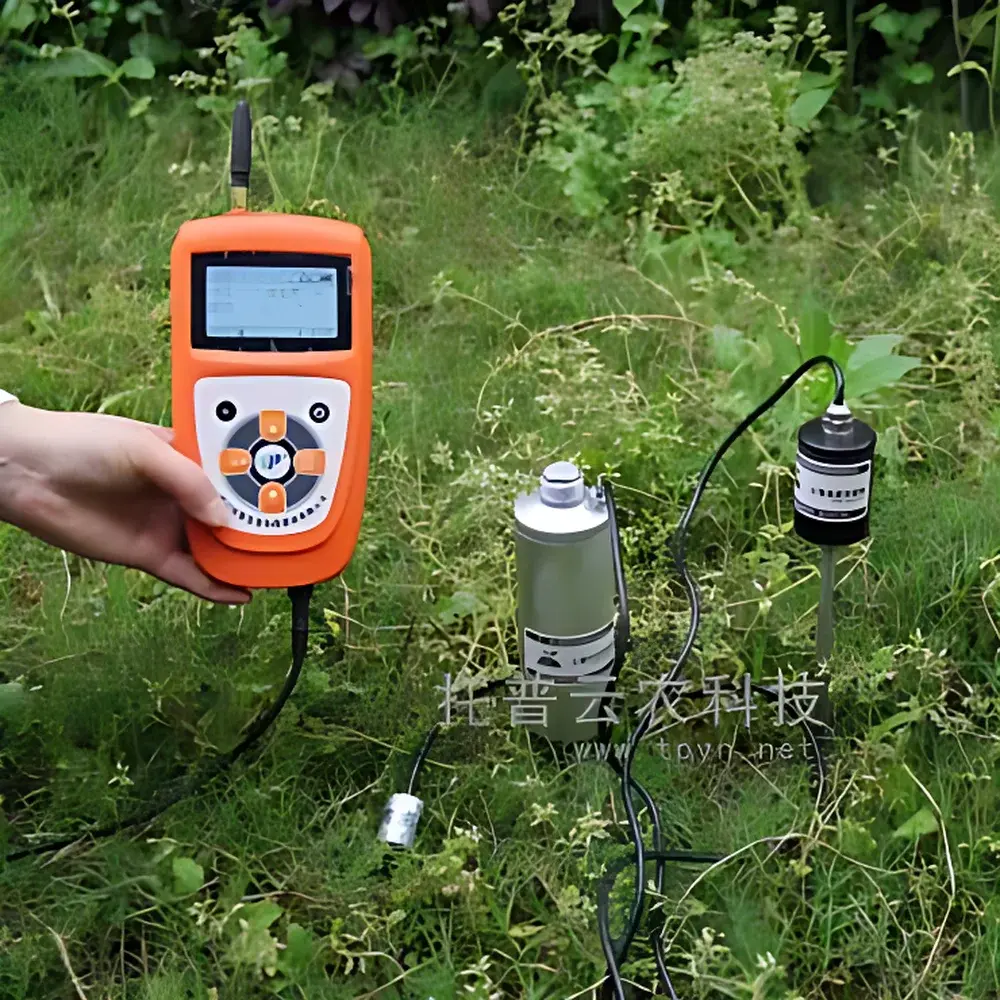
Top Cloud-agri TZS-ECW-G Portable Soil EC, Moisture & Temperature Analyzer
| Brand | Top Cloud-agri |
|---|---|
| Origin | Zhejiang, China |
| Manufacturer Type | Manufacturer |
| Product Category | Domestic |
| Model | TZS-ECW-G |
| Instrument Type | Multi-parameter Soil Analyzer |
| Power Supply | 7.4 V / 2.8 Ah Li-ion battery (with charging protection) |
| Internal Storage | 30,000 records in Flash memory |
| Expandable Storage | Standard 4 GB microSD card (user-replaceable) |
| Data Transmission | GPRS wireless upload with configurable interval or manual trigger |
| GPS | Integrated high-sensitivity module (accuracy ≤ 5 m CEP) |
| Sensor Interface | IP67-rated multi-channel hub supporting up to 32 sensors |
| Operating Temperature | –40 °C to +100 °C (sensor), –20 °C to +60 °C (host) |
| Soil Temperature Range | –40 °C to +100 °C |
| Temp Accuracy | ±0.5 °C |
| Temp Resolution | 0.1 °C |
| Soil EC Range | 0–20 mS/cm |
| EC Accuracy | ±2% FS |
| EC Resolution | 0.01 mS/cm |
| Soil Moisture Range | 0–100% vol (m³/m³) |
| Moisture Accuracy | ≤ ±3% relative error |
| Moisture Response Time | ≤ 2 s |
| Moisture Resolution | 0.1% vol |
| Cable Length (standard) | 1.5 m (extendable to 1000 m) |
Overview
The Top Cloud-agri TZS-ECW-G is a field-deployable, multi-parameter soil analyzer engineered for simultaneous measurement of electrical conductivity (EC), volumetric water content (VWC), and temperature in situ. It operates on the principle of frequency-domain reflectometry (FDR) for moisture quantification, platinum resistance thermometry (PT1000-class) for temperature, and four-electrode conductance sensing for EC—enabling direct, contact-based assessment of soil solution salinity without extraction. Designed for agronomic monitoring, precision irrigation management, and remediation site assessment, the instrument delivers traceable, reproducible data under variable field conditions. Its integrated architecture eliminates the need for lab-based extraction protocols, reducing time-to-insight while maintaining alignment with standard soil physical testing methodologies referenced in ISO 11277, ASTM D4959, and FAO guidelines for soil salinity classification.
Key Features
- Triple-parameter acquisition: Simultaneous real-time logging of EC (mS/cm), VWC (% vol), and temperature (°C) at a single probe location.
- GPRS-enabled telemetry: Configurable transmission intervals (5 min to 99 h); supports automatic upload to secure cloud platform via encrypted HTTP(S) endpoints.
- Embedded GPS geotagging: Each recorded dataset includes WGS84 coordinates with <5 m horizontal accuracy, enabling spatial interpolation and GIS integration.
- Modular sensor expansion: IP67-rated junction box accepts up to 32 heterogeneous sensors (e.g., pH, nitrate, redox) without cross-interference or recalibration.
- Dual storage architecture: 30,000 records retained in onboard Flash memory; expandable via hot-swappable microSD card (up to 4 GB standard, compatible with larger capacities).
- Low-power embedded design: Average standby current 14 days under typical 30-min sampling cycles.
- On-device user interface: Backlit monochrome LCD displays live values, timestamps, GPS status, memory usage, and alarm thresholds in Chinese language only.
- Voice alert system: Configurable Mandarin-language audio feedback for threshold breaches (e.g., EC > 4 mS/cm, VWC < 12% vol), supporting remote verification without screen access.
- Rechargeable lithium-ion power: 7.4 V / 2.8 Ah battery with overcharge/undervoltage protection; optional 8.4 V DC external supply for continuous operation.
Sample Compatibility & Compliance
The TZS-ECW-G is validated for use across mineral soils (sand to clay loam), organic substrates (peat, compost), and amended media (biochar-amended, saline-sodic profiles). Its solid-state EC sensor avoids polarization drift common in two-electrode systems, ensuring stable readings in high-salinity environments (>10 mS/cm). Moisture calibration accounts for bulk density and texture effects per manufacturer-provided lookup tables aligned with USDA soil taxonomy classes. The device complies with CE electromagnetic compatibility (EMC) Directive 2014/30/EU and RoHS 2011/65/EU. While not certified to IEC 61000-4 series for industrial immunity, its ruggedized enclosure (IP65-rated host, IP67 sensor cables) meets field durability expectations defined in MIL-STD-810G for shock, vibration, and humidity exposure. Data integrity adheres to ALCOA+ principles when used within documented SOPs—supporting GLP-aligned environmental monitoring workflows.
Software & Data Management
The proprietary Cloud-agri Instrument Management Platform employs a hybrid C/S architecture with redundant AWS-hosted databases (EU-West-1 and US-East-1 regions). Web and mobile applications (iOS/Android) provide role-based access control, audit trails, and versioned firmware updates. All uploaded datasets include metadata: timestamp (UTC), GPS coordinates (latitude/longitude/elevation), sensor ID, battery voltage, and signal quality indicators. Platform analytics support temporal trend visualization (line charts), spatial heatmaps (Kriging interpolation), and statistical summaries (mean, SD, CV%). Export formats include CSV, Excel (.xlsx), PDF reports, and NetCDF for interoperability with R, Python (pandas/xarray), and ArcGIS. Data retention is indefinite unless manually purged; automated backups occur every 6 hours. The platform implements TLS 1.2+ encryption, OAuth 2.0 authentication, and session timeout controls—meeting baseline cybersecurity requirements for environmental data repositories.
Applications
- Precision irrigation scheduling: Correlating EC-VWC-temperature gradients to determine optimal irrigation timing and volume, minimizing leaching and runoff.
- Salinity stress monitoring: Tracking seasonal EC dynamics in coastal or arid-zone agriculture to identify threshold exceedances affecting crop germination and root function.
- Phytoremediation progress tracking: Quantifying reductions in soluble salt load during halophyte-assisted soil reclamation projects.
- Fertigation management: Detecting nutrient accumulation (via EC spikes) and identifying zones requiring dilution or drainage intervention.
- Soil health benchmarking: Establishing longitudinal baselines for EC and moisture variability across management zones (no-till vs. conventional till, cover crop inclusion).
- Regulatory compliance reporting: Generating auditable records for EU Nitrates Directive, US EPA NPDES permits, or national soil quality monitoring programs.
FAQ
What is the recommended calibration frequency for field deployments?
Calibration is performed at the factory using NIST-traceable standards. Field recalibration is not required under normal operation; however, users should verify sensor response annually against known reference solutions (e.g., 5.00 mS/cm KCl standard) and document deviations exceeding ±3% of reading.
Can the device operate continuously for extended periods without maintenance?
Yes—when powered by external 8.4 V DC supply and configured for hourly sampling, the system supports unattended operation for >12 months. Battery-powered deployments require recharging every 10–14 days depending on GPRS activity and sampling interval.
Is raw sensor data accessible via API for integration with third-party platforms?
The platform provides RESTful JSON APIs (documentation available upon enterprise license agreement) supporting GET/POST requests for historical data retrieval, device configuration, and alert subscription.
How does the instrument handle frozen or waterlogged soil conditions?
The temperature sensor remains functional down to –40 °C, but FDR-based moisture measurement becomes unreliable below 0 °C due to dielectric property shifts in ice. In saturated soils, EC readings remain valid; however, VWC interpretation requires correction for air-filled porosity using concurrent bulk density measurements.
Are sensor cables customizable for deep-profile installation?
Standard cable length is 1.5 m; custom lengths up to 1000 m are available with reinforced polyurethane jacketing and optional stainless-steel armored conduit for trench burial applications.







