
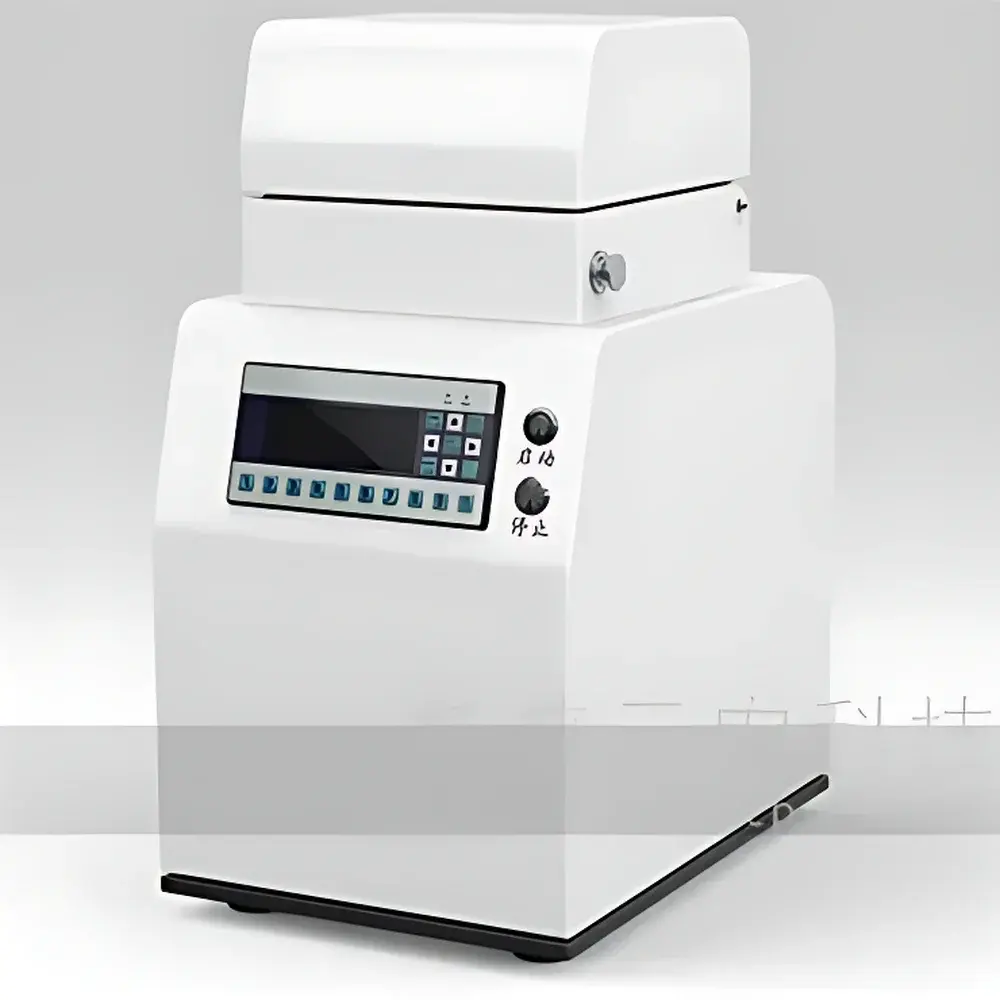
Top Cloud-agri YMY-240R Benchtop High-Efficiency Seed Grinding Mill
| Brand | Top Cloud-agri |
|---|---|
| Origin | Zhejiang, China |
| Manufacturer Type | Direct Producer |
| Origin Category | Domestic (China) |
| Model | YMY-240R |
| Instrument Type | Benchtop |
| Max Sample Capacity | 24 samples |
| Final Particle Size | ~5 µm |
| Homogenization Frequency Range | 0–70 Hz |
| Processing Time Range | 0–9999 min |
| Speed Range | 1000–7000 rpm |
| Grinding Ball Diameter | 0.1–30 mm |
| Grinding Ball Materials | Alloy Steel, Chrome Steel, Zirconia, Tungsten Carbide, Quartz Sand |
| Noise Level | <55 dB |
| Grinding Modes | Dry, Wet, Cryogenic |
| Chamber Material | Seamless Stainless Steel with Rounded Corners & Sloped Base |
| Acceleration Time to Target Speed | ≤2 s |
| Number of Grinding Platforms | ≥2 |
| Adapter Compatibility | Customizable for Various Tube Sizes (e.g., 2 mL, 5 mL, 15 mL, 50 mL) |
Overview
The Top Cloud-agri YMY-240R is a benchtop high-frequency vibratory grinding mill engineered specifically for rapid, reproducible, and contamination-free homogenization of plant seeds and other botanical matrices in agricultural research, seed quality control, and molecular biology laboratories. It operates on the principle of high-energy impact and shear forces generated by oscillating grinding balls within sealed sample tubes—commonly referred to as bead-beating or vibratory milling. Unlike rotor-stator or blade-based systems, this instrument delivers uniform mechanical energy distribution across all samples simultaneously, minimizing thermal degradation and preserving nucleic acid integrity during cryogenic grinding. Its design prioritizes compliance with routine laboratory workflows requiring GLP-aligned documentation, traceable parameter logging, and consistent inter-batch reproducibility—critical for seed viability testing, germination assays, metabolite extraction, and genomic DNA isolation.
Key Features
- Simultaneous processing of up to 24 samples in standardized or custom-configured adapters—ensuring zero cross-contamination through independent tube containment and non-contact vibration transmission.
- Vertically oriented reciprocating motion platform delivering precise amplitude control and rapid acceleration (<2 s to reach target frequency), enabling optimized disruption kinetics for hard-shelled seeds including maize, wheat, rice, soybean, and oilseed rape.
- Monolithic stainless-steel grinding chamber with radiused internal corners and sloped base—precision-molded to prevent material retention, facilitate complete sample recovery, and withstand repeated sterilization cycles (autoclave-compatible at 121°C).
- Integrated acoustic damping enclosure reducing operational noise to <55 dB(A), meeting ISO 7779 and ANSI S12.55 standards for laboratory ambient noise limits.
- Intuitive LCD interface with programmable parameters (frequency, duration, pause intervals); optional upgrade path to capacitive touch display supporting multi-user profiles and audit-ready operation logs.
- Auto-centering clamping mechanism ensures consistent pressure application across variable tube geometries—eliminating manual torque variability and improving inter-run repeatability (CV <3% for replicate seed grinding).
Sample Compatibility & Compliance
The YMY-240R accommodates diverse biological matrices beyond seeds—including roots, leaves, tubers, pollen, and fungal mycelia—via interchangeable adapters (2 mL, 5 mL, 15 mL, 50 mL formats). Cryogenic grinding is supported using liquid nitrogen-cooled adapters (−196°C), preserving thermolabile compounds such as phytohormones and volatile organic metabolites. All wet, dry, and low-temperature protocols align with ASTM D7429-22 (Standard Practice for Mechanical Disruption of Plant Tissue), ISO 21569:2019 (Molecular Biomarker Analysis), and FAO/WHO Codex Alimentarius guidelines for seed purity and varietal identification. The instrument’s mechanical architecture meets IEC 61000-6-2 (EMC immunity) and IEC 61000-6-4 (EMC emission) requirements, and its stainless-steel construction complies with FDA 21 CFR Part 11–compatible data integrity frameworks when paired with validated software modules.
Software & Data Management
While the base unit features embedded firmware with local parameter storage (up to 99 user-defined methods), optional PC-connected software enables full traceability: timestamped method execution logs, real-time frequency monitoring, deviation alerts, and CSV-exportable process records. Audit trail functionality supports 21 CFR Part 11 compliance through electronic signatures, role-based access control, and immutable record archiving—essential for accredited seed testing labs operating under ISO/IEC 17025 or national phytosanitary certification schemes. Firmware updates are delivered via secure USB protocol with SHA-256 checksum verification.
Applications
- Routine seed lot homogenization prior to moisture content analysis (ISO 6647), protein electrophoresis, or near-infrared (NIR) calibration modeling.
- High-yield genomic DNA extraction from recalcitrant species (e.g., oak, chestnut) where conventional bead mills fail due to endosperm hardness.
- Preparation of homogeneous reference materials for certified seed testing programs (ISTA, AOSA, FGIS).
- Metabolomic profiling workflows requiring sub-5 µm particle size distribution to ensure solvent penetration uniformity during Soxhlet or accelerated solvent extraction (ASE).
- Development of rapid field-deployable QC protocols for breeding stations conducting early-generation selection based on biochemical marker expression.
FAQ
What types of grinding media are compatible with the YMY-240R?
Alloy steel, chrome steel, zirconia, tungsten carbide, and quartz sand beads ranging from 0.1 mm to 30 mm in diameter—selected based on sample hardness, desired particle size, and downstream compatibility (e.g., zirconia for RNA work to minimize RNase contamination).
Can the instrument be integrated into automated lab workflows?
Yes—RS-232 and optional Ethernet interfaces support integration with LIMS platforms and robotic sample handlers via Modbus TCP or ASCII command protocols.
Is validation documentation available for regulatory submissions?
Factory-installed IQ/OQ documentation packages—including performance qualification reports against ISO 8573-1 (compressed air purity), vibration amplitude calibration certificates, and noise emission test reports—are provided upon request.
How is temperature rise controlled during extended grinding cycles?
The system incorporates passive thermal dissipation via aluminum heat sinks and active cooling channels in the base plate; for >5 min runs, cryo-adapters or intermittent pulsing modes are recommended to maintain sample integrity below 10°C.
What maintenance intervals are recommended for long-term reliability?
Lubrication-free linear bearings require no scheduled maintenance; annual verification of clamp force consistency and frequency calibration using NIST-traceable laser vibrometry is advised per ISO/IEC 17025 Clause 6.4.6.






