
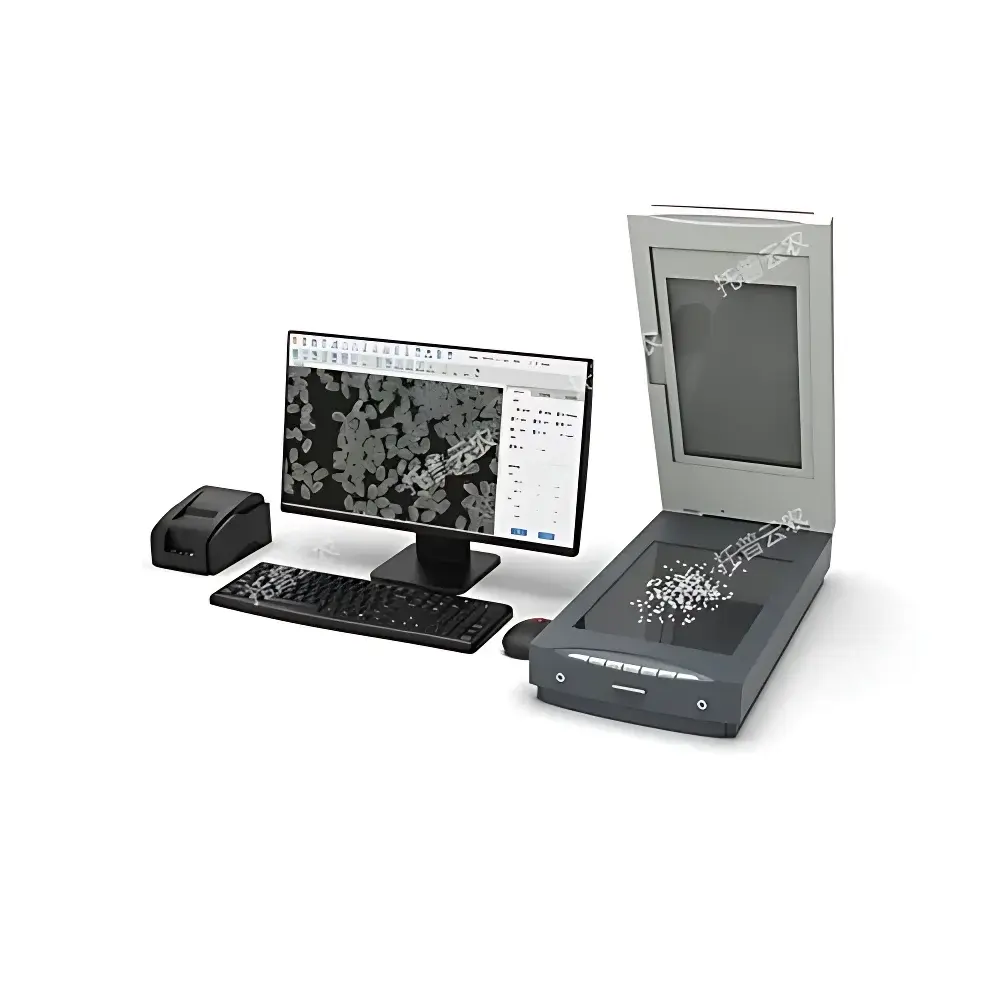
TopCloud-agri TPMZ-A Rice Quality Analyzer
| Brand | TopCloud-agri |
|---|---|
| Origin | Zhejiang, China |
| Manufacturer Type | Manufacturer |
| Country of Origin | Domestic (China) |
| Model | TPMZ-A |
| Pricing | Upon Request |
Overview
The TopCloud-agri TPMZ-A Rice Quality Analyzer is a high-precision digital image-based analytical instrument engineered for objective, standardized assessment of rice appearance quality. It operates on the principle of high-resolution optical scanning combined with computer vision algorithms to extract morphological, chromatic, and structural features from individual rice grains. Unlike subjective visual grading, this system delivers quantitative, traceable, and repeatable measurements aligned with national and industry-standard methodologies—including GB/T 1350 (Paddy), GB/T 17891 (High-Quality Paddy), GB 1354 (Milled Rice), and NY/T 2334–2013 (Rice Quality Evaluation). Designed for laboratories requiring regulatory compliance and research-grade reproducibility, the TPMZ-A supports both routine quality control in milling and trading operations and advanced phenotypic screening in breeding programs.
Key Features
- Automated single-grain analysis: Measures length, width, length-to-width ratio, perimeter, area, roundness, chalkiness area, translucency, and color indices (whiteness, yellowness) per grain.
- Intelligent segmentation engine: Robustly separates adhered or overlapping grains using adaptive edge detection and watershed algorithms—critical for accurate counting and parameter assignment.
- Configurable grain classification: Enables real-time reclassification of detected grains into user-defined categories (e.g., “head rice”, “broken rice”, “cracked grain”, “yellow kernel”, “germ-retained brown rice”, “glutinous black rice”) via point-and-assign interface.
- Region-of-interest (ROI) analysis: Supports manual polygonal or rectangular ROI selection to isolate sub-samples—ideal for heterogeneous batches or targeted evaluation of specific grain populations.
- Interactive annotation & filtering: Allows text labeling directly on scanned images and color-coded parameter overlays (e.g., red for broken grains, blue for chalky kernels) for rapid visual triage and data validation.
- Manual correction workflow: Permits deletion of misclassified grains or foreign particles; all metrics recalculate dynamically to maintain statistical integrity.
- Comprehensive reporting suite: Generates distribution histograms, comparative scatter plots, and tabular summaries exportable to Excel (.xlsx) with full metadata (timestamp, operator ID, sample ID, instrument log).
Sample Compatibility & Compliance
The TPMZ-A accommodates raw paddy, milled white rice, brown rice, glutinous rice (indica/japonica), pigmented varieties (black rice, yellow rice), germ-rich rice, and parboiled rice. Its measurement protocols are validated against Chinese national standards for rice quality inspection and support GLP-aligned documentation practices. The system’s measurement uncertainty—≤ ±0.05 mm for dimensional parameters, ≤ ±1.0% for head rice yield and chalkiness degree, and ≤ ±0.5% for yellow kernel repeatability—is established under controlled environmental conditions (10–35 °C, 20–85% RH) and conforms to ISO/IEC 17025 principles for testing laboratory competence. While not certified to FDA 21 CFR Part 11 out-of-the-box, audit trails, user access logs, and encrypted software licensing (hardware dongle + dynamic QR code) provide foundational elements for regulated environments.
Software & Data Management
The proprietary analysis software runs on Windows OS (64-bit, Windows 10/11 recommended) and integrates local storage with optional cloud synchronization via secure HTTPS endpoints. All analysis sessions are timestamped and linked to operator credentials. Data encryption at rest uses AES-256; transmission employs TLS 1.2+. Software licensing combines physical USB dongle authentication with time-limited dynamic QR verification—preventing unauthorized duplication or offline use beyond licensed terms. Cloud functionality enables remote access to historical datasets, cross-laboratory comparison dashboards, and version-controlled method templates. Raw image archives (TIFF, 4800 × 9600 dpi) and processed result files are stored separately to ensure raw-data integrity and audit readiness.
Applications
- Grain quality assurance in rice processing facilities and commodity trading houses.
- Phenotypic trait mapping in rice genetics labs—particularly for chalkiness, grain shape, and kernel translucency QTL studies.
- Regulatory inspection by provincial grain quality supervision centers and national food safety laboratories.
- Breeding program support: High-throughput screening of segregating populations for appearance-related traits.
- Research in post-harvest physiology, including crack formation kinetics and moisture-dependent whiteness degradation.
- Evaluation of milling efficiency and optimization of debranning parameters through head rice yield correlation modeling.
FAQ
What types of rice can the TPMZ-A analyze?
It supports indica, japonica, glutinous, black, yellow, brown, germinated, and parboiled rice—both paddy and milled forms.
Does the system require calibration with reference standards?
No routine calibration is required; however, daily verification using a certified dimension standard (e.g., NIST-traceable graticule) is recommended for metrological confidence.
Can the software run on virtual machines or network terminals?
Local installation on a dedicated Windows workstation is mandatory; virtualized or terminal-server deployment is unsupported due to hardware dongle dependency and real-time image processing demands.
Is raw image data retained after analysis?
Yes—scanned TIFF files and processed JSON/XML result packages are preserved independently, enabling reprocessing with updated algorithms or retrospective audits.
What is the maximum throughput per scan session?
A single scan processes up to ~3,000 grains (≈12 g typical), with total analysis time averaging 2–4 minutes depending on grain count and selected parameters.
Related Products




