
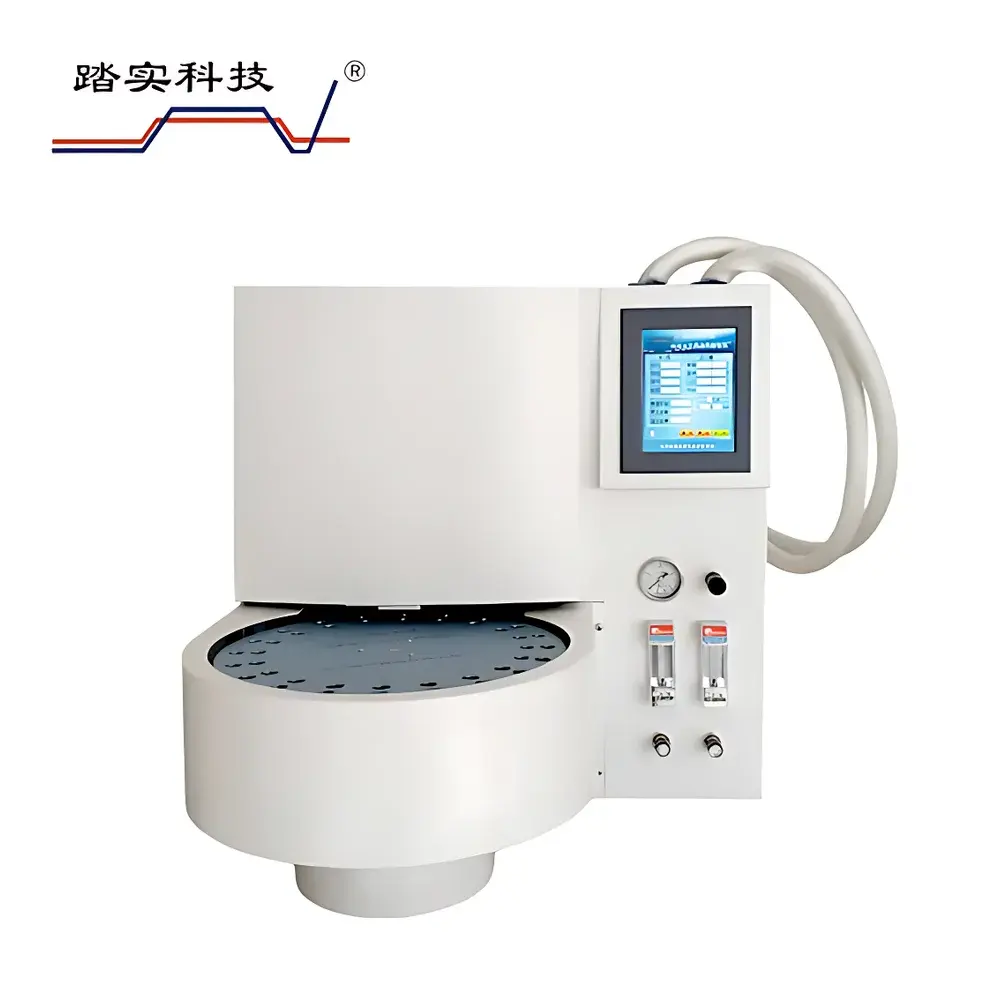
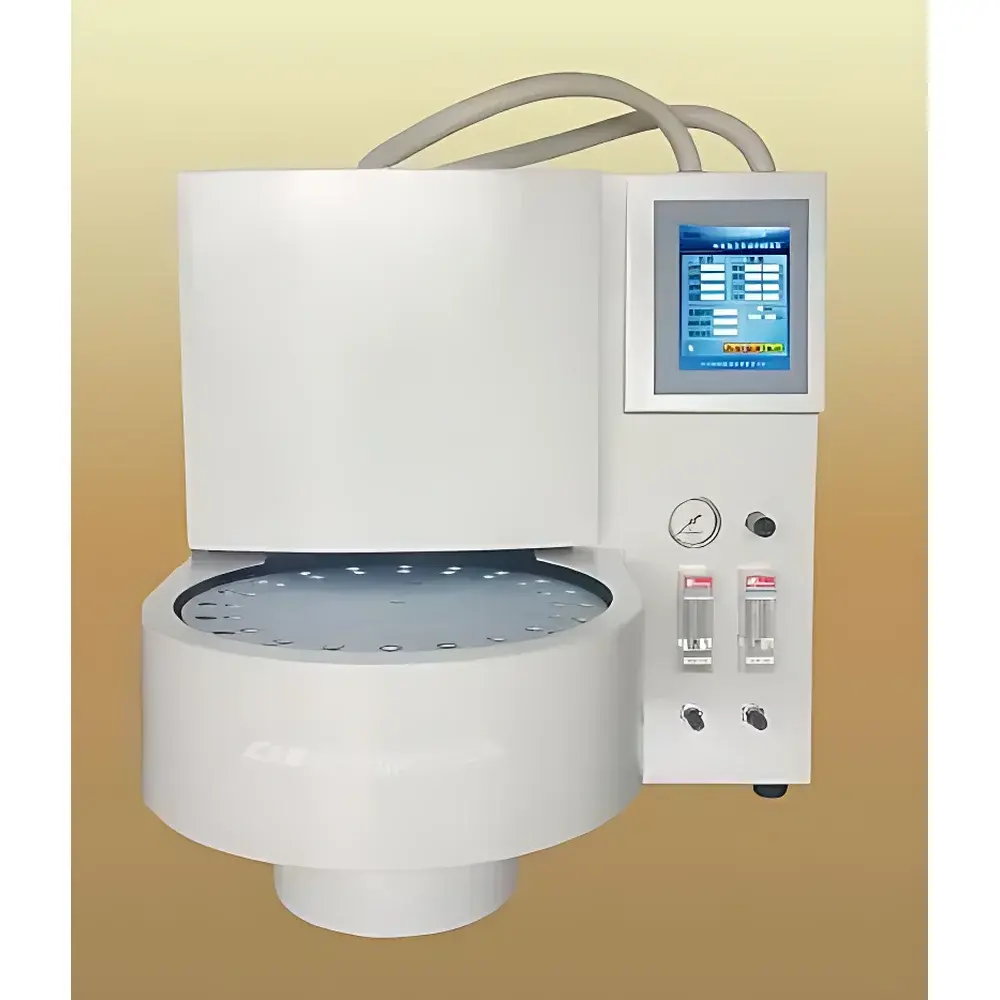
TouchScience AutoTDS-VI Dual-Channel Fully Automated Thermal Desorber
| Brand | TouchScience |
|---|---|
| Origin | Beijing, China |
| Manufacturer Type | Direct Manufacturer |
| Product Category | Domestic |
| Model | AutoTDS-VI |
| Instrument Type | Secondary Thermal Desorber / Thermal Desorber |
| Automation Level | Fully Automated |
| Primary Desorption Temperature Range | 50–400 °C |
| Valve Injection Temperature Range | Ambient to 200 °C |
| Transfer Line Temperature Range | 50–250 °C |
| Cold Trap Temperature Range | Down to –30 °C |
| Temperature Control Accuracy | ±1 °C |
| Desorption Recovery Rate | >85% |
| Sample Capacity | 40 adsorption tubes (2 × 20 positions) |
| Power Supply | 220 VAC, 50 Hz |
| Max. Power Consumption | <800 VA |
| Cold Trap Cooling Timing Error | <0.1% |
| Gas Path Pressure Rating | >40.4 MPa |
| Synchronization Outputs | Two TTL-compatible switch signals (1–2 s duration) |
| Dimensions (H×W×D) | 500 mm × 510 mm × 670 mm |
Overview
The TouchScience AutoTDS-VI is a dual-channel, fully automated secondary thermal desorber engineered for high-throughput, reproducible pre-concentration of volatile and semi-volatile organic compounds (VOCs and SVOCs) from sorbent-packed tubes prior to gas chromatographic analysis. It operates on the principle of sequential thermal desorption: primary desorption releases analytes from the sampling tube into a heated transfer line; analytes are then cryogenically focused in a thermoelectrically cooled cold trap (down to –30 °C); followed by rapid secondary desorption directly into the GC inlet. This two-stage process significantly enhances sensitivity, resolution, and quantitative accuracy—particularly for trace-level environmental, occupational hygiene, and indoor air quality applications where low detection limits and minimal carryover are critical.
Key Features
- Dual independent 20-position sample trays (total 40-tube capacity), enabling unattended batch processing of paired samples or method validation replicates.
- Electrically actuated multi-port switching valves combined with solenoid valves ensure precise, leak-tight gas path routing for primary desorption, cold trap focusing, secondary desorption, injection, and post-injection purge—all programmable via embedded software.
- Independent, PID-controlled heating zones: primary desorption oven (50–400 °C), valve manifold (ambient to 200 °C), transfer line (50–250 °C), and cold trap (–30 to +30 °C), eliminating cold spots and minimizing analyte condensation or degradation.
- Integrated cold trap cooling via Peltier elements—no liquid nitrogen or external chillers required—ensuring stable low-temperature focusing and rapid thermal ramping during re-desorption.
- Automated tube integrity check prior to each run: pressure decay test confirms proper seating and seal integrity of each sorbent tube before thermal cycling begins.
- Resistive direct-heating of the cold trap ensures fast, uniform temperature transitions and improved peak shape fidelity during GC injection.
- Front-panel 7-inch capacitive touchscreen with real-time graphical display of all zone temperatures, valve status, timing sequences, and active method parameters.
- Two synchronized TTL output triggers (1–2 s duration) initiate GC oven ramping and data acquisition simultaneously with secondary desorption—ensuring precise temporal alignment per ASTM D6196 and ISO 16017-1 protocols.
Sample Compatibility & Compliance
The AutoTDS-VI supports standard 6 mm OD × 89 mm length stainless steel or quartz sorbent tubes packed with common media including Tenax TA, Carbopack B/C, Carboxen, and mixed-bed configurations. Its robust gas path design (rated >40.4 MPa) accommodates high-flow purge-and-trap workflows and inert carrier gases (He, N₂, H₂). The instrument meets fundamental requirements for GLP-compliant laboratories: full audit trail logging (method parameters, timestamps, operator ID, temperature deviations), electronic signatures (via optional software upgrade), and hardware-level synchronization essential for FDA 21 CFR Part 11–aligned chromatographic data systems. It is routinely deployed in accordance with EPA TO-17, ISO 16017-1/2, and EN 14662 for ambient air, workplace air, and building material emission testing.
Software & Data Management
Control and method development are performed via TouchScience’s Windows-based TDS Control Suite, which supports drag-and-drop sequence building, multi-step temperature ramping profiles, and conditional logic (e.g., skip failed tubes, pause on error). All run logs—including actual vs. setpoint temperatures, valve actuation times, cold trap cooling curves, and sync signal timestamps—are saved in CSV and XML formats. Raw metadata is compatible with third-party LIMS and CDS platforms (e.g., Thermo Chromeleon, Agilent OpenLab, Waters Empower) through ODBC and vendor-neutral API hooks. Firmware updates are delivered via USB or Ethernet, with version rollback capability and checksum-verified installation.
Applications
- Regulatory monitoring of VOCs in ambient air (EPA Method TO-17), including benzene, toluene, ethylbenzene, xylenes (BTEX), and C2–C12 aliphatics.
- Workplace exposure assessment per OSHA and NIOSH methods (e.g., NIOSH 1501, 1600).
- Indoor air quality screening in residential, commercial, and healthcare facilities—especially for formaldehyde, terpenes, and plasticizer emissions.
- Material emission testing (e.g., carpets, adhesives, insulation) under ASTM D5116 and ISO 16000-9.
- Method development and validation for forensic toxicology and flavor/aroma profiling where trace-level reproducibility is paramount.
FAQ
Does the AutoTDS-VI support single-tube operation or only dual-channel mode?
It supports both modes: users may configure the system to process one channel independently while holding the second idle, or run parallel dual-channel sequences with identical or different methods.
Is the cold trap temperature calibration traceable to NIST standards?
Yes—the integrated Pt100 sensors in the cold trap and all heating zones are factory-calibrated against NIST-traceable references; calibration certificates and adjustment procedures are provided with each unit.
Can the instrument be integrated into an existing laboratory network for remote monitoring?
Yes—Ethernet connectivity enables remote desktop access, real-time status polling via Modbus TCP, and alarm notifications via SMTP email or SNMP traps.
What maintenance intervals are recommended for long-term reliability?
Valve manifolds require cleaning every 500 runs; cold trap surfaces should be inspected quarterly; and sorbent tube o-rings are recommended for replacement after 2,000 cycles or annually—whichever occurs first.
Is method transfer possible between AutoTDS-VI and other thermal desorbers?
Method parameters (temperatures, timings, flow rates) are exportable as standardized .tds files and can be adapted to most major CDS platforms; however, exact retention time alignment requires empirical GC column re-optimization due to inherent system dwell volume differences.





