
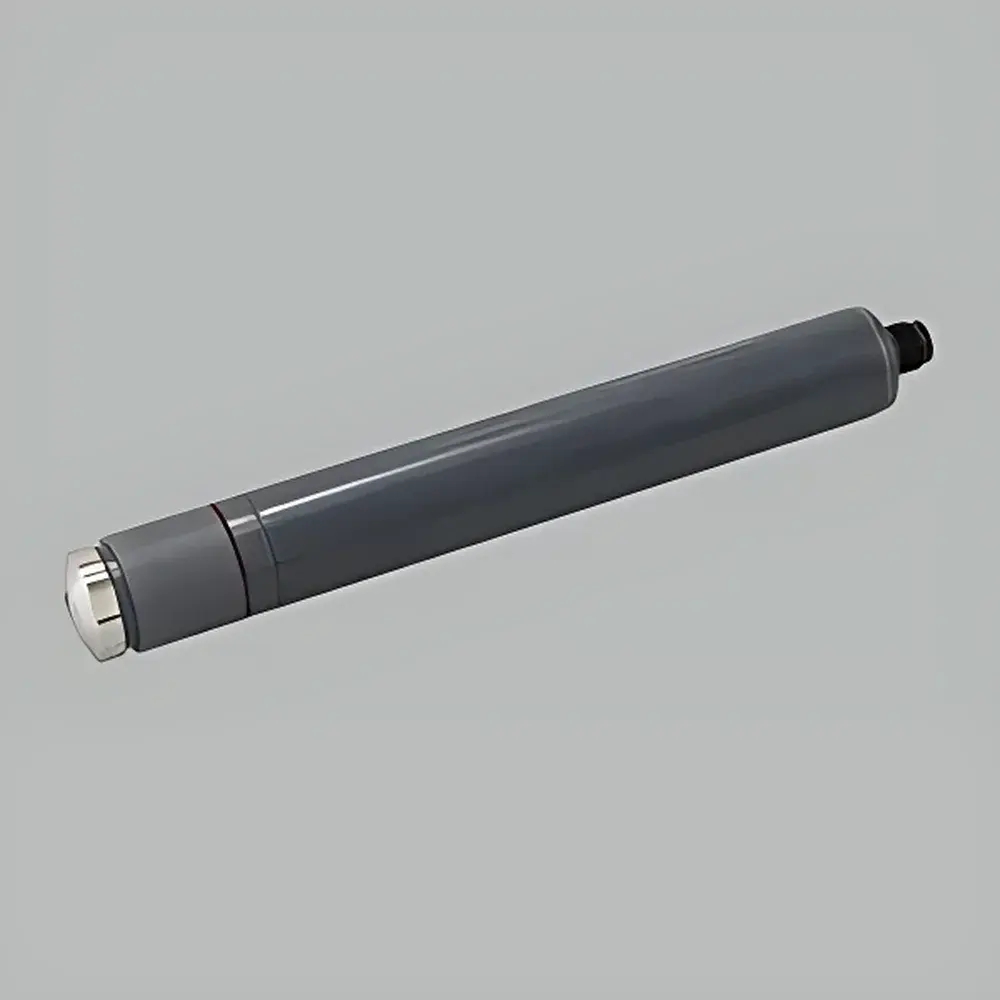
TriOS eCHEM Total Chlorine Sensor
| Brand | TriOS |
|---|---|
| Origin | Germany |
| Model | eCHEM Total Chlorine |
| Instrument Type | Online Analyzer |
| Measurement Principle | Electrochemical Amperometric (3-Electrode, Constant-Potential) |
| Measured Parameter | Total Chlorine (Free + Combined Chlorine) |
| Range Options | 0–2 mg/L and 0–20 mg/L |
| Accuracy | >97% (as validated against DPD-4 reference method) |
| Repeatability | ±0.1 mg/L |
| Resolution | 0.001 mg/L (0–2 mg/L range), 0.01 mg/L (0–20 mg/L range) |
| LOD | 0.001 mg/L |
| pH Range | 4–12 |
| Conductivity Range | 10 µS/cm – 200 mS/cm |
| Response Time (T90) | ~3 min (freshwater), ~5 min (seawater/brine) |
| Operating Temperature | 0–46 °C (sample), 0–55 °C (ambient) |
| Pressure Rating | 0.5 bar (unclamped), 3 bar (with clamp) |
| Output Interface | RS-485, Modbus RTU |
| Power Supply | 9–30 VDC |
| Housing Materials | PEEK, PVC-U, 1.4571 stainless steel, hydrophilic microporous membrane |
| Weight | 1.1 kg |
| Dimensions (L × Ø) | 205 mm × 25 mm |
Overview
The TriOS eCHEM Total Chlorine Sensor is a high-stability, online electrochemical amperometric sensor engineered for continuous, real-time quantification of total chlorine—defined as the sum of free chlorine (HOCl/OCl⁻) and combined chlorine (chloramines)—in aqueous environments. It operates on a three-electrode constant-potential amperometric principle, where chlorine species undergo catalytic reduction at a working electrode under controlled bias voltage, generating a current proportional to concentration. Unlike colorimetric DPD-based methods, the eCHEM sensor exhibits inherently low pH dependency across pH 4–12, eliminating the need for pH correction or buffer addition during routine operation. This robustness stems from its selective membrane chemistry and optimized electrode kinetics, making it especially suitable for dynamic water matrices where pH fluctuation is unavoidable—such as chlorinated seawater, saline cooling loops, or variable-source drinking water distribution systems.
Key Features
- Low-pH-dependency design ensures stable signal output across pH 4–12 without calibration drift or compensatory reagents
- Proven resistance to moderate concentrations of non-ionic surfactants commonly present in recreational water and industrial process streams
- Integrated Pt1000 temperature sensor enables automatic, real-time temperature compensation—critical for maintaining accuracy across seasonal or diurnal thermal shifts
- Modular consumables architecture: replaceable membrane cap and electrolyte solution with annual maintenance intervals under typical operating conditions
- High chemical resilience: validated for continuous operation in up to 15% NaCl (seawater-strength brine) and conductivity up to 200 mS/cm
- Compact, pressure-rated housing (3 bar with clamp) supports direct insertion into FlowCell assemblies or pressurized pipe spools without bypass plumbing
- RS-485 digital interface with Modbus RTU protocol ensures seamless integration into SCADA, PLC, and centralized water management platforms
Sample Compatibility & Compliance
The eCHEM sensor is compatible with potable water, swimming pool water, cooling tower water, seawater, and chlorinated wastewater effluents. It responds stoichiometrically to Cl₂, NaOCl, Ca(OCl)₂, and electrolytically generated chlorine—enabling consistent measurement regardless of chlorine dosing method. Cross-sensitivity is limited and quantified: ClO₂ yields a 1:1 equivalent response; O₃ yields a 1.3× over-response, necessitating removal or quenching if ozone coexists. The sensor does not respond to organic chloramines beyond their hydrolyzable chlorine content, nor to chlorinated organics (e.g., chloroform). It is not intended for use in solutions containing heavy metal chelators, strong reducing agents, or unquenched aldehydes (e.g., formaldehyde), which may poison the electrode surface. While not certified to ISO 9001 or ISO/IEC 17025 out-of-the-box, its performance aligns with ASTM D1253 (Standard Test Method for Total Chlorine in Water) and EPA Method 334.0 (Amperometric Titration) when paired with appropriate validation protocols. Data integrity meets GLP-aligned traceability requirements when used with TriOS TriBox3 controllers supporting audit-trail logging.
Software & Data Management
The eCHEM sensor interfaces natively with TriOS’s TriBox3 and TriBox Mini controller platforms, which provide embedded firmware for zero-point stability monitoring, slope verification via automated DPD-4 correlation routines, and configurable alarm thresholds (e.g., low-chlorine alerts, sensor timeout warnings). Raw current output is digitized at 16-bit resolution and converted to mg/L using factory-determined sensitivity coefficients stored in EEPROM. All calibration events—including date, operator ID (if entered), and post-calibration deviation—are time-stamped and exportable via USB or Ethernet. When deployed in regulated environments, TriBox3 firmware supports 21 CFR Part 11-compliant user access control and electronic signature workflows when integrated with TriOS’s AquaView software suite (v4.2+). Data export formats include CSV, XML, and OPC UA—facilitating ingestion into LIMS, CMMS, or cloud-based water intelligence dashboards.
Applications
- Real-time residual disinfectant monitoring in municipal drinking water distribution networks and booster stations
- Automated dosing control and safety interlock in public and commercial swimming pools per EN 15288-1
- Chlorine demand profiling in seawater-cooled power plant condensers and desalination pre-treatment stages
- Process validation in pharmaceutical water-for-injection (WFI) loop sanitization cycles (USP )
- Regulatory compliance reporting for EPA Stage 2 Disinfectants and Disinfection Byproducts Rule (DBPR) monitoring points
- Research-grade kinetic studies of chlorine decay and chloramine formation in pilot-scale treatment trains
FAQ
Does the eCHEM sensor require zero-point calibration?
No. The sensor is designed for zero-point stability and does not require periodic zero adjustment. Drift is monitored via slope verification against DPD-4 reference measurements.
How often must the membrane cap and electrolyte be replaced?
Under continuous operation in typical municipal water (20–25 °C, <5 NTU), membrane caps and electrolyte are rated for 12 months. In high-fouling or high-salinity applications (e.g., seawater), replacement every 6–9 months is recommended.
Can the sensor operate in fully dechlorinated water for extended periods?
Yes—but prolonged exposure (<24 h) to chlorine-free water may cause reversible baseline shift due to electrolyte dilution. For storage, remove electrolyte and keep sensor dry at 5–40 °C.
Is temperature compensation automatic?
Yes. An integrated Pt1000 sensor provides continuous temperature feedback, and firmware applies Nernstian and diffusion-coefficient corrections in real time.
What flow rate is required for accurate measurement in a FlowCell?
Optimal laminar flow is 15–30 L/h. Lower flow rates increase response lag; higher rates risk mechanical stress on the membrane without improving accuracy.







