
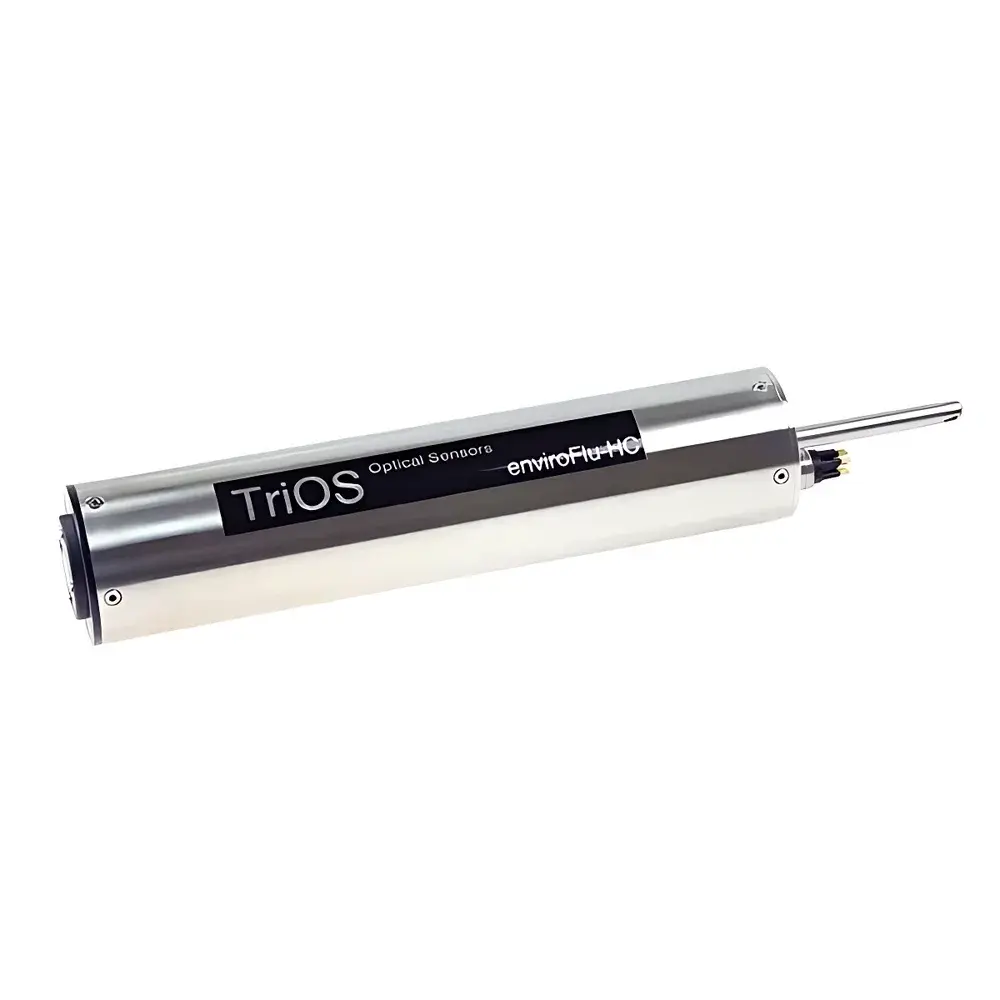
TriOS enviroFlu-BT Benzene and Monocyclic Aromatic Hydrocarbons (MAH) Online Fluorometer
| Brand | TriOS |
|---|---|
| Origin | Germany |
| Model | enviroFlu-BT |
| Instrument Type | Online |
| Measurement Principle | UV-Induced Fluorescence |
| Measurement Range | 0–1000 ppb and 0–10,000 ppb (switchable) |
| Detection Limit | 20 ppb |
| Accuracy | ±3% of reading |
| Resolution | 0.3 ppb |
| Measurement Frequency | Up to 1 Hz (1 measurement per second) |
| Response Time (T₁₀₀) | ≤10 s |
| Measurement Interval | ≤5 s |
| Excitation Wavelength | 254 nm (Xenon lamp + optical filter) |
| Emission Wavelength | 289 nm (Photodiode + optical filter) |
| Housing Material | Stainless Steel 1.4571 / 1.4404 or Titanium Grade 3.7035 |
| Dimensions (L × Ø) | 311 mm × 68 mm |
| Weight | ~2.7 kg (stainless steel), ~1.9 kg (titanium) |
| Digital Interface | RS-232 (TriOS protocol) |
| Analog Outputs | 4–20 mA and 0–5 V |
| Power Supply | 12–24 VDC (±10%) |
| Power Consumption | ≤3.5 W |
| Operating Pressure | SubConn connector: up to 30 bar |
| Fixed cable version | 3 bar |
| Flow cell variant | 1 bar |
| Flow Rate Compatibility | 0.1–10 m/s |
| Ingress Protection | IP68 |
| Operating Temperature (Sample) | +2 °C to +40 °C |
| Ambient Temperature Range | –5 °C to +55 °C (±3% accuracy maintained between 0–40 °C) |
| Storage Temperature | –20 °C to +80 °C |
| Optical Window | Nano-coated quartz for fouling resistance |
| Turbidity Compensation | Not implemented |
| Data Logging | Internal storage not included |
| Calibration Interval | 24 months under standard operating conditions |
Overview
The TriOS enviroFlu-BT is a submersible, online fluorometer engineered for the selective, real-time quantification of monocyclic aromatic hydrocarbons (MAHs)—including benzene, toluene, ethylbenzene, and xylenes (BTEX)—in aqueous environments. It operates on the principle of ultraviolet-induced fluorescence (UVF): a pulsed xenon lamp emits light at 254 nm, exciting aromatic ring structures in target compounds; emitted fluorescence at 289 nm is detected via a calibrated photodiode with narrowband optical filtering. This method delivers inherently high molecular selectivity for conjugated π-electron systems, distinguishing MAHs from aliphatic hydrocarbons, humic substances, and common interferents—without chemical reagents or sample extraction. Unlike infrared absorption or scattering-based techniques, UVF provides superior sensitivity at trace concentrations, enabling reliable detection down to 20 ppb in drinking water, condensate, process water, and industrial effluents. The instrument is designed for permanent installation in vertical shafts, open-channel flow, pressurized pipelines, or portable deployment with handheld controllers.
Key Features
- True online, in-situ measurement—no sampling pumps, tubing, or offline preparation required
- Nano-structured anti-fouling coating on the optical quartz window minimizes oil film adhesion and biofilm accumulation, extending maintenance intervals and sustaining signal stability over extended deployments
- Dual-range capability: user-selectable 0–1000 ppb (high-resolution mode) and 0–10,000 ppb (extended-range mode) for flexibility across regulatory and process monitoring applications
- Robust mechanical architecture: pressure-rated housings in marine-grade stainless steel (1.4571/1.4404) or corrosion-resistant titanium (3.7035); IP68-rated for continuous submersion
- Low-power operation (≤3.5 W) compatible with solar-powered telemetry stations and remote SCADA networks
- Fast response dynamics: T₁₀₀ ≤10 s and configurable measurement intervals as short as 5 s, supporting dynamic leak detection and rapid event response
- Integrated analog outputs (4–20 mA and 0–5 V) ensure seamless integration into legacy PLCs, DCS, and environmental data acquisition systems
Sample Compatibility & Compliance
The enviroFlu-BT is validated for use in potable water, cooling tower condensate, refinery wastewater, desalination plant intake/outfall streams, airport de-icing runoff, and hydrocarbon pipeline monitoring points. It complies with fundamental performance expectations outlined in ISO 8466-1 (calibration of analytical instruments) and supports adherence to national drinking water guidelines referencing benzene limits (e.g., WHO: 10 µg/L; U.S. EPA MCL: 5 µg/L). While the sensor itself does not perform turbidity compensation, its spectral selectivity mitigates interference from suspended solids when deployed within recommended flow velocity ranges (0.1–10 m/s). For GMP/GLP-regulated environments, the device supports audit-ready calibration logs via external data recorders; however, it does not implement FDA 21 CFR Part 11 electronic signature functionality natively—integration with compliant SCADA platforms is recommended for full regulatory traceability.
Software & Data Management
Data acquisition is managed externally via TriOS’s proprietary software suite (e.g., TriOS SensorControl or third-party OPC UA-compliant platforms). The RS-232 interface transmits ASCII-formatted frames containing timestamped concentration values, diagnostic flags (lamp status, temperature, voltage), and internal sensor health metrics. No onboard memory is provided; all data persistence relies on connected edge controllers or cloud-based environmental monitoring platforms. Firmware updates are performed via serial command line or integrated field service tools. Calibration coefficients are stored in non-volatile memory and remain stable for up to 24 months under typical operating conditions—reducing operational overhead in remote or hazardous locations.
Applications
- Drinking water safety assurance: Early warning detection of benzene contamination from underground storage tank leaks or cross-connection events
- Industrial process water monitoring: Real-time BTEX tracking in refinery closed-loop cooling systems and petrochemical effluent streams
- Airport environmental compliance: Quantification of glycol and aromatic co-contaminants in de-icing fluid collection basins
- Desalination plant feedwater screening: Prevention of membrane fouling and product water quality excursions
- Leak detection in buried hydrocarbon transport pipelines: Integration with distributed acoustic sensing (DAS) or pressure wave analysis systems
- Regulatory reporting support for EU Water Framework Directive (WFD) priority substance monitoring programs
FAQ
Does the enviroFlu-BT require reagents or consumables?
No—operation is entirely reagent-free. The UV fluorescence method relies solely on optical excitation and emission detection.
Can it be used in seawater or high-salinity environments?
Yes. Titanium-housed variants are specifically rated for marine applications; stainless steel versions are suitable for brackish or low-chloride industrial waters.
Is turbidity correction available?
No. The sensor does not incorporate dual-wavelength or scatter-compensation optics. Deployment in highly turbid media (>100 NTU) is not recommended without pre-filtration or flow conditioning.
What is the maximum allowable backpressure during inline installation?
For SubConn-coupled configurations: up to 30 bar. Flow cell variants are limited to 1 bar and require regulated flow rates of 2–4 LPM.
How often must the sensor be calibrated?
TriOS specifies a 24-month calibration interval under stable thermal and hydraulic conditions; field verification using certified benzene standards is advised annually where regulatory enforcement applies.







