
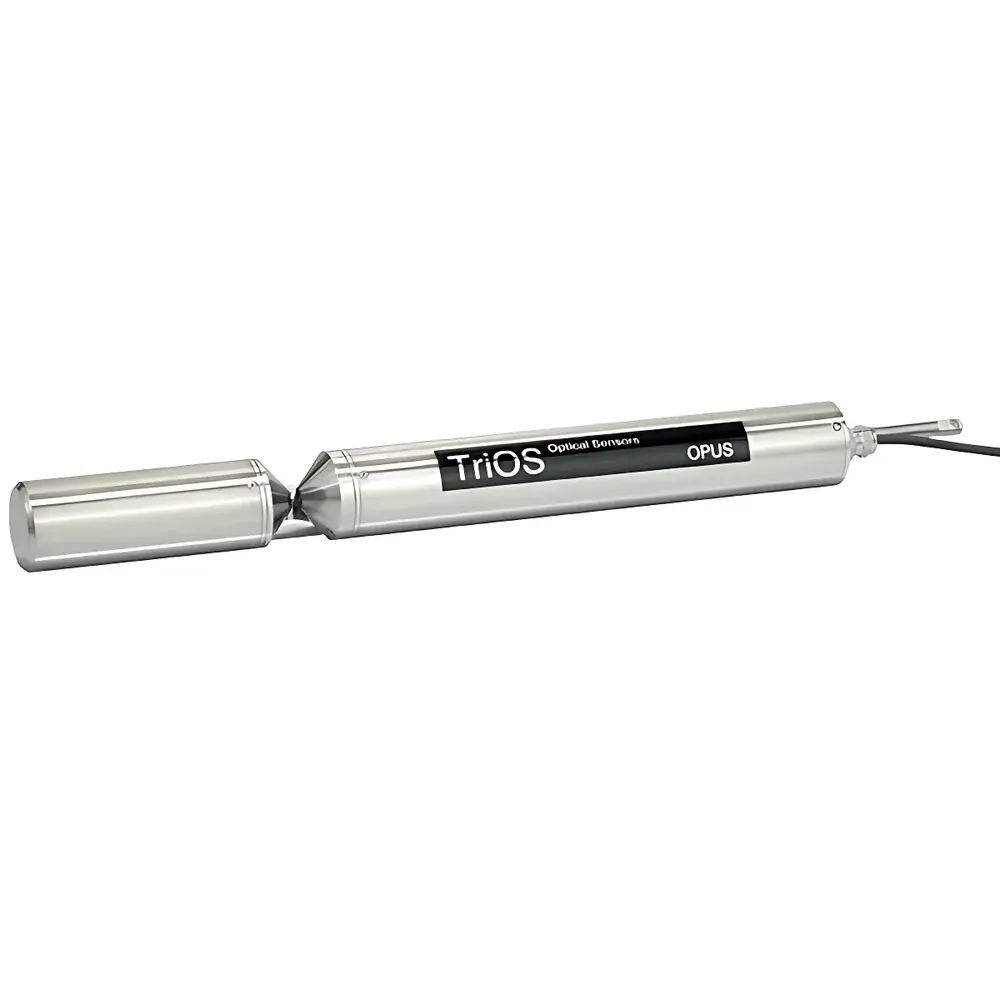
TriOS OPUS UV Spectrophotometric Sensor for Online Nitrate and Nitrite Measurement in Surface Water
| Brand | TriOS |
|---|---|
| Origin | Germany |
| Model | OPUS |
| Spectral Range | 200–360 nm |
| Optical Path Length Options | 0.3, 1, 2, 5, 10, 50 mm |
| Detection Principle | Linear Spectral Analysis (LSA) based on UV absorption |
| Turbidity Compensation | Yes |
| Data Storage | 2 GB internal |
| Interface | Ethernet (TCP/IP), RS-232/RS-485 (Modbus RTU), Wi-Fi |
| Housing Material | Stainless Steel 1.4571/1.4404 or Titanium 3.7035 |
| IP Rating | IP68 |
| Operating Temperature | +2 °C to +40 °C |
| Power Supply | 12–24 VDC (±10 %) |
| Max. Pressure Rating | 30 bar (SubConn), 3 bar (fixed cable), 1 bar (flow cell) |
| Response Time | ≤ 2 min |
| Measurement Interval | ≥ 1 min |
| Calibration Interval | 24 months |
| Accuracy (NO₃-N, 10 mm path) | ±(5 % + 0.01) mg/L |
| LOD (NO₃-N, 10 mm path) | 0.03 mg/L |
Overview
The TriOS OPUS UV Spectrophotometric Sensor is an industrial-grade, submersible online analyzer engineered for continuous, reagent-free quantification of nitrate-nitrogen (NO₃-N) and nitrite-nitrogen (NO₂-N) in surface water, drinking water, wastewater, and process streams. It employs Linear Spectral Analysis (LSA), a physics-based optical method grounded in the Beer–Lambert law, to resolve concentration-dependent UV absorbance signatures across a high-resolution spectral band (200–360 nm, 256-channel micro-spectrometer, 0.8 nm/pixel resolution). Unlike conventional colorimetric or ion-selective methods, OPUS does not require chemical reagents, sample extraction, or laboratory preparation—enabling true in-situ, real-time monitoring with minimal operational overhead. The sensor integrates pre-loaded, factory-calibrated spectral libraries for NO₃⁻ and NO₂⁻, while simultaneously compensating for interferences from turbidity, dissolved organic matter (DOM), and overlapping chromophores via multivariate spectral deconvolution. Its robust stainless steel (1.4571/1.4404) or titanium (3.7035) housing ensures long-term stability in aggressive aquatic environments, and its IP68 rating guarantees reliable operation under submerged or high-humidity conditions.
Key Features
- Reagent-free, maintenance-light operation: Eliminates consumables, hazardous chemicals, and associated disposal compliance burdens.
- Multi-parameter capability: Simultaneously reports NO₃-N, NO₂-N, CODeq, BODeq, DOCeq, TOCeq, TSSeq, SAC254, KHP-equivalents, and derived indices (e.g., COD-SACeq, BOD-SACeq) from a single UV spectrum.
- Adaptive optical path length selection: Configurable path lengths (0.3–50 mm) enable optimal sensitivity and dynamic range tuning—from trace-level detection (e.g., 0.03 mg/L NO₃-N LOD at 10 mm) to high-concentration applications (up to 1000 mg/L NO₃-N at 1 mm).
- Turbidity-resilient measurement: Real-time correction using reference channel data and spectral shape analysis ensures accuracy even in highly scattering waters (e.g., rivers with suspended solids or algal blooms).
- G2 intelligent interface: Embedded web server enables browser-based configuration, firmware updates, and live spectral visualization without proprietary software.
- Flexible integration architecture: Native support for Modbus RTU (RS-232/RS-485), TCP/IP Ethernet, and optional Wi-Fi allows seamless interoperability with SCADA, DCS, PLCs, and cloud-based data platforms.
- Field-deployable design: Optional battery pack and wireless connectivity support mobile surveys, temporary monitoring stations, and remote sites lacking fixed power or network infrastructure.
Sample Compatibility & Compliance
The OPUS sensor is validated for direct immersion or flow-cell installation in natural surface waters (rivers, lakes, reservoirs), treated drinking water, secondary and tertiary effluents, and industrial process streams. It operates reliably within a pH range of 5–9 and conductivity up to 5 mS/cm. Its optical window features a nano-coated quartz surface resistant to biofouling and abrasion, significantly extending service intervals between cleaning. From a regulatory standpoint, OPUS supports GLP-compliant data acquisition through timestamped, audit-trail-enabled internal logging (2 GB flash memory), and its calibration traceability aligns with ISO 7027 (turbidity) and ASTM D515/D4519 (nitrate/nitrite spectrophotometry) principles. While not certified as a primary reference method per EPA Method 353.2 or ISO 10301, it is widely deployed as a performance-monitoring tool under ISO 5667-3 (water sampling) and EN 14181 (QA/QC for automated analyzers), particularly where high-frequency trend analysis and early-warning detection are prioritized over discrete lab validation.
Software & Data Management
OPUS operates autonomously with onboard firmware that executes LSA algorithms, stores raw spectra and processed results, and manages communication protocols. Configuration and diagnostics are accessible via any modern web browser—no client installation required. Data export supports CSV, JSON, and XML formats; timestamps include UTC synchronization via NTP when connected to Ethernet. For enterprise integration, the sensor complies fully with Modbus RTU register mapping (holding registers for concentrations, diagnostics, spectral metadata), enabling direct ingestion into Historian systems (e.g., OSIsoft PI, AVEVA System Platform) or IIoT platforms (e.g., AWS IoT Core, Azure IoT Hub). All stored data are cryptographically signed and tamper-evident, satisfying foundational requirements for FDA 21 CFR Part 11 adherence in regulated utilities and pharmaceutical water systems—though formal Part 11 validation remains site-specific and requires documented IQ/OQ/PQ procedures.
Applications
- Surface water quality surveillance networks: Continuous tracking of agricultural runoff impacts, seasonal eutrophication drivers, and transboundary nutrient loading.
- Drinking water intake protection: Early detection of nitrate spikes from septic leakage or fertilizer leaching upstream of abstraction points.
- Wastewater treatment plant optimization: Real-time feedback for denitrification control loops, effluent compliance verification (e.g., EU Urban Wastewater Directive limits), and sludge digestion monitoring.
- Industrial process water management: Monitoring of cooling tower cycles, rinse water reuse circuits, and semiconductor fab ultrapure water (UPW) pre-treatment stages.
- Research and environmental observatories: High-temporal-resolution datasets for biogeochemical modeling, climate–nutrient interaction studies, and method validation against HPLC-IC or chemiluminescence references.
FAQ
Does OPUS require regular calibration in the field?
No—OPUS is factory-calibrated using NIST-traceable standards and designed for 24-month calibration stability under typical operating conditions. Field verification using certified reference solutions is recommended quarterly for QA/QC, but full recalibration is rarely necessary unless exposed to extreme fouling or mechanical shock.
Can OPUS distinguish between nitrate and nitrite in mixed samples?
Yes—its high-resolution UV spectrum (200–360 nm) captures distinct absorption maxima near 201 nm (NO₃⁻) and 212 nm (NO₂⁻), and the LSA algorithm applies constrained spectral unmixing to resolve both analytes independently, even at low signal-to-noise ratios.
How does OPUS handle variable turbidity?
It uses a dual-reference approach: one channel measures incident intensity via an integrated reference photodiode; the other records transmitted intensity after water-path attenuation. Scattering effects are modeled and subtracted using spectral slope analysis across non-absorbing regions, minimizing bias in high-TSS environments.
Is the sensor compatible with existing telemetry or SCADA infrastructure?
Yes—OPUS natively supports Modbus RTU over RS-485 (industrial standard for serial telemetry) and TCP/IP Ethernet (for fiber or cellular backhaul), with configurable polling intervals and alarm thresholds mapped directly to Modbus holding registers.
What is the minimum detectable concentration for nitrate-nitrogen?
At 10 mm optical path length, the limit of detection (LOD) is 0.03 mg/L NO₃-N (equivalent to ~0.13 mg/L NO₃); at 1 mm path, LOD rises to 0.3 mg/L NO₃-N—users select path length based on expected concentration range and required precision.







