
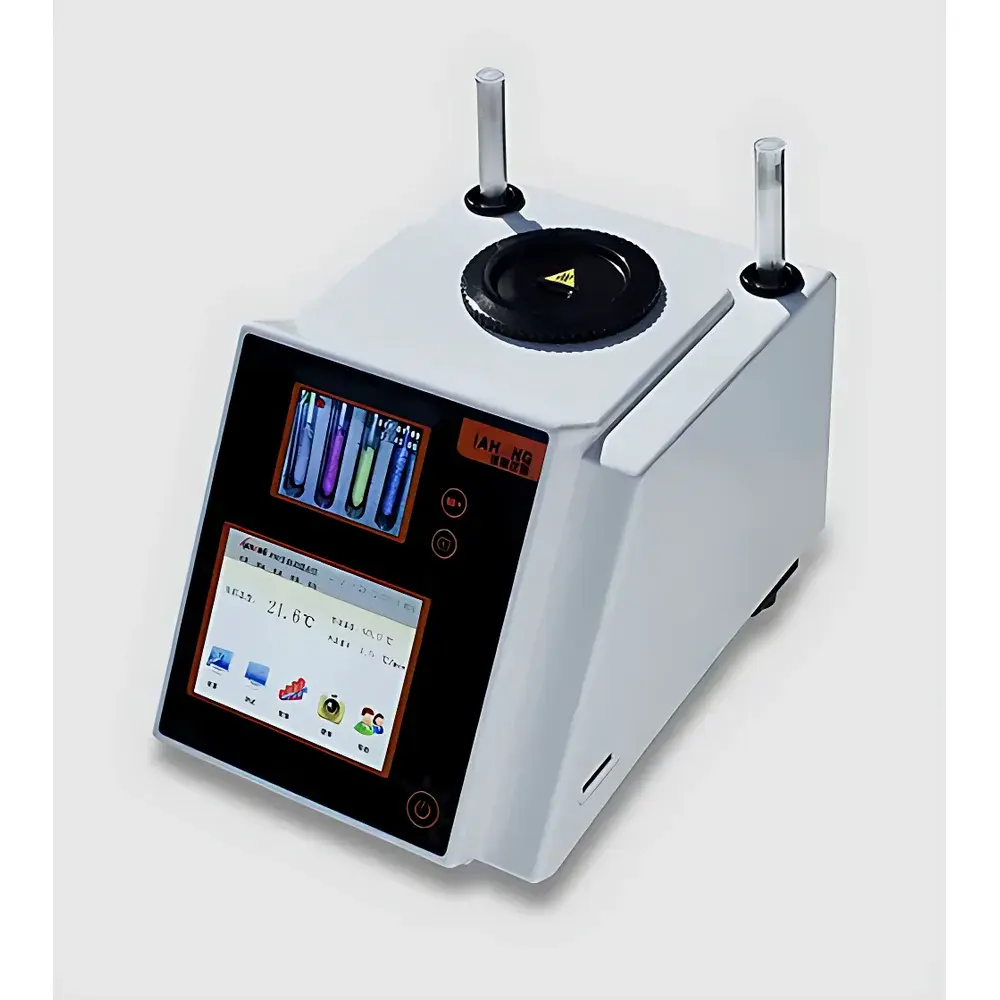
Truelab JH50 / JH70 / JH90 Automated Video Melting Point Apparatus
| Brand | Truelab |
|---|---|
| Origin | Shanghai, China |
| Model | JH50, JH70, JH90 |
| Temperature Range | RT to 350 °C |
| Heating Rate | 0.1–20 °C/min (200-step adjustable) |
| Temperature Accuracy | ±0.3 °C (<250 °C), ±0.5 °C (>250 °C) |
| Temperature Repeatability | ±0.1 °C (at 0.1 °C/min) |
| Temperature Resolution | 0.1 °C |
| Capillary Dimensions | OD 1.4 mm, ID 1.0 mm |
| Sample Capacity | 4 samples per batch |
| Display | TFT high-definition color LCD |
| Data Storage | 8 GB internal |
| Image Capture | Still frame capture with real-time video streaming |
| Video Playback | Local playback supported |
| Connectivity | USB, RS-232, Ethernet |
| Power Supply | 220 VAC, 50 Hz, 120 W |
| Magnification | 7× optical |
Overview
The Truelab JH50, JH70, and JH90 series are fully automated video melting point apparatuses engineered for precision thermal transition analysis of crystalline organic solids. These instruments operate on the principle of real-time optical observation coupled with high-stability PID temperature control, enabling accurate determination of both onset and endpoint melting temperatures—as well as melt range (melting interval)—through synchronized digital video acquisition. Unlike traditional analog or semi-automatic units, the JH-series integrates a calibrated high-resolution camera system directly into the heating block chamber, delivering live magnified (7×) visualization of capillary tube samples during controlled thermal ramping. This architecture eliminates subjective endpoint interpretation and supports objective, traceable documentation of phase change behavior in compliance with pharmacopeial standards including USP <741>, EP 2.2.17, and JP 2.60.
Key Features
- Real-time HD video imaging with 7× optical magnification and adjustable focus, enabling clear observation of crystal lattice collapse, sintering, discoloration, and bubbling phenomena
- Precision temperature control across a broad operational range (room temperature to 350 °C) with programmable heating rates from 0.1 to 20 °C/min in 200 discrete or continuously variable steps
- High thermal uniformity and stability: temperature repeatability of ±0.1 °C under standardized 0.1 °C/min ramp conditions; accuracy certified to ±0.3 °C below 250 °C
- Four-position sample holder permitting parallel analysis of up to four capillaries per run—ideal for method validation, reference standard verification, or multi-batch QC screening
- TFT high-definition color display with intuitive touch-enabled interface for direct parameter input, real-time video monitoring, and immediate image capture
- Onboard 8 GB non-volatile storage supporting timestamped still images and compressed video clips (H.264), each embedded with full metadata (temperature, time, operator ID, method name)
- Multi-protocol connectivity (USB 2.0, RS-232, and 10/100 Mbps Ethernet) for integration into LIMS environments and remote instrument supervision
Sample Compatibility & Compliance
The JH-series accommodates standard thin-wall glass capillaries (OD 1.4 mm, ID 1.0 mm), compatible with ASTM E324, ISO 6382, and pharmacopeial requirements for solid dosage form characterization. Each unit is supplied with pre-calibrated reference standards (e.g., pure caffeine, benzoic acid, indomethacin) traceable to NIST SRMs. Instrument validation documentation—including IQ/OQ templates, calibration certificates, and uncertainty budgets—is provided to support GLP and GMP-regulated laboratories. Data integrity conforms to FDA 21 CFR Part 11 principles via audit-trail-enabled user management (JH70/JH90 models), electronic signatures, and secure data export protocols.
Software & Data Management
Built-in firmware supports full-cycle data lifecycle management: acquisition, annotation, archiving, and export. All captured videos and thumbnails are stored with embedded EXIF-style metadata (temperature log, ramp profile, user ID, date/time stamp). Export formats include MP4 (video), PNG (still frames), CSV (temperature-time series), and PDF (summary reports with annotated melt curves). Optional PC-based software (Truelab MP-Studio v3.2) extends functionality with batch reporting, statistical trend analysis, method library synchronization, and automated pass/fail evaluation against configurable specification limits. Audit trail logs record all critical events—including parameter changes, image deletions, and user logins—with immutable timestamps.
Applications
- Pharmaceutical QC/QA: identity confirmation and purity assessment of active pharmaceutical ingredients (APIs), excipients, and intermediates per ICH Q5, Q6A, and USP monographs
- Chemical R&D: polymorph screening, eutectic mixture identification, and thermal stability profiling of novel synthetic compounds
- Food & flavor chemistry: verification of fatty acid composition, triglyceride purity, and adulteration detection in edible oils and waxes
- Materials science: characterization of polymer additives, organic semiconductors, and phase-change materials used in thermal energy storage systems
- Academic teaching labs: visual demonstration of solid-state transitions, kinetic vs. thermodynamic melting behavior, and impurity depression effects
FAQ
What capillary dimensions are supported?
Standard capillaries with outer diameter 1.4 mm and inner diameter 1.0 mm are recommended; alternative sizes may be accommodated with optional adapters.
Is video recording stored internally or only streamed?
Both: real-time streaming to the display is continuous, while user-triggered or auto-captured clips are saved to internal 8 GB flash memory with full metadata embedding.
Does the system support 21 CFR Part 11 compliance?
JH70 and JH90 models include role-based user accounts, electronic signature capability, and tamper-evident audit trails—fully configurable to meet Part 11 technical and procedural requirements.
Can multiple users share method settings across instruments?
Yes—via Truelab MP-Studio software, method libraries can be centrally managed, version-controlled, and deployed across networked JH-series devices using encrypted configuration files.
How is temperature calibration verified?
Each unit ships with a certificate of calibration referencing NIST-traceable standards; field recalibration is performed using certified reference materials (e.g., USP DSC standards) and validated against ISO/IEC 17025 procedures.



