
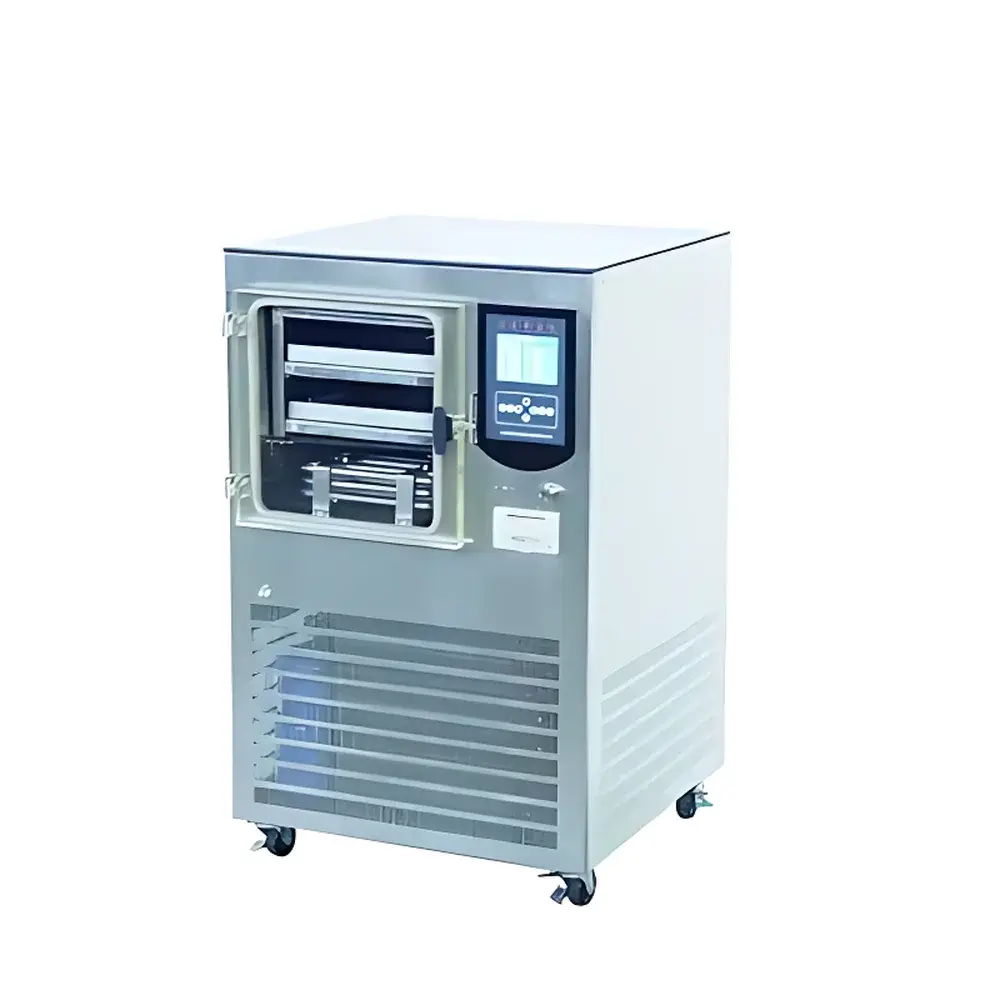
Truelab VFD-2000 Benchtop Freeze Dryer
| Brand | Truelab |
|---|---|
| Origin | Shanghai, China |
| Model | VFD-2000 |
| Instrument Type | Standard Shelf-Type Freeze Dryer |
| Application | Laboratory-Scale Lyophilization |
| Lyophilization Area | 0.2 m² |
| Ultimate Vacuum | < 13 Pa |
| Condenser Temperature | < −70 °C |
| Water Capture Capacity | 4 kg/24 h |
| Dimensions (W×D×H) | 652 × 700 × 1100 mm |
| Power Supply | 220 V, 50 Hz, 1800 W |
| Shelf Configuration | 2 Shelves, 77 mm Spacing, 390 × 275 mm Tray Size |
| Programmable Cycles | 20 Programs × 20 Steps Each |
| Data Interface | USB (Standard), RS-485 (Optional) |
| Refrigeration System | Dual-Compressor Cascade Cooling |
| Chamber Design | Vertical Front-Opening, In-Situ Freezing & Drying |
| Gas Inlet Valve | Imported Solenoid Valve for N₂ or Inert Gas Purging |
| Display | Large LCD with Real-Time Curve + Numeric Monitoring (Chamber Temp, Shelf Temp, Condenser Temp, Vacuum Level, Elapsed Time) |
Overview
The Truelab VFD-2000 is a vertically oriented, benchtop freeze dryer engineered for laboratory-scale lyophilization of heat-sensitive biologicals, pharmaceuticals, diagnostics, and research samples. It operates on the fundamental principle of sublimation—removing water from frozen materials under high vacuum while maintaining temperatures below the eutectic point—thereby preserving structural integrity, bioactivity, and long-term stability. Unlike conventional air-drying or spray-drying methods, lyophilization minimizes thermal degradation and ensures reproducible reconstitution characteristics. The VFD-2000 integrates in-situ freezing and drying within a single chamber, eliminating manual transfer between pre-freezing and drying stages—a critical advantage for maintaining sample sterility, reducing contamination risk, and improving process consistency. Its dual-compressor cascade refrigeration system achieves condenser temperatures below −70 °C, enabling efficient capture of volatile solvents and robust performance even during extended drying cycles.
Key Features
- In-situ freezing capability: Samples are frozen directly on temperature-controlled shelves, replicating industrial-scale primary drying conditions at the lab bench.
- Dual-compressor cascade cooling architecture: Delivers stable condenser temperatures ≤ −70 °C, supporting low-melting-point formulations and high-moisture-load samples.
- Programmable shelf temperature control: Supports up to 20 user-defined protocols, each with 20 independent steps—including ramp rates, hold times, and pressure modulation—enabling precise optimization of primary and secondary drying phases.
- Real-time multi-parameter monitoring: Large backlit LCD displays shelf temperature, product temperature (via optional PT100 probe), condenser temperature, vacuum level (Pirani gauge), and elapsed time—simultaneously in both graphical curve and numeric formats.
- Integrated inert gas purging: Factory-installed imported solenoid valve allows controlled introduction of dry nitrogen or argon post-drying to prevent oxidation and facilitate sterile vial stoppering.
- USB data logging interface (standard) and optional RS-485 port: Enables seamless export of time-stamped process data—including full lyophilization curves—for audit-ready documentation and GLP/GMP-aligned recordkeeping.
Sample Compatibility & Compliance
The VFD-2000 accommodates a broad range of sample formats, including bulk solutions in stainless steel or aluminum trays (max. 2 L total volume), standard 10–20 mL serum vials (up to 24 units per shelf), and custom-sized containers compatible with its 390 × 275 mm shelf dimensions. Its 0.2 m² drying area supports typical R&D batch sizes without compromising mass transfer efficiency. The system meets essential safety and electromagnetic compatibility requirements per IEC 61000-6-3 and IEC 61000-6-2. While not certified as Class I medical device equipment, its programmability, data traceability, and process repeatability align with ASTM F2476-21 (Standard Guide for Lyophilization Process Development) and support validation activities required under FDA 21 CFR Part 11 when paired with compliant software and procedural controls.
Software & Data Management
The VFD-2000 ships with Truelab’s proprietary Windows-based data acquisition software (English-language interface), which records all monitored parameters at user-selectable intervals (1–60 s). Raw data exports in CSV format for integration with LIMS or statistical analysis platforms (e.g., JMP, Minitab). The software generates timestamped lyophilization curves with overlay capability for comparative batch analysis and includes password-protected user roles (Operator, Supervisor, Administrator) to enforce procedural discipline. Audit trail functionality logs all parameter changes, program uploads, and system events—meeting foundational expectations for electronic records under ALCOA+ principles. Optional firmware upgrades support future compliance with enhanced cybersecurity protocols and expanded communication protocols (Modbus TCP).
Applications
This freeze dryer serves diverse applications across academic, biotech, and quality control laboratories: stabilization of monoclonal antibodies, enzymes, vaccines, and probiotics; preparation of reference standards for HPLC and mass spectrometry; preservation of microbial cultures and tissue extracts; development of fast-dissolving oral films and nasal powders; and small-batch production of clinical trial materials. Its ability to maintain low shelf temperatures during primary drying makes it particularly suitable for amorphous formulations with low glass transition temperatures (Tg’), while its vacuum stability (<13 Pa) ensures consistent sublimation front progression across heterogeneous sample matrices.
FAQ
Does the VFD-2000 support direct connection to a building’s central vacuum system?
No—it uses an integrated oil-lubricated rotary vane vacuum pump optimized for low-pressure stability and moisture tolerance; external vacuum sources are not supported.
Can shelf temperature be controlled independently for each shelf?
No—both shelves share a common refrigerant circuit and operate at identical setpoints; differential control is not available on this model.
Is a temperature probe included for monitoring actual product temperature?
A PT100 sensor port is provided on each shelf, but the probe itself is an optional accessory and must be ordered separately.
What maintenance intervals are recommended for the vacuum pump and refrigeration system?
Vacuum pump oil should be changed every 500 operating hours or semiannually; condenser coil cleaning and refrigerant pressure verification are advised annually by qualified service personnel.
Is remote monitoring via Ethernet or Wi-Fi supported?
Not natively—the system offers only USB and optional RS-485 serial interfaces; third-party SCADA integration requires external protocol converters.



