
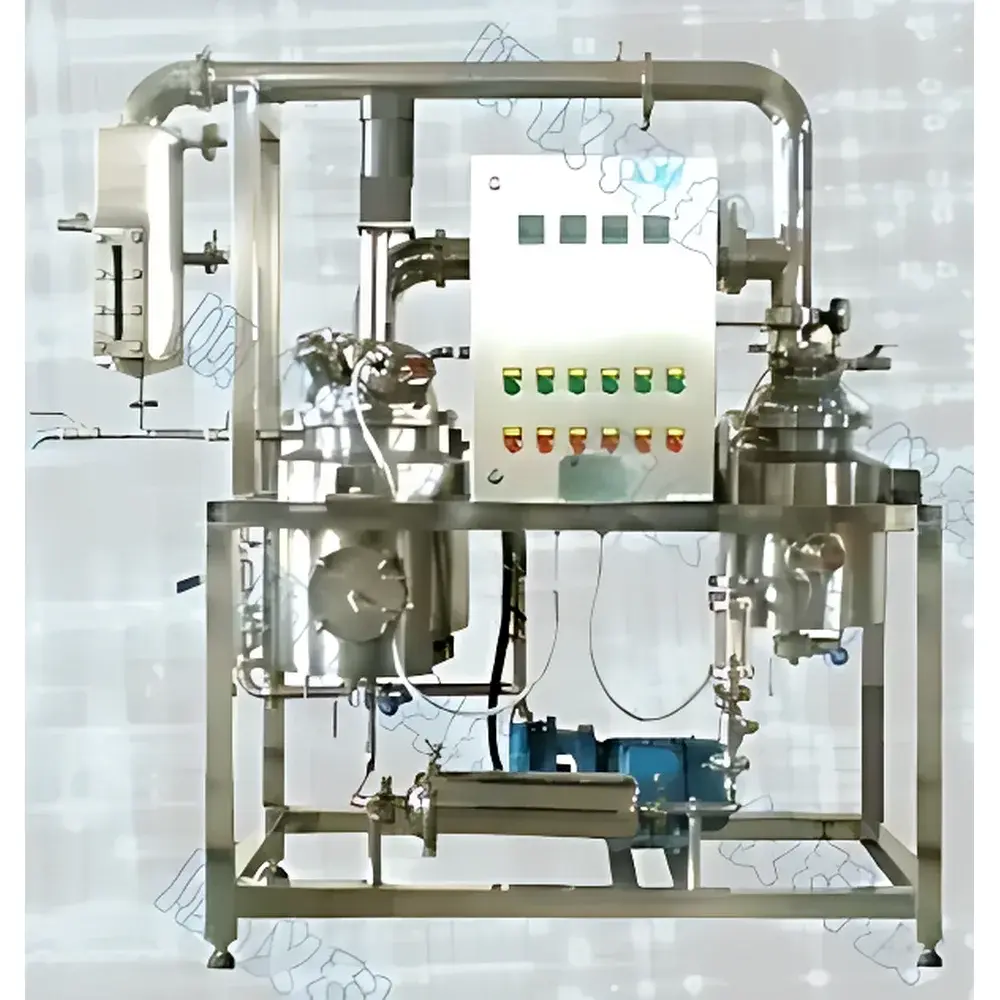
TS-NS Series Benchtop Integrated Extraction and Concentration System
| Origin | Shanghai, China |
|---|---|
| Manufacturer Type | Authorized Distributor |
| Country of Origin | China |
| Model | TS-NS-05 / TS-NS-10 / TS-NS-20 / TS-NS-30 / TS-NS-50 / TS-NS-100 |
| Capacity | 5–100 L |
| Heating Power | 5–20 kW |
| Jacket Pressure | 0.3–0.4 MPa |
| Internal Vessel Pressure | 0.09 MPa |
| Extraction Temperature | up to 100 °C |
| Concentration Temperature Range | 40–80 °C |
| Stirring Motor Power | 0.09–0.40 kW |
| Condensing Area | 0.20–0.95 m² |
| Heating Surface Area | 0.20–0.95 m² |
| Vacuum Pump Power | 0.75–2.25 kW |
| Ultimate Vacuum | –0.05 to –0.08 MPa |
| Ultrasonic Frequency Options | 15–60 kHz (optional) |
| Material | SUS304 stainless steel, electropolished welds (300-grit finish) |
| Insulation | Triple-layer thermal insulation |
| CIP System | Integrated Clean-in-Place |
| Compliance | Designed to meet GMP requirements for laboratory-scale R&D and pilot production |
Overview
The TS-NS Series Benchtop Integrated Extraction and Concentration System is an engineered solution for small-scale, high-fidelity extraction and solvent recovery in research laboratories and early-stage process development. Based on the principle of thermal reflux extraction combined with optional ultrasonic-assisted mass transfer, the system enables simultaneous solid–liquid extraction and subsequent vacuum concentration within a single, compact, and fully enclosed unit. Unlike conventional batch setups requiring separate extractors, evaporators, and condensers, the TS-NS integrates dynamic extraction, heat-controlled concentration, condensate reflux, and solvent recovery into one modular architecture—minimizing footprint, reducing operator intervention, and improving reproducibility across experimental runs. Its design supports both atmospheric and sub-atmospheric operation, accommodating water-based decoctions, hydroalcoholic percolation, volatile oil distillation, and organic solvent recycling (e.g., ethanol, acetone, ethyl acetate) under controlled temperature and vacuum conditions.
Key Features
- Compact benchtop configuration with footprint as low as 1.5 m × 1.2 m — optimized for limited lab space without compromising volumetric scalability (5–100 L variants)
- Integrated central control panel with PID-regulated temperature monitoring, real-time vacuum display, and programmable heating/concentration cycles
- SUS304 stainless steel construction throughout; all internal welds electropolished to ≤0.8 µm Ra (300-grit finish) and validated for corrosion resistance and cleanability
- Triple-layer thermal insulation and arc-shaped vessel geometry eliminate dead zones during heating, extraction, and CIP—ensuring complete material discharge and uniform thermal distribution
- Optional high-efficiency ultrasonic module with frequency selection (15–60 kHz), focused transducer array, and frame-type agitator to enhance cell wall disruption and solute diffusion in botanical matrices
- Onboard CIP system with spray ball and recirculation loop—validated for residue removal per ASTM E3067 and aligned with GLP documentation requirements
- Electric heating with jacketed vessel; precise temperature control (±1 °C) across extraction (up to 100 °C) and concentration (40–80 °C) phases
Sample Compatibility & Compliance
The TS-NS system accommodates diverse sample formats including dried herbs, powdered botanicals, animal tissues, algal biomass, and synthetic polymer matrices. It supports aqueous, hydroalcoholic, and low-boiling organic solvent systems—compatible with ISO 17025-accredited method development for phytochemical quantification (e.g., flavonoids, alkaloids, terpenes). All wetted parts conform to USP Class VI biocompatibility standards. The system’s pressure-rated design (0.09 MPa internal, 0.4 MPa jacket) and vacuum capability (–0.08 MPa) comply with ASME BPVC Section VIII Div. 1 for laboratory pressure equipment. Documentation packages include Factory Acceptance Test (FAT) reports, material traceability certificates (MTRs), and GMP-aligned IQ/OQ templates for regulated environments.
Software & Data Management
The embedded controller logs time-stamped operational parameters—including jacket temperature, internal temperature, vacuum level, agitation speed, and cycle duration—with automatic export to CSV or PDF. Optional Ethernet/RS485 interface enables integration with LIMS or SCADA platforms. Audit trail functionality meets FDA 21 CFR Part 11 requirements when paired with user-authenticated login and electronic signature modules. All data are stored locally on non-volatile memory with battery-backed clock synchronization—supporting full traceability from raw material loading to final concentrate collection.
Applications
- R&D of herbal active ingredients (e.g., ginsenosides, curcuminoids) under standardized extraction protocols per Chinese Pharmacopoeia (ChP) and European Pharmacopoeia (Ph. Eur.)
- Pilot-scale optimization of solvent-to-solid ratios, residence time, and temperature gradients prior to scale-up to industrial extractors
- Recovery and reuse of ethanol or other GRAS solvents in food-grade botanical processing—reducing waste disposal costs and environmental impact
- Isolation of heat-labile compounds (e.g., anthocyanins, enzymes) via ultrasonically enhanced low-temperature extraction
- Development of analytical reference standards for HPLC, GC-MS, and LC-MS/MS quantitation workflows
- Teaching applications in pharmaceutical sciences, food engineering, and natural product chemistry curricula
FAQ
What regulatory standards does the TS-NS system support for GMP-compliant labs?
The system is designed to align with EU Annex 15, ICH Q5C, and WHO TRS 986 guidelines for equipment qualification. Its construction, documentation, and validation support IQ/OQ execution under GMP and GLP frameworks.
Can the ultrasonic module be retrofitted to existing units?
Yes—ultrasonic transducers and control modules are available as field-installable kits compatible with all TS-NS models manufactured after 2022.
Is solvent compatibility data available for aggressive media such as chloroform or DMSO?
Material compatibility charts covering >40 solvents—including halogenated and polar aprotic compounds—are provided upon request and validated per ASTM D543.
How is cleaning verification performed post-extraction?
Residue limits are established using swab sampling per USP , followed by HPLC or TOC analysis. CIP efficacy is verified through conductivity and pH profiling across rinse cycles.
What maintenance intervals are recommended for vacuum pumps and ultrasonic generators?
Vacuum pump oil change every 500 operating hours; ultrasonic transducer impedance calibration annually or after 2,000 hours of cumulative use—both tracked via built-in service timers.



