
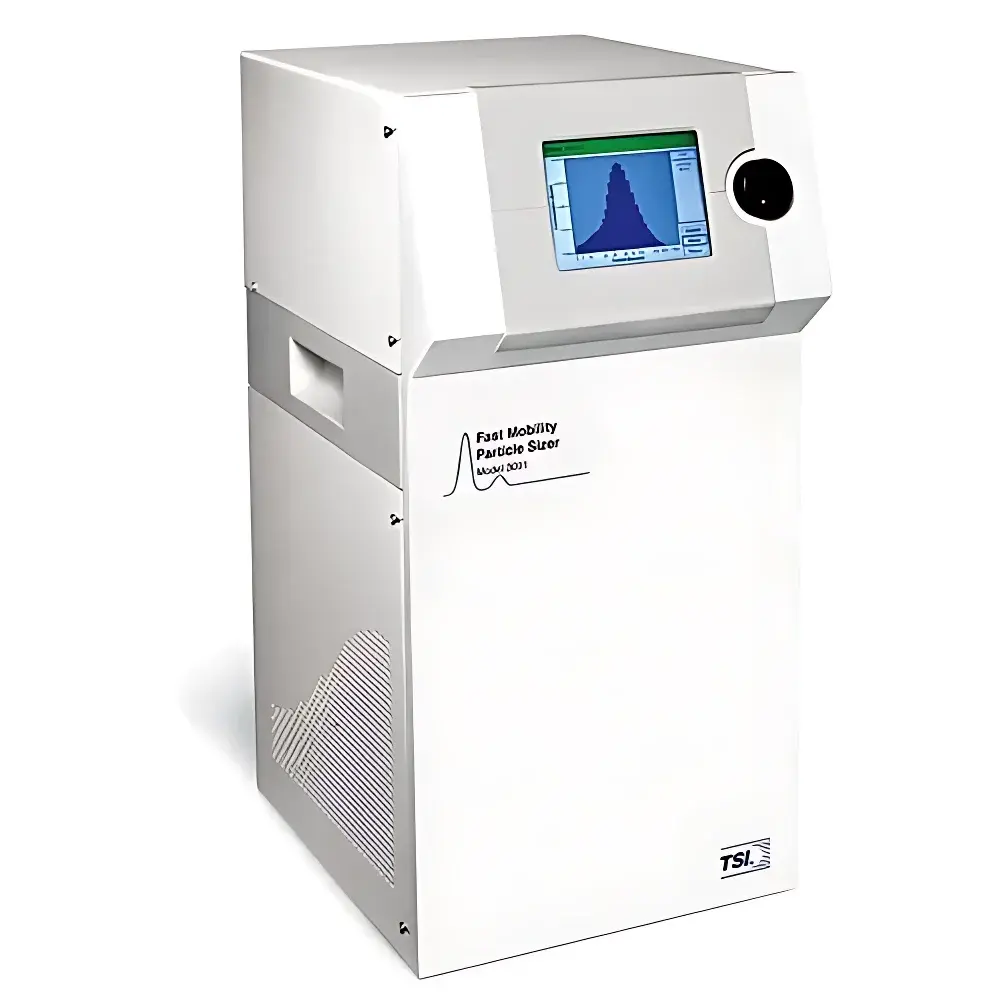
TSI EEPS-3090 Engine Exhaust Particle Sizer
| Origin | USA |
|---|---|
| Manufacturer Type | Authorized Distributor |
| Origin Category | Imported |
| Model | EEPS-3090 |
| Pricing | Available Upon Request |
Overview
The TSI EEPS-3090 Engine Exhaust Particle Sizer is a high-speed, real-time electrical mobility spectrometer engineered specifically for measuring the size distribution of nanoparticles in transient engine exhaust streams. Unlike conventional scanning mobility particle sizers (SMPS), which rely on sequential voltage scanning and require stable aerosol conditions over tens of seconds to minutes, the EEPS-3090 employs parallel detection architecture based on differential electrical mobility classification. It utilizes a custom bipolar diffusion charger coupled with an array of 22 independent electrometers to simultaneously resolve particle current signals across a continuous mobility range. This architecture enables true real-time measurement—delivering a full 32-channel particle size distribution every 0.1 second—without compromising resolution or signal fidelity. The instrument operates on the principle of charged particle migration in a uniform electric field, where particle mobility is inversely related to aerodynamic diameter under defined temperature and pressure conditions. Its design addresses the fundamental limitation of traditional systems in dynamic combustion environments, making it uniquely suited for regulatory testing, R&D validation, and aftertreatment system development under transient drive cycles (e.g., WLTC, FTP-75, RDE).
Key Features
- Real-time particle size distribution acquisition at 10 Hz (one full spectrum per 0.1 s)
- Size range: 5.6–560 nm (electrical mobility diameter), covering nucleation-mode through coarse accumulation-mode particles
- 32 logarithmically spaced channels (16 bins per decade) with high size resolution and low inter-channel crosstalk
- Parallel electrometer array (22 detectors) eliminating scan-induced temporal smearing and enabling multi-charge correction via embedded DSP algorithms
- High-flow sampling capability: 50 L/min nominal inlet flow, compatible with dilution tunnel interfaces and heated sample lines per ISO 8573 and U.S. EPA 40 CFR Part 1065 requirements
- Ruggedized industrial enclosure rated for laboratory, test cell, and mobile chassis-dyno deployment
- Integrated digital signal processing firmware with real-time charge-state deconvolution and drift compensation
Sample Compatibility & Compliance
The EEPS-3090 is optimized for hot, humid, and chemically reactive exhaust streams from gasoline direct injection (GDI), diesel compression ignition (CI), and alternative fuel engines. It accepts conditioned sample gas via heated transfer lines (up to 200 °C) and integrates seamlessly with constant-volume samplers (CVS), partial-flow dilution systems, and thermodenuders. The instrument meets key metrological requirements for regulatory particle number (PN) measurement under UN ECE R83, R49, and Euro 6d/7 legislation. While not a certified type-approval device per se, its data output aligns with ISO 29463-3 (high-efficiency filter testing), ISO 15900 (electrical aerosol measurement), and ASTM D7521 (nanoparticle size distribution by mobility analysis). Its time-resolved output supports GLP-compliant traceability when paired with TSI’s TrakPro™ software with 21 CFR Part 11 audit trail functionality.
Software & Data Management
Data acquisition and visualization are managed through TSI’s proprietary TrakPro™ Software Suite (v6.0+), which provides synchronized time-series plotting, spectral overlay, derivative analysis (dN/dlogDp), and export to CSV, HDF5, or MATLAB-compatible formats. The software supports hardware-triggered acquisition synchronized with engine control unit (ECU) CAN bus signals, enabling cycle-phase-resolved emission mapping. All raw electrometer currents, corrected size distributions, and metadata (temperature, pressure, flow rate, calibration timestamp) are stored with SHA-256 checksum integrity. Optional cloud-based data aggregation modules enable fleet-level comparative analysis across multiple test cells while maintaining data sovereignty and encryption-at-rest compliance.
Applications
- Regulatory emissions certification testing (RDE, PEMS, lab-based type approval)
- Aftertreatment system evaluation (DPF regeneration dynamics, GPF filtration efficiency, SCR ammonia slip interaction)
- Fuel formulation impact studies on nucleation-mode particle formation
- Transient combustion optimization under rapid load changes and cold-start conditions
- Validation of CFD-based soot modeling and particle microphysics submodels
- On-board diagnostics (OBD) algorithm development for real-time PN monitoring
FAQ
How does the EEPS-3090 differ from an SMPS system in transient applications?
The EEPS-3090 acquires full spectra in parallel, enabling 10 Hz resolution; SMPS requires sequential voltage scanning, resulting in 30 s–5 min per spectrum and temporal averaging that obscures rapid emission transients.
Is the EEPS-3090 suitable for unheated ambient aerosol measurements?
Yes—though optimized for exhaust, it can measure room-temperature aerosols; optional heated inlet kits maintain volatility control for semi-volatile species.
Does the instrument require periodic factory recalibration?
Annual verification against NIST-traceable polystyrene latex (PSL) standards is recommended; built-in zero-check and gain-stability monitoring reduce downtime.
Can EEPS-3090 data be integrated into existing test cell DAQ systems?
Yes—via Ethernet TCP/IP, analog voltage outputs (0–10 V), or CAN FD interface with configurable message frames for ECU synchronization.
What particle charging method does the EEPS-3090 use?
A dual-polarity soft X-ray charger ensures stable, repeatable bipolar charge distribution per ISO 15900 Annex B, minimizing space charge effects in high-concentration exhaust.







