
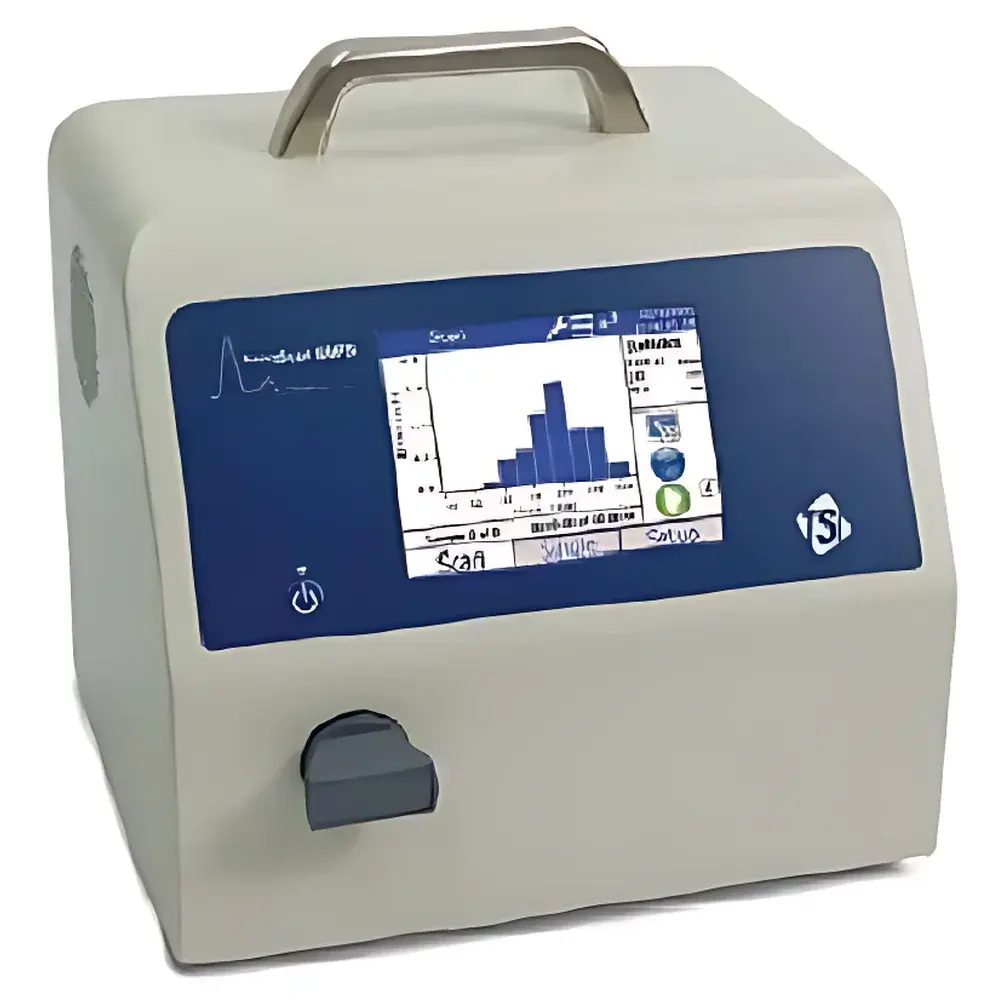
TSI NanoScan SMPS Particle Size Spectrometer Model 3910
| Brand | TSI |
|---|---|
| Origin | USA |
| Model | 3910 |
| Principle | Scanning Mobility Particle Sizer (SMPS) |
| Size Range | 10–420 nm |
| Counting Range | 100–1,000,000 particles/cm³ |
| Size Channels | 13 |
| Battery Life | ~6 hours (hot-swappable Li-ion) |
| Data Acquisition Modes | Scan (full size distribution in ≤60 s), Single-Size (concentration at user-selected mobility diameter, update rate ≤1 s) |
| Software | NanoScan Manager v3.x |
| Compliance | Designed for GLP-aligned workflows |
Overview
The TSI NanoScan SMPS Particle Size Spectrometer Model 3910 is a compact, battery-powered scanning mobility particle sizer engineered for field-deployable, real-time measurement of nanoparticle size distributions in the critical 10–420 nm range. Based on the well-established differential mobility analysis (DMA) principle—where charged aerosol particles are classified by electrical mobility in a laminar flow sheath gas environment—the Model 3910 integrates a miniature cylindrical DMA with a condensation particle counter (CPC) to deliver high-fidelity, mobility-diameter-resolved number concentration data. Unlike optical or laser diffraction techniques, SMPS provides traceable, calibration-standard-based sizing rooted in fundamental electrokinetic theory, making it suitable for regulatory-supportive studies, emission source characterization, and inhalation toxicology research where nanoscale resolution and metrological rigor are essential.
Key Features
- True portable SMPS architecture: Complete system housed in a single enclosure (~28 × 20 × 15 cm), weighing under 4.5 kg—designed for rapid deployment in mobile monitoring campaigns, workplace surveys, and outdoor ambient studies.
- Dual operational modes: “Scan” mode acquires full 13-channel size distribution in ≤60 seconds; “Single-Size” mode delivers real-time concentration at any user-defined mobility diameter with ≤1-second temporal resolution.
- Integrated hot-swappable lithium-ion battery pack supporting up to six hours of continuous operation—enabling unattended time-series measurements without external power sources.
- No radioactive neutralizer: Utilizes a soft X-ray charger (TSI Model 3077A-compatible) for particle charging, eliminating regulatory handling constraints associated with 85Kr or 210Po sources.
- Onboard memory and USB interface: Stores >10,000 size distribution records internally; exports ASCII and CSV files compatible with MATLAB, Python (pandas), and R-based aerosol analysis pipelines.
- Robust thermal management: Active temperature stabilization ensures consistent DMA transfer function performance across ambient conditions from 5°C to 35°C.
Sample Compatibility & Compliance
The Model 3910 is validated for use with dilute to moderately concentrated aerosols—up to 1×10⁶ particles/cm³—without requiring external dilution for most ambient, occupational, or combustion-generated nanoparticle applications. It complies with ISO 27891:2018 (aerosol instrumentation—requirements for mobility particle sizers), and its data acquisition architecture supports Good Laboratory Practice (GLP) and Good Manufacturing Practice (GMP) documentation standards when deployed with NanoScan Manager’s optional 21 CFR Part 11 compliance module (user role management, electronic signatures, and immutable audit trails). The instrument meets CE marking requirements for electromagnetic compatibility (EN 61326-1) and safety (EN 61010-1), and its non-radioactive design facilitates international shipping and institutional procurement under IAEA Category 3 exemption thresholds.
Software & Data Management
NanoScan Manager v3.x is a Windows-based desktop application providing full instrument control, real-time visualization, batch processing, and report generation. It supports synchronized multi-instrument operation (e.g., pairing Model 3910 with optical particle sizers or gas analyzers), time-aligned overlay of size distributions, and automated calculation of derived metrics—including geometric mean diameter (GMD), count median diameter (CMD), and total particle number concentration. Raw data files include timestamped metadata (DMA voltage ramp parameters, CPC gain settings, temperature/pressure logs), enabling full traceability. Export formats include standardized .csv, .txt, and HDF5 for integration into institutional LIMS or cloud-based environmental data platforms.
Applications
- Ambient and indoor air quality assessment: Quantifying ultrafine particle (UFP) emissions from traffic corridors, cooking activities, and HVAC systems.
- Occupational exposure monitoring: Real-time tracking of nanoparticle releases during additive manufacturing, welding fume characterization, and nanomaterial handling procedures.
- Combustion and engine emission studies: Resolving nucleation-mode particle dynamics in diesel exhaust, biomass burning plumes, and laboratory flame reactors.
- Inhalation toxicology and health effects research: Correlating time-resolved size distributions with deposition fraction models (e.g., MPPD v3.04) for pulmonary dosimetry.
- Source apportionment and point-source identification: Deploying multiple units in spatial arrays to triangulate emission origins via temporal cross-correlation and wind-assisted dispersion modeling.
- Educational laboratories: Teaching aerosol physics, electrical mobility theory, and real-world sensor validation protocols with a fully documented, open-architecture platform.
FAQ
What size calibration standards does the Model 3910 support?
The instrument is factory-calibrated using NIST-traceable polystyrene latex (PSL) spheres and tetracontane (C₄₀H₈₂) nanoparticles; users may perform routine verification with 100 nm and 300 nm PSL standards.
Can the Model 3910 be used with external pumps or diluters?
Yes—it accepts inlet flows between 0.3–1.0 L/min; external isokinetic sampling probes, cyclones, or certified diluters (e.g., TSI Model 3302) can be integrated via standard 1/4-inch Swagelok fittings.
Is remote operation possible?
Via USB-to-Ethernet adapters or third-party serial-over-IP gateways, NanoScan Manager supports LAN-based control and data streaming; no native Wi-Fi or cellular module is included.
How is particle charging achieved without radioactive sources?
The system employs a low-intensity soft X-ray generator (10 keV maximum energy, <1 µSv/h at 10 cm), compliant with IEC 61000-6-4 and exempt from nuclear regulatory licensing in most jurisdictions.
Does the software support automated QA/QC flagging?
Yes—NanoScan Manager includes configurable alarms for CPC saturation, DMA voltage instability, and flow deviation exceeding ±5%, with automatic annotation of flagged scans in exported datasets.
Related Products







