
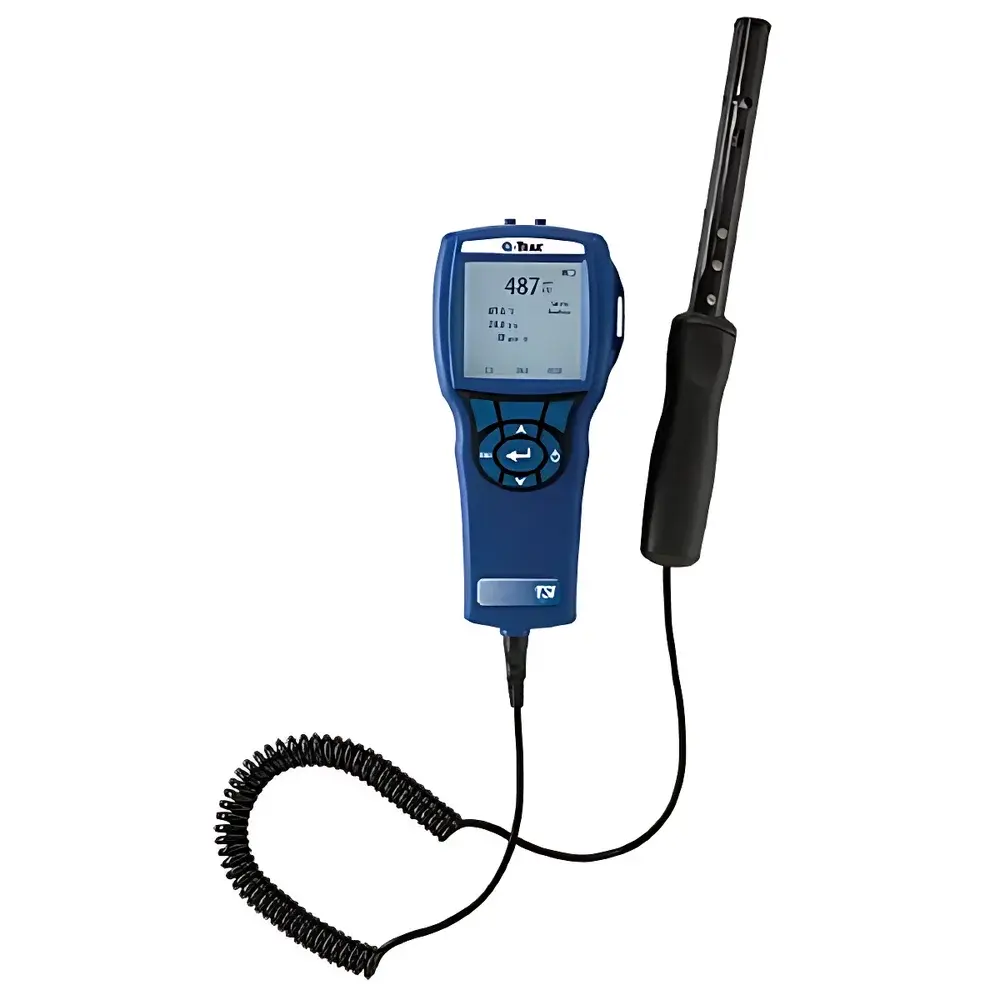
TSI Q-TRAK 7575 Indoor Air Quality Monitor
| Brand | TSI |
|---|---|
| Origin | USA |
| Model | 7575 |
| Instrument Type | Portable |
| Detection Target | Single-component gases |
| Resolution | 1 ppm (CO₂), 0.1 ppm (CO) |
| Response Time | 20 s (CO₂), <60 s (CO), 30 s (Temperature), 20 s (RH) |
| Accuracy | ±3.0% or ±50 ppm (CO₂), ±3.0% or ±3 ppm (CO), ±0.5 °C (Temperature), ±3 %RH (Relative Humidity) |
| Data Storage Capacity | Up to 56,035 points |
| Operating Temperature | 5–45 °C |
| Power Supply | 4 × AA batteries or AC adapter |
| Dimensions (Instrument) | 9.7 × 21.1 × 5.3 cm |
| Weight | 0.39 kg |
Overview
The TSI Q-TRAK™ 7575 Indoor Air Quality (IAQ) Monitor is an engineered field instrument designed for precise, real-time assessment of critical environmental parameters in commercial, institutional, and industrial indoor spaces. Based on dual-wavelength non-dispersive infrared (NDIR) detection for carbon dioxide and electrochemical sensing for carbon monoxide, the 7575 delivers trace-level gas quantification with metrological integrity suitable for compliance verification, HVAC performance validation, and occupational health surveillance. Its modular architecture supports interchangeable probes—including four optional VOC sensors—enabling configurable multi-parameter measurement of CO₂, CO, temperature, relative humidity, air velocity, and volatile organic compounds. The device operates within a defined environmental envelope (5–45 °C operating range, 5–95 %RH), and its compact, handheld form factor (9.7 × 21.1 × 5.3 cm, 0.39 kg) ensures operational flexibility across walk-through surveys, duct traverses, and fixed-point monitoring deployments.
Key Features
- Multi-sensor platform with factory-calibrated NDIR CO₂ sensor (0–5000 ppm range) and electrochemical CO sensor (0–500 ppm range)
- Integrated thermal resistor (±0.5 °C accuracy) and thin-film capacitive RH sensor (±3 %RH accuracy at 25 °C)
- User-selectable time constants (1, 5, 10, 20, or 30 seconds) for dynamic signal filtering under variable airflow conditions
- Onboard data logging with up to 56,035 memory slots; programmable sampling intervals from 1 second to 1 hour
- Extended autonomous operation: >38 days of continuous logging at 1-minute intervals on standard AA batteries
- AC adapter compatibility for unattended long-term monitoring applications
- Keyboard lock function to prevent accidental parameter changes during field use
- Backlit LCD display with intuitive menu navigation and real-time graphical trend visualization
Sample Compatibility & Compliance
The Q-TRAK 7575 is intended for gaseous sampling in ambient indoor air environments. It complies with fundamental requirements outlined in ASHRAE Standard 62.1 (Ventilation for Acceptable Indoor Air Quality) and supports evaluation against EPA IAQ guidelines and WHO indoor CO exposure thresholds. While not certified for intrinsic safety in hazardous locations, its sensor design adheres to ISO 8573-1 for compressed air purity classification when used with compatible sampling accessories. All gas sensors are calibrated traceably to NIST-standard reference gases, and calibration certificates include uncertainty budgets per ISO/IEC 17025 principles. The instrument meets CE marking requirements for electromagnetic compatibility (EMC Directive 2014/30/EU) and low-voltage safety (LVD Directive 2014/35/EU). Data integrity protocols align with GLP documentation expectations, though full 21 CFR Part 11 compliance requires external audit-trail-enabled software integration.
Software & Data Management
TrakPro™ Desktop Software (v5.0 or later) serves as the primary interface for post-acquisition analysis and regulatory reporting. It enables bidirectional communication via USB or Bluetooth, supporting batch export to CSV, Excel, and PDF formats. Users can apply time-based filters, overlay multiple parameters on synchronized axes, generate ASHRAE-compliant ventilation rate calculations (e.g., using the CO₂ decay method), and annotate events directly onto time-series plots. The software maintains immutable metadata—including instrument ID, probe serial numbers, calibration dates, and operator annotations—to support laboratory QA/QC workflows. Audit logs record all data export actions, file modifications, and report generation timestamps—providing foundational traceability for internal quality audits and third-party inspections.
Applications
- Verification of demand-controlled ventilation (DCV) system responsiveness in office buildings and schools
- Occupational exposure assessment for CO in parking garages, maintenance facilities, and combustion equipment rooms
- Commissioning and functional testing of HVAC systems per ASHRAE Guideline 0 and BCxA protocols
- Post-occupancy evaluation (POE) studies measuring thermal comfort indices (PMV/PPD) and ventilation effectiveness
- Baseline IAQ characterization prior to LEED v4.1 EQ Credit: Indoor Air Quality Assessment
- Epidemiological field studies correlating CO₂ concentrations with cognitive performance metrics in controlled workspaces
FAQ
What calibration standards are used for the CO₂ and CO sensors?
CO₂ calibration is performed using NIST-traceable 1000 ppm and 4000 ppm certified gas mixtures; CO calibration uses 10 ppm and 200 ppm NIST-traceable standards. Full calibration reports include expanded uncertainties (k=2) per ISO/IEC 17025.
Can the Q-TRAK 7575 be used outdoors?
It is rated for indoor ambient use only. Extended exposure to rain, direct sunlight, or temperatures below 5 °C or above 45 °C may affect sensor stability and battery performance.
Is the TrakPro software validated for regulated environments?
TrakPro itself is not FDA 21 CFR Part 11 validated; however, it supports electronic signature configuration and generates audit-ready log files that may be incorporated into validated workflows when deployed under documented SOPs.
How does the instrument handle cross-sensitivity between CO and other combustion gases?
The electrochemical CO sensor includes proprietary catalytic filtering to minimize interference from H₂, NO₂, and ethanol vapors; typical cross-sensitivity remains below 2% of reading for common interferents at ambient concentrations.
What is the recommended recalibration interval?
TSI recommends annual calibration verification using certified span gases. Field zero checks with nitrogen or fresh air should be conducted before each critical measurement campaign.
Related Products







