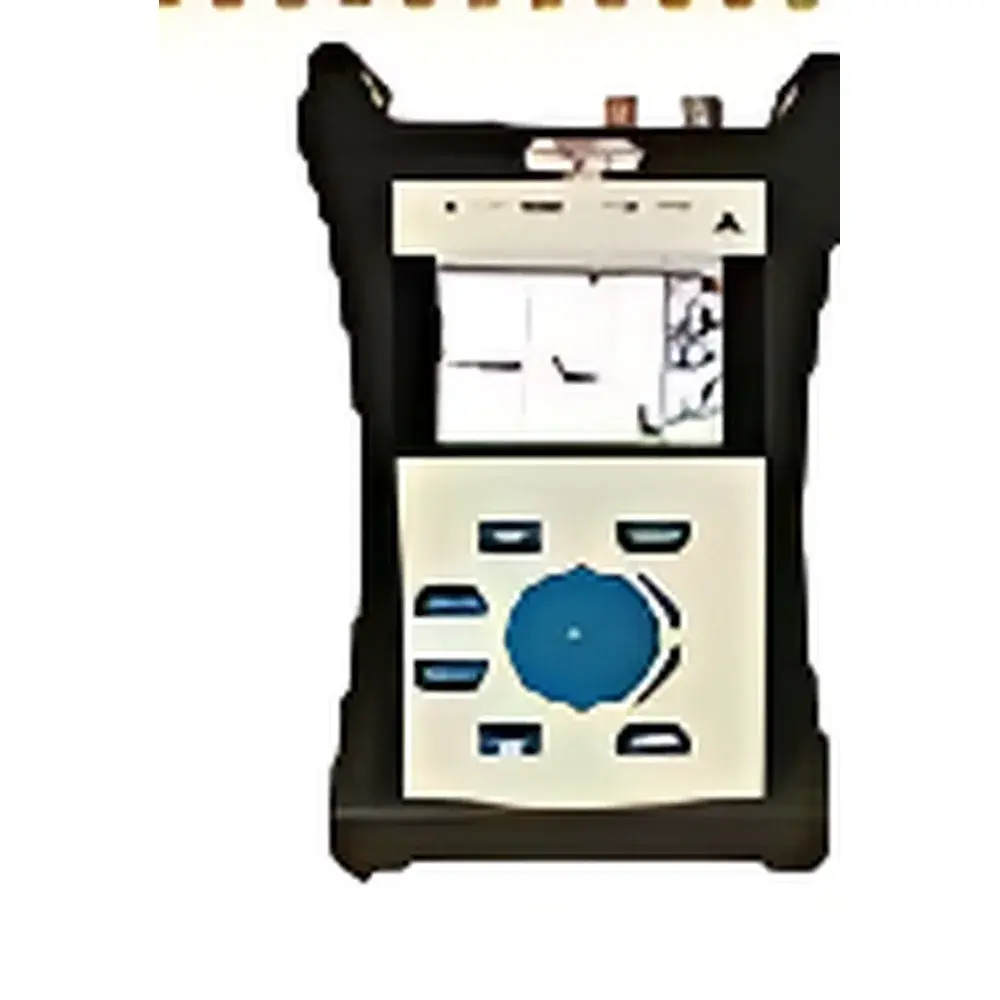
TTI FTE-7500 Optical Time-Domain Reflectometer
| Brand | TTI |
|---|---|
| Origin | USA |
| Model | FTE-7500 |
| Wavelengths | 850/1300 nm (MM), 1310/1550 nm (SM), 1625 nm (optional) |
| Dynamic Range | 27/26 dB (MM), 32/30 dB (SM), 30/29/29 dB (TRI) |
| Pulse Width | 20–10,000 ns |
| Event Dead Zone | 2 m |
| Attenuation Dead Zone | 5 m |
| Distance Resolution | 0.25–64 m |
| Distance Uncertainty | ±(0.75 m + 0.005% × distance + sampling resolution) |
| Max Measurement Range | 240 km (SM), 64 km (MM) |
| Real-time Refresh Rate | 4 Hz |
| Refractive Index Range | 1.024–2.048 |
| Linearity | ±0.05 dB/dB |
| Onboard Memory | 1,000 traces |
| Battery Life | 8 hours |
| Operating Temperature | –10 to 50 °C |
| Storage Temperature | –20 to 60 °C |
| Dimensions (L×W×H) | 197 × 114 × 57 mm |
| Weight | 0.91 kg (2 lbs) |
| Interface | USB Type-A & Mini-USB |
| Connector Options | Interchangeable FC, ST, SC |
Overview
The TTI FTE-7500 Optical Time-Domain Reflectometer (OTDR) is an engineered field instrument designed for precise characterization of optical fiber links across local area networks (LAN), metropolitan area networks (MAN), and long-haul infrastructure. It operates on the principle of time-of-flight analysis: injecting calibrated laser pulses into the fiber and measuring backscattered (Rayleigh) and reflected (Fresnel) light to generate distance-resolved loss profiles. With a maximum measurement range of 240 km in single-mode (SM) configurations and sub-2-meter event dead zone performance, the FTE-7500 delivers high spatial resolution and signal fidelity essential for identifying splices, connectors, bends, breaks, and macro/micro-bend losses. Its dual-wavelength and quad-wavelength variants support comprehensive multimode (850/1300 nm) and single-mode (1310/1550/1625 nm) testing — enabling compliance verification against industry-standard pass/fail thresholds defined in Telcordia GR-196-CORE and ITU-T G.652/G.655 specifications.
Key Features
- Short event dead zone (2 m) and attenuation dead zone (5 m) for accurate detection of closely spaced events such as patch panel connections or cascaded splitters.
- High dynamic range up to 32 dB (SM at 1550 nm), ensuring reliable characterization of long spans with low reflectivity interfaces.
- Real-time trace acquisition at 4 Hz refresh rate, supporting rapid troubleshooting during live network commissioning or maintenance.
- Interchangeable optical adapters (FC, ST, SC) eliminate need for external couplers — reducing setup time and calibration drift risk.
- Integrated color LCD display (4-inch, high-brightness) with intuitive GUI and context-sensitive on-screen help — optimized for both novice technicians and experienced fiber engineers.
- Onboard storage for 1,000 OTDR traces; export via USB flash drive or Mini-USB to host PC for further analysis or archival.
- Ruggedized housing rated for field deployment: shock-absorbing rubber overmold, IP52-rated ingress protection, and thermal stability from –10 °C to 50 °C.
- Built-in pass/fail evaluation engine aligned with Telcordia SR-4731 requirements, automatically flagging events exceeding user-defined loss or reflectance thresholds.
- One-button automated test mode with adaptive pulse width selection — minimizing manual configuration while maintaining measurement integrity.
Sample Compatibility & Compliance
The FTE-7500 supports standard ITU-T G.652.D, G.655, and OM1–OM5 multimode fibers. Its wavelength options comply with IEEE 802.3, ISO/IEC 11801, and EN 50173 fiber certification frameworks. The instrument’s linearity (±0.05 dB/dB) and distance uncertainty (±0.75 m + 0.005% × distance) meet ANSI/TIA-526-14-B and IEC 61280-4-1 test method accuracy requirements for Tier 1 and Tier 2 fiber certification. All firmware and software components are validated per Telcordia SR-4731 Section 4.2 for trace reproducibility and reporting consistency. While not FDA-regulated, its data export architecture supports audit-ready documentation for GLP/GMP-aligned telecom infrastructure validation programs.
Software & Data Management
The included Windows-based analysis suite provides full trace visualization, bi-directional averaging, splice loss calculation (via least-squares regression), and automatic event table generation compliant with Telcordia SR-4731 Appendix A. Trace files are stored in industry-standard .sor format (compliant with IEC 61280-4-1 Annex B), enabling interoperability with third-party platforms including VIAVI SmartLink, EXFO FTB-200, and AFL OptiFiber Pro. Firmware updates are delivered via USB without requiring network connectivity. All onboard memory operations maintain write-cycle integrity — no data corruption during unexpected power loss. Audit trail functionality logs user ID, timestamp, test parameters, and pass/fail status per trace, satisfying internal QA record retention policies.
Applications
- Installation acceptance testing of campus LAN backbone cabling (up to 64 km MM, 240 km SM).
- Preventive maintenance of FTTx distribution networks, including PON splitter characterization and drop cable fault localization.
- Troubleshooting intermittent faults caused by stress-induced loss in aerial or duct-installed cables.
- Verification of fusion splice quality and mechanical connector insertion loss in central offices and headends.
- Baseline documentation for fiber infrastructure prior to service activation under SLA-mandated performance guarantees.
- Training and certification labs requiring repeatable, standards-aligned OTDR practice environments.
FAQ
What wavelengths does the FTE-7500 support?
The base model offers dual-wavelength operation: 850/1300 nm for multimode fiber or 1310/1550 nm for single-mode fiber. Optional configurations include quad-wavelength (850/1300/1310/1550 nm) and triple-wavelength SM (1310/1550/1625 nm) variants.
Is the FTE-7500 compliant with Telcordia SR-4731?
Yes — all factory-default test modes, event detection algorithms, and reporting templates conform to Telcordia SR-4731 Revision 4 requirements for OTDR-based fiber characterization.
Can the instrument perform bi-directional loss analysis?
While the FTE-7500 does not perform real-time bi-directional averaging onboard, exported .sor files are fully compatible with external software that implements IEC 61280-4-1-compliant bi-directional loss calculation.
What is the battery life under continuous use?
The integrated rechargeable Li-ion battery provides ≥8 hours of continuous operation at 25 °C ambient temperature, with runtime scaling inversely with pulse width and averaging count.
Does the unit support external GPS tagging of test locations?
No — GPS functionality is not embedded. Location metadata must be added manually during report generation or via integration with external GIS-enabled asset management systems.