
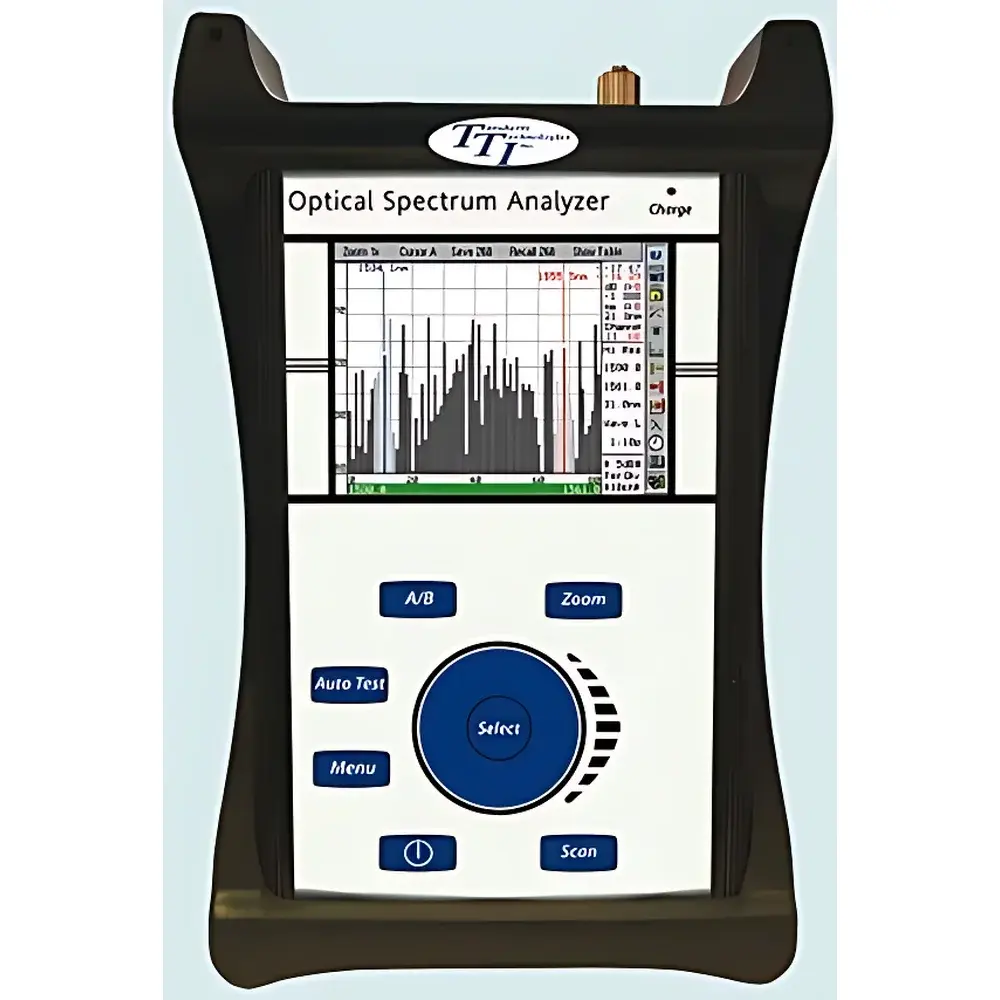
TTI FTE-8000 Handheld Optical Spectrum Analyzer
| Brand | TTI |
|---|---|
| Origin | USA |
| Model | FTE-8000 |
| Wavelength Range | FTE-8000S: 1492–1528 nm (200.9–196.2 THz) |
| FTE-8000C | 1530–1561 nm (196.0–192.0 THz) |
| FTE-8000L | 1572–1608 nm (190.5–186.3 THz) |
| FTE-8000CWDM | 1271–1611 nm |
| Wavelength Accuracy | ±0.1 nm |
| Channel Spacing | 50 GHz, 100 GHz, or 20 nm (CWDM) |
| Power Range | +10 dBm to –50 dBm |
| Absolute Power Accuracy | ±1 dB |
| Resolution | 0.01 dB |
| Polarization-Dependent Loss (PDL) | ±0.15 dB |
| Optical Attenuation Ratio | 40 dBc (@50 GHz) |
| Sweep Time | <0.5 s |
| Return Loss | >40 dB |
| Optical Connector | Universal UPC (FC/SC compatible) |
| Display | 4-inch TFT color LCD |
| Dimensions | 19.7 × 11.45 × 5.6 cm |
| Weight | 0.91 kg |
| Battery | Rechargeable NiMH, 8-hour runtime |
| Operating Temperature | –10 °C to +50 °C |
| Storage Capacity | 1000 test records |
| Interface | USB host/device (for PC and USB flash drive) |
Overview
The TTI FTE-8000 Handheld Optical Spectrum Analyzer is a field-deployable, solid-state optical measurement instrument engineered for high-fidelity spectral characterization of dense wavelength-division multiplexing (DWDM), coarse wavelength-division multiplexing (CWDM), and reconfigurable optical add-drop multiplexer (ROADM) systems. Based on fixed-grating diffraction and optimized photodiode array detection—without moving mechanical parts—the FTE-8000 delivers robust, repeatable spectral power distribution measurements across ITU-T G.694.1-compliant channel grids. Its design prioritizes operational reliability in demanding environments: from central office floor testing and outside plant fiber verification to lab-based EDFA gain flatness validation and DWDM channel power tilt analysis. The analyzer supports full-spectrum acquisition at sub-half-second intervals, enabling real-time monitoring of dynamic network events such as transient power surges, filter drift, or amplifier saturation.
Key Features
- Solid-state optical architecture with no moving components—ensuring long-term calibration stability and resistance to mechanical shock
- Multi-band configuration options: S-band (1492–1528 nm), C-band (1530–1561 nm), L-band (1572–1608 nm), and extended CWDM coverage (1271–1611 nm)
- ITU-T G.694.1 alignment for up to 88 channels at 50 GHz or 100 GHz spacing; CWDM mode supports 20 nm spacing
- Real-time spectral display with bar-chart visualization and numeric channel listing on a 4-inch high-brightness TFT color LCD
- On-device Pass/Fail evaluation with user-definable power thresholds and statistical drift tracking over sequential measurements
- Ruggedized aluminum chassis with overmolded elastomeric bumper—tested to MIL-STD-810G for drop, vibration, and thermal cycling
- Integrated help system guiding first-time users through setup, calibration, and test execution without external documentation
- USB 2.0 interface supporting both host-mode (PC connectivity) and device-mode (direct data export to USB flash drives)
- Onboard storage for 1000 complete spectral scans with timestamp, GPS-tagged metadata (optional), and channel-specific annotations
Sample Compatibility & Compliance
The FTE-8000 is designed for single-mode fiber (SMF-28® compliant) applications and accepts standard UPC-terminated connectors (FC/SC interchangeable via included adapters). It meets IEC 61300-3-35 for connector repeatability and IEC 61280-2-9 for optical spectrum analyzer performance verification. While not certified for safety-critical telecom infrastructure deployment under GR-1089-CORE or Telcordia SR-3580, the instrument complies with FCC Part 15 Class B, CE EN 61326-1 (EMC), and EN 61010-1 (safety) for laboratory and field service use. Its optical input protection circuitry conforms to IEC 61000-4-2 (ESD) Level 4 and IEC 61000-4-4 (EFT) Level 3. For regulated environments requiring auditability, the device supports manual logging of calibration dates and firmware revision history—though it does not implement FDA 21 CFR Part 11 electronic signature or GLP/GMP audit trail functionality natively.
Software & Data Management
The FTE-8000 ships with Windows-compatible desktop software licensed for unlimited installation, enabling automated report generation (PDF/CSV), spectral overlay comparison, and batch processing of stored datasets. All exported files include embedded metadata: instrument serial number, firmware version, date/time stamp, wavelength reference, and user-defined test ID. The software supports spectral mask definition per ITU-T G.694.1, automatic channel identification, and deviation reporting relative to target power levels. USB mass-storage mode allows direct drag-and-drop access to internal memory without proprietary drivers. Firmware updates are delivered via signed .bin packages verified using SHA-256 checksums; rollback capability is retained for traceability during field maintenance.
Applications
- DWDM system commissioning and troubleshooting—including channel insertion loss, OSNR estimation (via noise floor interpolation), and spectral tilt quantification
- EDFA and Raman amplifier gain profile characterization and flatness optimization
- CWDM passive network verification across metro and access segments
- Fiber Bragg grating (FBG) reflection spectrum analysis and center-wavelength validation
- Optical filter passband shape assessment (e.g., interleavers, MUX/DEMUX units)
- Field verification of tunable laser sources and wavelength-stabilized transceivers
- Lab-based research on nonlinear effects (e.g., four-wave mixing suppression via spectral gap analysis)
FAQ
What wavelength bands does the FTE-8000 support, and how are they selected?
The FTE-8000 is available in four factory-configured variants: S-band (1492–1528 nm), C-band (1530–1561 nm), L-band (1572–1608 nm), and CWDM (1271–1611 nm). Band selection is hardware-determined at time of order; no field-swappable optics or firmware upgrades enable cross-band operation.
Does the FTE-8000 provide OSNR measurement capability?
It does not perform direct OSNR calculation via polarization-nulling or out-of-band noise interpolation. However, users may estimate OSNR manually by measuring signal peak power and adjacent noise floor amplitude within a defined resolution bandwidth (RBW) using the built-in marker functions.
Is the instrument suitable for use in outdoor environments with temperature extremes?
Yes—the operating range spans –10 °C to +50 °C, and the sealed enclosure with IP52-rated ingress protection ensures reliable function during rain, dust exposure, and rapid ambient transitions typical of aerial or manhole deployments.
Can test data be exported in formats compatible with network management systems (NMS)?
Exported CSV files contain structured spectral data (wavelength, power, SNR estimate) with column headers conforming to common NMS ingestion schemas. Custom mapping templates can be configured within the desktop software for integration with vendor-specific platforms.
What is the calibration interval recommendation, and is field recalibration possible?
TTI recommends annual calibration against NIST-traceable reference sources. Full recalibration requires return to an authorized service center; end users may perform zero-reference compensation using the built-in dark-current correction routine before each measurement session.






