
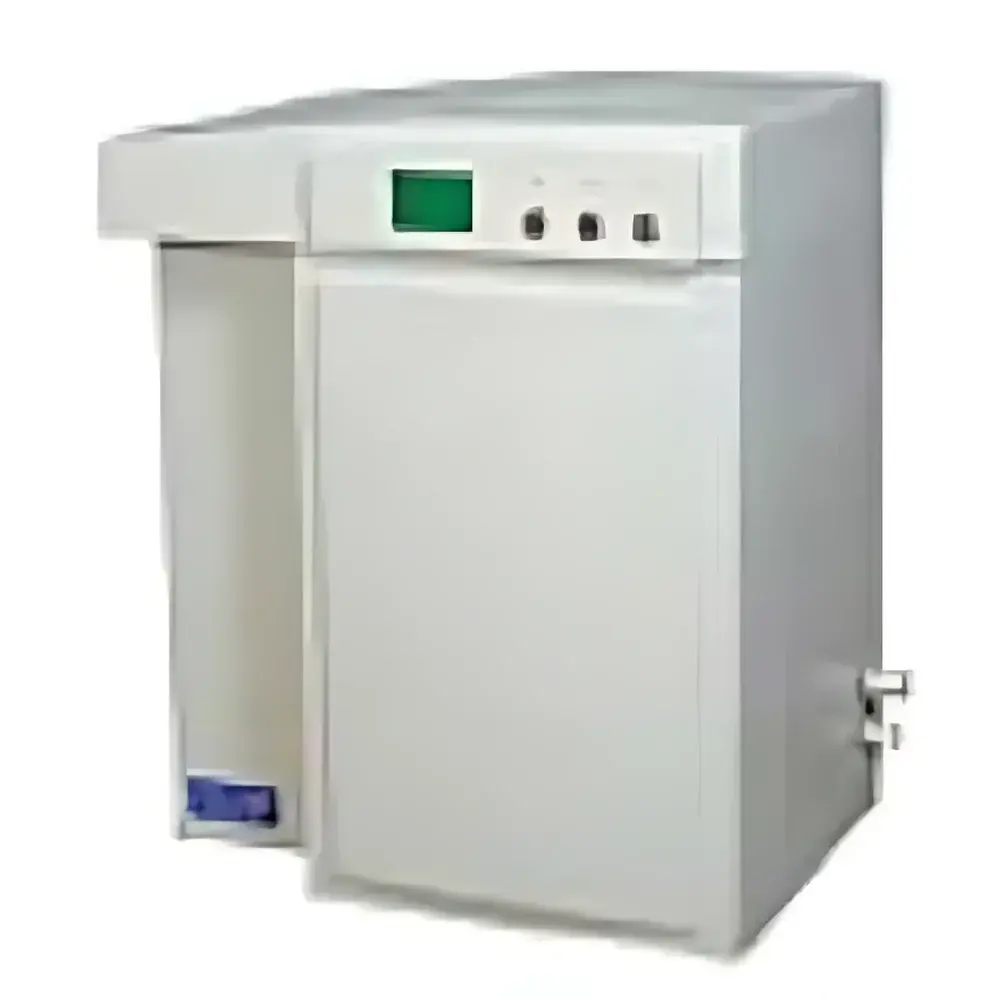
TTL TTL-10A Ultra Pure Water System
| Brand | TTL |
|---|---|
| Origin | Beijing, China |
| Manufacturer Type | Direct Manufacturer |
| Region Classification | Domestic (China) |
| Model | TTL-10A |
| Price Range | USD 1,400 – 4,200 |
| Purified Water Grade | ASTM Type I |
| Resistivity | 18.2 MΩ·cm at 25°C |
| Heavy Metals & Soluble Silica | <0.1 ppb |
| Total Organic Carbon (TOC) | <10 ppb |
| Microbial Count | <0.001 EU/mL |
| Particulates (>0.1 µm) | ≤0.22 particles/mL |
| Feed Water | Municipal tap water |
| Production Rate | 10 L/h |
Overview
The TTL TTL-10A Ultra Pure Water System is an integrated, benchtop-grade purification platform engineered for laboratories requiring continuous, on-demand production of ASTM Type I ultrapure water. It employs a sequential, multi-stage purification architecture—comprising pre-filtration, reverse osmosis (RO), dual-stage ion exchange, and final ultrafiltration—to achieve stringent purity specifications mandated for trace-level analytical applications. The system operates on municipal tap water feedstock and delivers 10 liters per hour of ultrapure water with a resistivity of 18.2 MΩ·cm at 25°C, verified in real time via temperature-compensated conductivity sensors. Its design adheres to core principles of laboratory water quality assurance: reproducibility, contamination control, and operational transparency. Unlike single-stage systems, the TTL-10A integrates an automated RO membrane flush cycle triggered by pressure differential and runtime thresholds—minimizing fouling, extending membrane service life, and maintaining consistent rejection efficiency across extended operation.
Key Features
- Microprocessor-based control system with intuitive Chinese-English bilingual interface and full-system self-diagnostics at startup
- Dual-stage polishing cartridge architecture using high-capacity, low-leaching ion exchange resins certified for low TOC leachables
- Integrated 0.22 µm final ultrafiltration membrane to remove sub-micron particulates, colloids, and endotoxins
- Front-access modular cabinet design enabling rapid cartridge replacement and routine maintenance without tools or system disassembly
- Real-time, temperature-compensated resistivity monitoring with audible/visual alarms for out-of-specification events
- Automatic RO membrane flush protocol activated every 2 hours during standby and after each production cycle
- Low-power standby mode with programmable recirculation loop to maintain reservoir purity between uses
Sample Compatibility & Compliance
The TTL-10A is validated for compatibility with high-sensitivity analytical workflows where background interference must be minimized—including inductively coupled plasma mass spectrometry (ICP-MS), graphite furnace atomic absorption spectroscopy (GFAAS), high-performance liquid chromatography (HPLC), and cell culture media preparation. Its output meets or exceeds ASTM D1193-20 (Type I), ISO 3696:1987 (Grade 1), and CLSI EP22-A guidelines for ultrapure water. While not inherently 21 CFR Part 11 compliant as a standalone device, its digital logging capability supports integration into GLP/GMP environments when paired with validated third-party audit trail software. All wetted materials—including housing, tubing, and cartridges—are USP Class VI-certified and extractables-tested per USP .
Software & Data Management
The TTL-10A features embedded firmware with non-volatile memory for storing up to 12 months of operational logs, including daily production volume, cumulative runtime, cartridge usage hours, and resistivity/TOC excursions. Data export is supported via USB 2.0 port in CSV format for traceability and QA documentation. No cloud connectivity or remote access is implemented—ensuring data sovereignty and alignment with institutional cybersecurity policies. Calibration of the resistivity sensor follows NIST-traceable procedures; calibration certificates are provided with initial commissioning and upon request for revalidation.
Applications
- Preparation of mobile phases and standards for HPLC, UHPLC, and LC-MS
- Sample dilution and reagent formulation for ICP-OES and ICP-MS analysis
- Rinsing of optical components, photomasks, and semiconductor wafers requiring particle-free rinse water
- Feed water for steam generators used in autoclaves supporting sterile processing
- Final rinse in critical cleaning validation protocols for pharmaceutical manufacturing equipment
- Buffer preparation for electrophoresis, ELISA, and qPCR assays sensitive to endotoxin or nucleases
FAQ
What is the expected service life of the RO membrane under typical lab use?
With regular automatic flushing and municipal feed water meeting NSF/ANSI 61 standards, the RO membrane typically lasts 24–36 months before replacement is indicated by >15% decline in rejection rate or persistent resistivity drift below 17.5 MΩ·cm.
Can the system be connected to a central distribution loop?
Yes—the TTL-10A includes a 1/4″ FNPT outlet compatible with standard polyether ether ketone (PEEK) or fluorinated ethylene propylene (FEP) distribution tubing; however, loop integration requires external UV irradiation and recirculation pump for microbial control.
Is TOC monitoring built-in or optional?
TOC measurement is performed offline using external analyzers; the TTL-10A provides TOC-compliant water (<10 ppb) based on resin performance validation and does not include an onboard TOC sensor.
How often must the dual-stage polishing cartridges be replaced?
Cartridge replacement interval depends on feed water quality and daily usage volume; typical replacement occurs every 6–12 months, with firmware tracking cumulative production volume and triggering visual alerts at 90% capacity.
Does the system support remote monitoring via Ethernet or Wi-Fi?
No—the TTL-10A is a standalone instrument with no network interface; all status and diagnostic information is accessible only via the front-panel display and USB data export.
Related Products



