
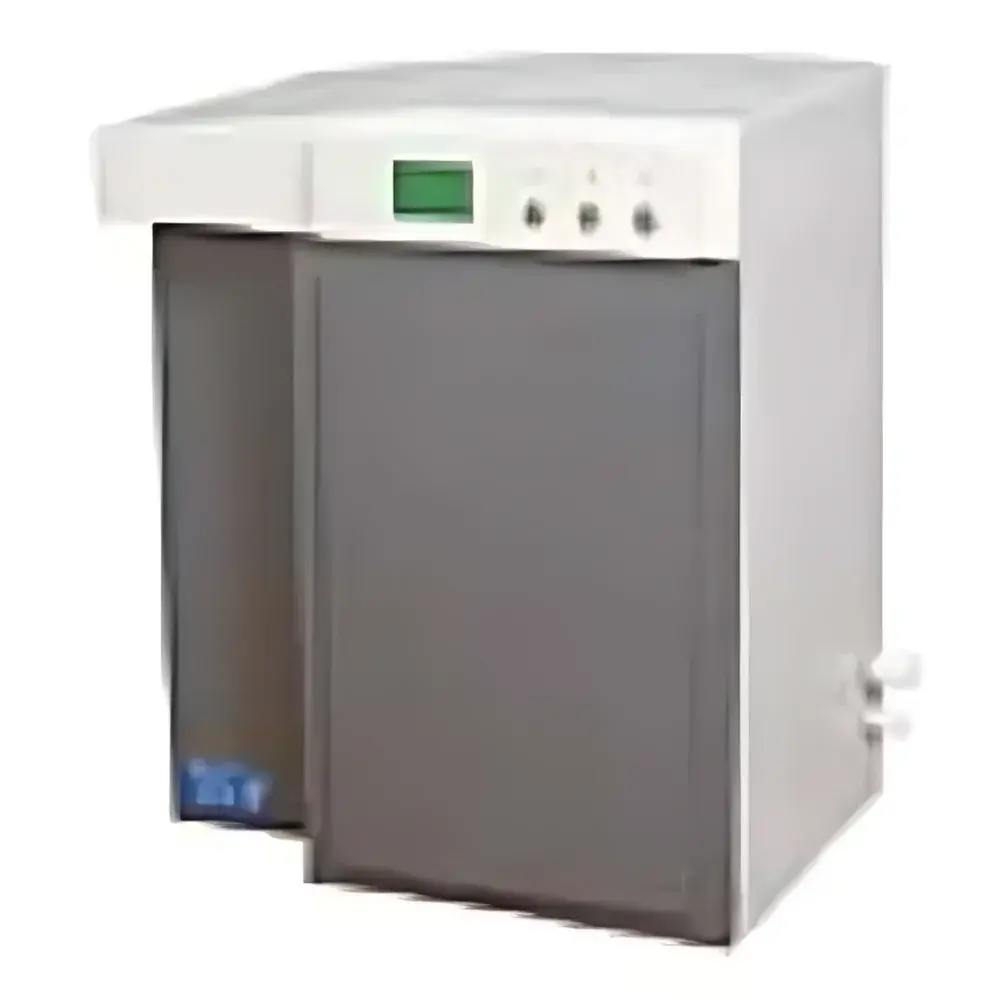
TTL TTL-20B Ultra Pure Water System
| Brand | TTL |
|---|---|
| Origin | Beijing, China |
| Manufacturer Type | Direct Manufacturer |
| Regional Classification | Domestic (China) |
| Model | TTL-20B |
| Price Range | USD 1,400 – 4,200 |
| Purified Water Grade | ASTM Type II / GB/T 6682–1992 Grade II |
| Resistivity | ≥10 MΩ·cm @ 25°C |
| Heavy Metals & Soluble Silica Removal Efficiency | 94–99% |
| Total Organic Carbon (TOC) | <10 ppb |
| Microbial Count | <0.001 CFU/mL |
| Endotoxin Level | <0.001 EU/mL |
| Particulate Removal (>0.1 µm) | >99% |
| Feed Water | Municipal Tap Water |
| Production Flow Rate | 23 L/h |
| Conductivity of Purified Water | <5 µS/cm |
| Housing Material | Full Polypropylene (PP) Construction |
| Control System | Embedded Microprocessor with Chinese GUI |
| Dual-Stage Purification | Integrated RO + Mixed-Bed Ion Exchange + Activated Carbon + UF |
| Auto-RO Flush | Yes |
| Self-Diagnostic Startup | Yes |
| Cartridge Replacement Alert | Yes |
Overview
The TTL TTL-20B Ultra Pure Water System is a compact, benchtop-grade laboratory water purification platform engineered for consistent production of Type II analytical-grade water per ASTM D1193–20 and GB/T 6682–1992 specifications. It employs a validated multi-stage purification architecture—comprising pre-filtration, reverse osmosis (RO), activated carbon adsorption, mixed-bed deionization, and optional ultrafiltration—to remove ionic, organic, particulate, microbial, and endotoxin contaminants from municipal tap feed water. Unlike single-stage systems, the TTL-20B’s dual-stage ion exchange design ensures stable resistivity ≥10 MΩ·cm at 25°C over extended operational cycles, minimizing drift in critical applications such as buffer preparation, HPLC mobile phase formulation, and cell culture media dilution. The system operates without external pressurization or compressed air, relying on an integrated booster pump to maintain nominal 23 L/h output at ≤5 µS/cm conductivity for purified water and <10 ppb TOC for ultra-pure water output.
Key Features
- Full polypropylene (PP) housing—chemically inert, corrosion-resistant, and compliant with ISO 9001-certified manufacturing protocols
- Embedded microprocessor controller with real-time LCD display showing resistivity, conductivity, flow rate, system pressure, and cartridge service life
- Automated RO membrane flush cycle triggered daily or after idle periods >4 hours—reducing biofilm formation and scaling risk
- Self-diagnostic startup sequence verifying sensor calibration, pump function, and valve actuation prior to water delivery
- Intelligent consumables management: visual and audible alerts for RO membrane, carbon block, and mixed-bed resin replacement based on cumulative volume and runtime
- Front-access modular design enabling tool-free replacement of all filtration stages—no disassembly of internal plumbing required
- No external UV lamp or ozone generator; microbial control achieved via 0.1 µm absolute-rated final filter with >99% particle retention efficiency
Sample Compatibility & Compliance
The TTL-20B delivers water suitable for non-critical molecular biology workflows, general analytical chemistry, and routine QC testing where Type II water suffices per ASTM D1193–20 Table I. Its output meets the electrical resistivity (≥10 MΩ·cm), TOC (<10 ppb), and microbial limits (<0.001 CFU/mL) required for EPA Method 1633 sample preparation and USP purified water monograph. While not certified for ISO 3696 Class 1 or ASTM Type I use, the system supports GLP-compliant documentation when paired with optional data logging modules. All wetted components comply with FDA 21 CFR 177.1520 for polyolefins, and the RO membrane element conforms to NSF/ANSI Standard 58 for material safety.
Software & Data Management
The TTL-20B does not include network connectivity or cloud-based software. However, its embedded controller logs timestamped operational events—including daily RO flush activation, conductivity excursions beyond ±5% tolerance, and cartridge replacement records—for local audit trail generation. Optional RS-232 or USB-C interface kits enable export of CSV-formatted system logs to laboratory information management systems (LIMS) for integration into 21 CFR Part 11–aligned electronic record workflows. Calibration certificates for built-in resistivity and temperature sensors are traceable to NIM (National Institute of Metrology, China) standards.
Applications
- Preparation of reagent-grade solutions for titration, spectrophotometry, and atomic absorption spectroscopy
- Routine cleaning of glassware and instrumentation requiring low-conductivity rinse water
- Dilution of standards and stock solutions in environmental testing labs accredited to CNAS-CL01
- Feed water supply for standalone autoclaves and steam generators where endotoxin levels must remain below 0.001 EU/mL
- Supporting role in pharmaceutical stability studies under ICH Q5C guidelines, provided final water contact occurs post-TTL-20B and pre-use filtration is applied
FAQ
What water quality standard does the TTL-20B meet?
It complies with ASTM Type II and GB/T 6682–1992 Grade II specifications for purified water.
Is the system suitable for producing water for HPLC or LC-MS?
No—it is not rated for Type I ultrapure water; users requiring ≤0.05 ppb TOC or <0.1 CFU/mL must implement downstream polishing (e.g., UV oxidation + 0.22 µm PES filter).
Can the TTL-20B be connected to a central lab water network?
It is designed as a standalone unit; no factory-installed manifold or pressure-regulated distribution interface is provided.
How often must consumables be replaced?
RO membrane: every 12–24 months depending on feed water hardness; carbon block: every 6 months; mixed-bed resin: every 6–12 months based on usage volume and resistivity decay profile.
Does the system include validation documentation?
Factory test reports covering flow rate, resistivity, TOC, and microbial testing are supplied; IQ/OQ protocols are available upon request for GMP-aligned installations.



