
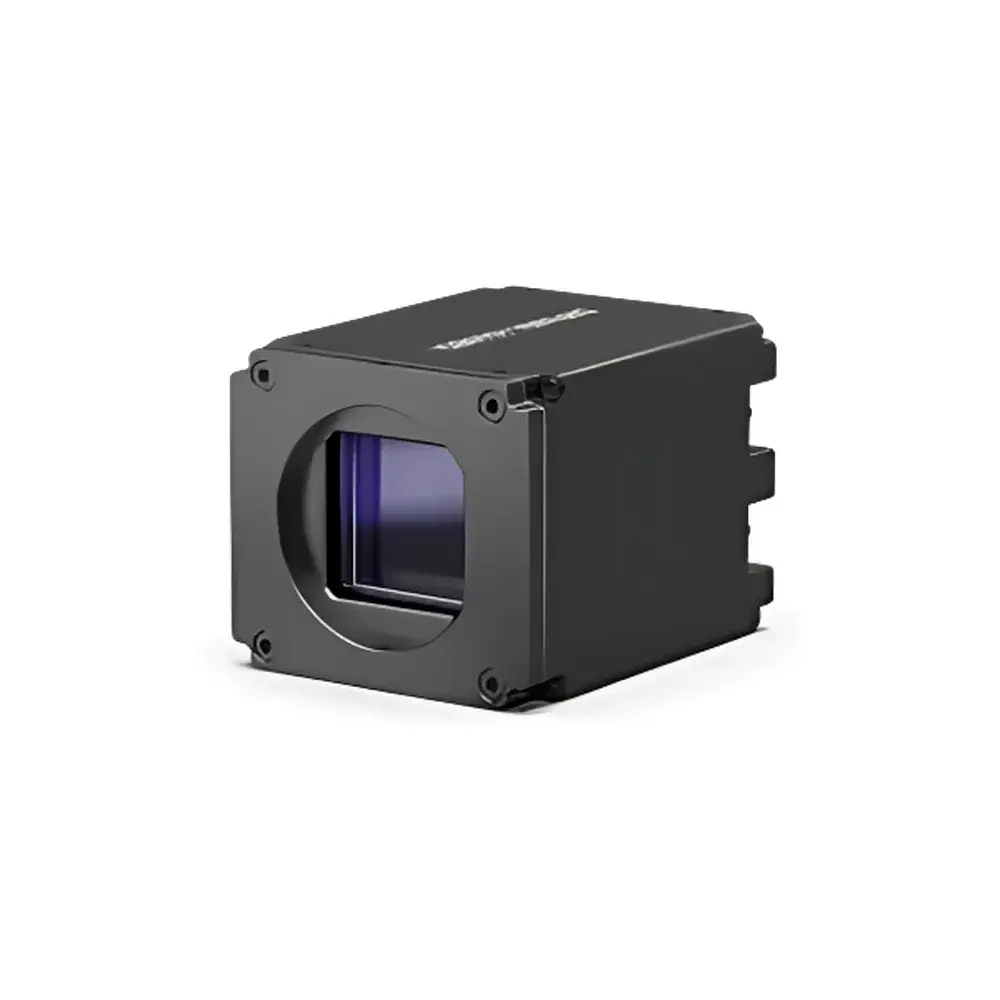
Tucsen Dhyana 4040 V2 Scientific sCMOS Camera for Space Debris Detection, Astrophysics, Soft X-ray Imaging & Quantum Optics
| Brand | Tucsen |
|---|---|
| Origin | Fujian, China |
| Manufacturer Type | OEM Manufacturer |
| Region of Origin | Domestic (China) |
| Model | Dhyana 4040 V2 |
| Image Resolution | 4096 (H) × 4096 (V) |
| Pixel Size | 9 µm × 9 µm |
| Sensor Diagonal | 52.1 mm |
| Readout Speed | 16.5 fps @ CameraLink, 9.7 fps @ USB 3.0 |
| Dynamic Range | 86 dB |
| Quantum Efficiency | 74% @ 600 nm |
Overview
The Tucsen Dhyana 4040 V2 is a high-performance, large-format scientific CMOS (sCMOS) camera engineered for demanding low-light, quantitative imaging applications in space situational awareness, astrophysical observation, soft X-ray detection, and quantum optical experiments. Built around the Gpixel GSENSE4040 front-side illuminated (FSI) sCMOS sensor, it features a 52.1 mm diagonal active area—among the largest monolithic sCMOS sensors commercially available—enabling wide-field, single-shot acquisition without image tiling or mechanical scanning. Its architecture leverages true sCMOS advantages over legacy CCD technology: significantly higher frame rates, lower read noise (3.6 e⁻ RMS), broader dynamic range (86 dB), and superior photon capture efficiency—critical for detecting faint, transient objects such as orbital debris or weak quantum emission signatures. The sensor operates with global shutter-compatible rolling shutter timing and supports ultra-long exposures (up to 3600 s), making it suitable for both time-resolved quantum correlation measurements and deep-sky astronomical surveys.
Key Features
- 52.1 mm diagonal FSI sCMOS sensor with native 4096 × 4096 resolution and 9 µm pixel pitch, delivering high spatial sampling across wide fields-of-view
- Peak quantum efficiency of 74% at 600 nm, enhanced by anti-reflective and back-thinning optimizations for extended response into soft X-ray (0.1–2 keV) and near-UV bands when coupled with appropriate phosphor or direct-detection optics
- High dynamic range (86 dB) enabled by 70 ke⁻ full-well capacity and sub-4 e⁻ read noise—ideal for simultaneous capture of saturated and sub-photon-level signals in heterogeneous illumination environments
- Dual cooling options (forced-air and liquid) achieving ΔT ≤ −45 °C below ambient; dark current reduced to ≤ 0.1 e⁻/pix/s under water-cooled operation, essential for long-exposure astrometry and spectroscopy
- Precision photometric calibration suite including DSNU (Dark Signal Non-Uniformity) and PRNU (Photo Response Non-Uniformity) correction, traceable to NIST-traceable flat-field and dark-reference standards
- Hardware-triggered synchronization with <1 µs timestamp accuracy and optional GPS-disciplined 8 ns time-stamping—required for multi-site coincidence detection in quantum entanglement experiments and radar-aided space object tracking
Sample Compatibility & Compliance
The Dhyana 4040 V2 is compatible with standard astronomical optical trains (F-mount interface, optionally customizable), vacuum-compatible enclosures (with feedthrough connectors), and synchrotron beamline endstations. Its mechanical and electrical design conforms to CE, FCC Class A, and RoHS directives. For regulated research environments—including federally funded observatories and national space surveillance programs—the camera supports audit-ready metadata logging (exposure time, temperature, gain, trigger source) aligned with ISO/IEC 17025 documentation requirements. While not FDA-certified (as it is not a medical device), its deterministic timing, deterministic data flow, and deterministic firmware update protocol satisfy GLP-compliant instrument qualification criteria per ASTM E2500 and ICH Q9.
Software & Data Management
Native SDKs for C, C++, and C# enable seamless integration into custom acquisition pipelines (e.g., Python-based observatory control systems or LabVIEW-based quantum optics setups). Pre-compiled drivers support Windows (x64) and Linux (kernel ≥ 5.4) platforms. Third-party compatibility includes Mosaic 1.6, MaxIm DL, MATLAB Image Acquisition Toolbox, and National Instruments Vision Builder. All software modules implement lossless 16-bit linear data export (TIFF, FITS), embedded FITS header compliance (including WCS keywords for astrometric registration), and optional on-the-fly bias/dark/flat correction. Audit trails—including acquisition timestamps, environmental telemetry (sensor temperature, cooler power), and user-defined experiment IDs—are stored in SQLite-backed logs compliant with 21 CFR Part 11 electronic record retention guidelines when deployed in regulated QC/QA workflows.
Applications
- Space debris monitoring via ground-based optical tracking telescopes, where large FOV and high SNR enable detection of sub-10 cm objects in LEO at magnitude >20
- Stellar photometry and exoplanet transit spectroscopy using differential imaging techniques requiring stable, calibrated photometric baselines over hours
- Soft X-ray imaging in laboratory-scale plasma diagnostics and synchrotron beamlines, leveraging thin CsI scintillators coupled to the sensor
- Quantum optics experiments involving Hong-Ou-Mandel interference, Bell-state measurement, and time-of-flight entanglement distribution—where precise inter-frame timing and single-photon sensitivity are critical
- High-resolution laser-induced fluorescence (LIF) and particle image velocimetry (PIV) in hypersonic wind tunnels and combustion research facilities
FAQ
What cooling methods are supported, and what is the minimum achievable sensor temperature?
The Dhyana 4040 V2 supports both forced-air and liquid cooling. With water cooling at 20 °C ambient, the sensor can be stabilized up to 45 °C below ambient—i.e., down to −25 °C—ensuring dark current remains ≤ 0.1 e⁻/pix/s.
Is the camera compatible with vacuum environments?
Yes, the housing is hermetically sealable and compatible with UHV-compatible feedthroughs (e.g., SMA, CC1); optional vacuum-rated variants are available upon request.
Does the camera support hardware triggering with external timing sources like GPS or atomic clocks?
Yes—via SMA inputs supporting TTL/CMOS logic levels, with programmable trigger modes (start-of-exposure, global reset, end-of-readout) and optional GPS-referenced PPS input for sub-10 ns absolute time alignment.
Can I perform real-time flat-field and dark-current correction during acquisition?
Yes—both corrections are implemented in FPGA firmware and applied in real time when reference frames are loaded; correction coefficients are saved in non-volatile memory and persist across reboots.
What is the maximum sustained data throughput over CameraLink?
At full resolution and 16.5 fps, the sustained throughput is 2.7 GByte/s, compatible with Base/Medium/Full CameraLink configurations using 80-bit parallel transmission.




