
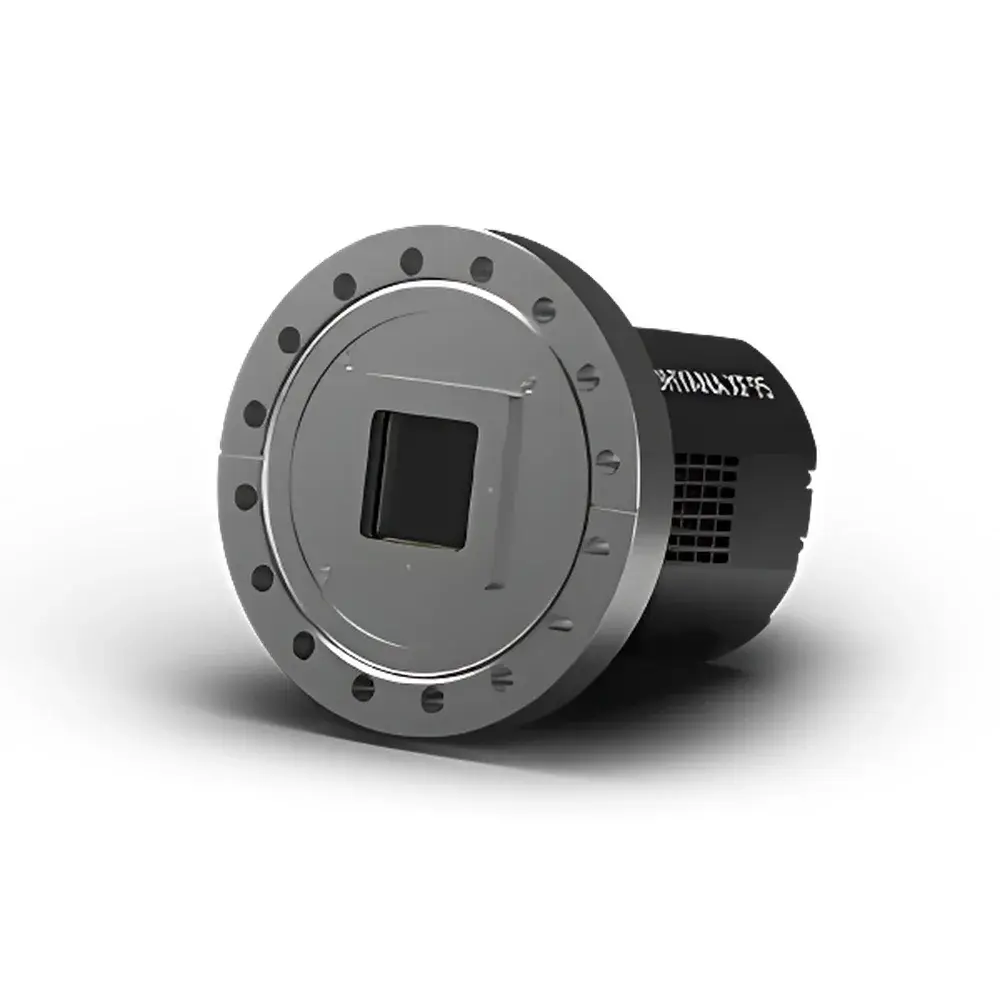
Tucsen Dhyana XF95 Back-Illuminated sCMOS Camera for Soft X-ray Scattering, EUV Spectroscopy, Ptychography, and High-Harmonic Generation Imaging
| Brand | Tucsen |
|---|---|
| Origin | Fujian, China |
| Manufacturer Type | Original Equipment Manufacturer (OEM) |
| Region of Origin | Domestic (China) |
| Model | Dhyana XF95 |
| Image Resolution | 2048 × 2048 |
| Pixel Size | 11 µm × 11 µm |
| Sensor Diagonal | 31.9 mm |
| Dynamic Range | 90 dB |
| Quantum Efficiency | ~100% @ 80–1000 eV |
Overview
The Tucsen Dhyana XF95 is a high-performance, vacuum-compatible, back-illuminated scientific CMOS (sCMOS) camera engineered specifically for demanding photon-starved applications in the soft X-ray (SXR), extreme ultraviolet (EUV), and high-harmonic generation (HHG) regimes. Unlike front-illuminated sensors, the XF95 employs an uncoated, deep-depletion back-illuminated architecture—based on the Gpixel GSENSE400BSI sensor platform—optimized to eliminate absorption losses at low photon energies. This design delivers quantum efficiency (QE) exceeding 90% across the full 80–1000 eV range, with peak QE approaching 100% between ~100–400 eV—a critical band for resonant scattering at carbon, oxygen, nitrogen, and transition-metal L-edges. Its performance aligns with the stringent requirements of synchrotron beamlines, free-electron laser (FEL) endstations, tabletop HHG sources, and laboratory-scale EUV lithography testbeds. The camera’s mechanical and thermal architecture supports operation under ultra-high vacuum (UHV) conditions down to 10⁻⁷ Pa, enabling direct integration into experimental chambers without differential pumping or window-based coupling.
Key Features
- Vacuum-rated housing compliant with UHV standards (≤10⁻⁷ Pa), certified for in-chamber mounting in SXR/EUV beamlines and FEL endstations
- Deep-cooling capability: thermoelectric cooling to −50 °C (ΔT ≤ 70 °C below ambient), reducing dark current to ≤0.1 e⁻/pixel/s and enabling exposures up to 10 seconds with minimal thermal noise
- High-fidelity readout: median read noise of 1.6 e⁻ in high-gain mode, >99% pixel-to-pixel linearity, and <0.3% photo-response non-uniformity (PRNU)
- Flexible acquisition modes: global shutter emulation via synchronized hardware triggering, rolling shutter with configurable exposure (21 µs – 10 s), and HDR mode supporting dual-gain readout at 24 fps
- Multi-interface connectivity: Camera Link (base configuration) and USB 3.0 (for lab-integrated control), with SMA-trigger I/O for precise synchronization to pump-probe lasers, choppers, or pulsed sources
- Modular mechanical interface: DN100 CF flange standard; custom flanges (e.g., DN63 CF, KF40, or ISO-KF) available upon request for beamline integration
Sample Compatibility & Compliance
The Dhyana XF95 is routinely deployed in experiments governed by ISO/IEC 17025-accredited metrology protocols and GLP-compliant synchrotron user facilities. Its radiation-hardened sensor stack demonstrates robustness against cumulative dose exposure in SXR environments—validated through accelerated lifetime testing at beamlines such as BESSY II (HZB), ALBA (CELLS), and SSRF. The absence of anti-reflection coatings eliminates spectral artifacts and interfacial degradation under EUV irradiation. All firmware and driver binaries comply with Linux kernel LTS (5.10+) and Windows 10/11 WHQL signing requirements. Data provenance is preserved via microsecond-precision hardware timestamping and trigger-locked metadata embedding—supporting audit readiness for FDA 21 CFR Part 11–aligned workflows where imaging data serves as primary analytical evidence.
Software & Data Management
The XF95 is supported by Tucsen’s Mosaic SDK (v4.3+), offering native C/C++, C#, and Python bindings compatible with PyTorch, NumPy, and HDF5-based pipelines. It integrates seamlessly with open-source microscopy frameworks including Micro-Manager 2.0, ImageJ/Fiji (via LOCI Bio-Formats), and MATLAB’s Image Acquisition Toolbox. For time-resolved ptychography or single-shot SXR scattering, the SDK provides real-time ROI binning (2×2, 4×4), frame buffering with ring-buffer DMA, and lossless 16-bit TIFF/BigTIFF export with embedded EXIF-style metadata (exposure, temperature, trigger status, gain setting). Optional LabVIEW drivers include VI libraries for NI PXIe timing synchronization—enabling sub-100 ns jitter alignment with delay-stage controllers in pump-probe setups.
Applications
- Resonant soft X-ray scattering (RSXS) for charge-ordering and magnetic domain mapping in correlated oxides
- Ptychographic coherent diffractive imaging (CDI) of nanoscale biological specimens (e.g., frozen-hydrated viruses) using tabletop HHG sources
- EUV reflectometry and mask inspection at 13.5 nm in semiconductor metrology labs
- Time-resolved photoemission electron microscopy (PEEM) detection with fs-laser excitation
- In situ catalysis studies under reactive gas environments using differential pumping-compatible chamber integration
- Calibration reference detector for absolute photon flux measurement at synchrotron bending magnets and undulators
FAQ
Is the Dhyana XF95 suitable for in-vacuum operation at 10⁻⁷ Pa?
Yes—the camera’s hermetically sealed, all-metal housing and feedthrough-qualified connectors are rated for continuous operation at ≤10⁻⁷ Pa without outgassing or cold-trapping risks.
What is the effective full-well capacity and how does it impact dynamic range?
The typical full-well capacity is 90 ke⁻ per pixel. Combined with 1.6 e⁻ read noise and 16-bit digitization, this yields a measured dynamic range of 90 dB—enabling simultaneous capture of weak diffuse scattering and intense Bragg peaks in a single exposure.
Can the camera be synchronized to external laser pulses with sub-microsecond jitter?
Yes—hardware triggering supports TTL-compatible input with <200 ns latency and <50 ns jitter; optional FPGA-based timing module (XF95-TIM) extends precision to <10 ns RMS jitter for FEL synchronization.
Does the SDK support real-time GPU-accelerated reconstruction for ptychography?
Yes—Mosaic SDK includes CUDA-accelerated modules for iterative phase retrieval (ePIE, DM), compatible with NVIDIA A100/V100 GPUs and deployable within Jupyter-based analysis notebooks.
Is vacuum bake-out supported?
The camera is not rated for bake-out above 60 °C; however, it maintains UHV integrity after standard 120 °C, 24-hour chamber bake-out when installed behind a cooled shield or isolated via gate valve.






