
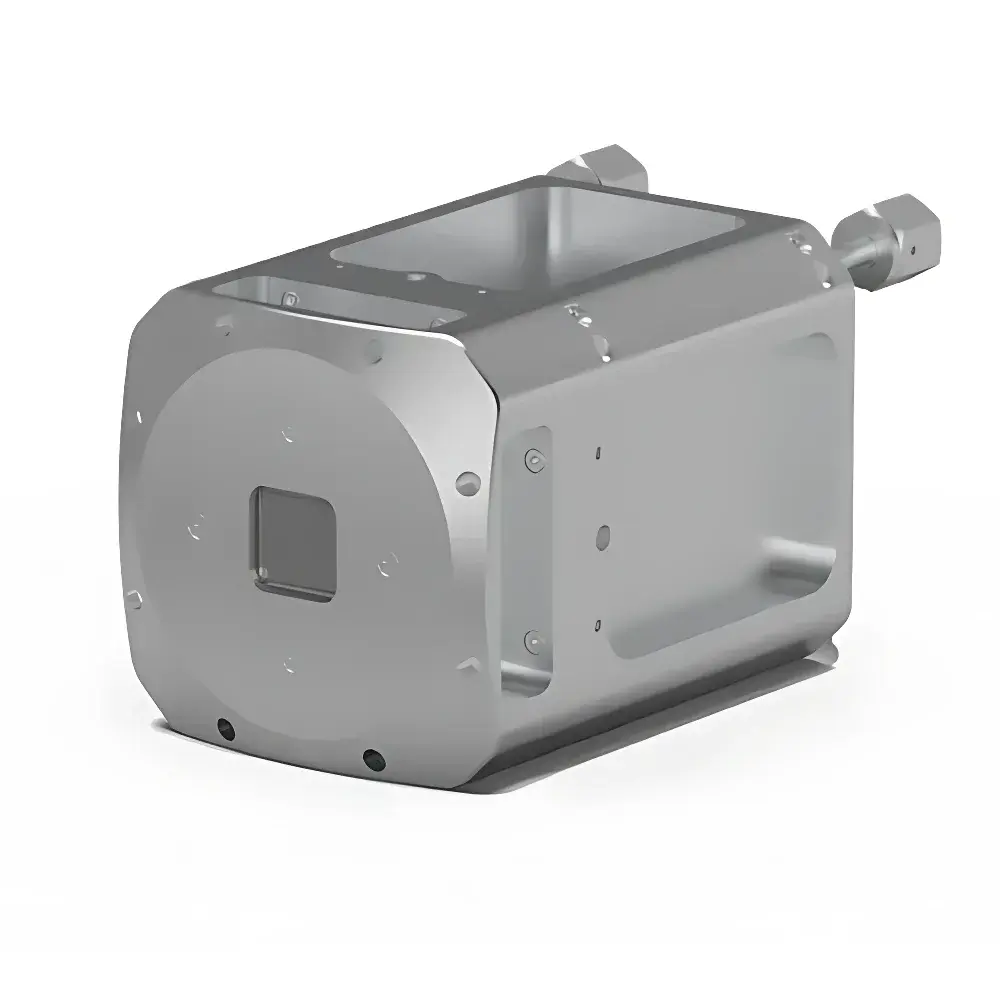
Tucsen Dhyana XV95 In-Vacuum sCMOS Camera for Soft X-ray Scattering, EUV Spectroscopy, Ptychography, and High-Harmonic Generation
| Brand | Tucsen |
|---|---|
| Origin | Fujian, China |
| Manufacturer Type | OEM Manufacturer |
| Product Category | Domestic |
| Model | Dhyana XV95 (In-Vacuum) |
| Imaging Resolution | 4.2 MP, 2048 (H) × 2048 (V) |
| Pixel Size | 11 µm × 11 µm |
| Sensor Active Area | 22.5 mm × 22.5 mm |
| Readout Speed | HDR: 24 fps |
| STD | 48 fps |
| Dynamic Range | 90 dB |
| Quantum Efficiency | ~100% @ 80–1000 eV |
Overview
The Tucsen Dhyana XV95 is a purpose-engineered in-vacuum scientific CMOS (sCMOS) camera designed for high-fidelity detection in soft X-ray (SXR), extreme ultraviolet (EUV), and high-harmonic generation (HHG) experimental environments. Operating across the photon energy range of 80–1000 eV (corresponding to wavelengths of ~12.4–1.24 nm), it leverages a back-illuminated, anti-reflection-coating-free sCMOS sensor—specifically the GSENSE 400BSI-PS—to achieve near-unity quantum efficiency (>90% average, up to ~100% at select energies). This performance enables quantitative, low-noise imaging essential for coherent diffraction techniques such as ptychography, time-resolved SXR scattering, EUV spectroscopy, and single-shot HHG beam characterization. Its vacuum-compatible mechanical architecture (rated to ≤10⁻⁶ Pa) and integrated water-cooled thermal management (stabilized to –45 °C at ambient 20 °C) ensure stable operation within synchrotron beamlines, free-electron laser endstations, and tabletop HHG vacuum chambers—without compromising dark current suppression or long-exposure fidelity.
Key Features
- In-vacuum rated design compliant with UHV systems (≤10⁻⁶ Pa), featuring DN100 CF rear flange interface for direct integration into beamline vacuum chambers.
- Back-illuminated sCMOS sensor with no AR coating—optimized for native soft X-ray/EUV response and radiation hardness under prolonged exposure.
- Ultra-low read noise (1.6 e⁻ median) and high full-well capacity (85 ke⁻) enabling high dynamic range (90 dB) imaging without pixel saturation or nonlinearity artifacts.
- Programmable rolling shutter with exposure range from 21 µs to 300 s, supporting both pulsed (e.g., FEL, HHG) and continuous (synchrotron bending magnet) sources.
- Hardware-triggered acquisition with sub-microsecond timestamp precision (1 µs), synchronized to external timing signals via Hirose connector (exposure start, global reset, readout completion).
- Water-cooling system maintains sensor temperature at –45 °C (±0.1 °C stability) under 20 °C ambient conditions, reducing dark current to 100 s integrations with negligible thermal drift.
Sample Compatibility & Compliance
The Dhyana XV95 is engineered for use in regulated and research-grade photon science infrastructure. It supports standard vacuum interlocks and bake-out protocols (≤70 °C), conforms to ISO 8573-1 Class 4 compressed air requirements for auxiliary cooling interfaces (if applicable), and meets CE electromagnetic compatibility directives (2014/30/EU). While not certified to FDA 21 CFR Part 11 or GLP/GMP by default, its deterministic trigger behavior, hardware timestamping, and audit-ready metadata logging (via Mosaic and LabVIEW SDKs) facilitate compliance with ISO/IEC 17025-accredited laboratory workflows. The camera’s radiation-tolerant sensor stack and absence of organic adhesives or epoxies in the optical path align with long-term reliability expectations in synchrotron and FEL user facilities.
Software & Data Management
The Dhyana XV95 integrates natively with open-source and commercial scientific platforms including Micro-Manager, MATLAB Image Acquisition Toolbox, and LabVIEW via documented C/C++/C# SDKs. Tucsen’s Mosaic software provides real-time histogram analysis, region-of-interest (ROI) binning (2×2, 4×4), non-uniformity correction (DSNU <0.2, PRNU 99%). All acquired frames embed precise UTC-synchronized timestamps, exposure metadata, and sensor temperature logs—enabling traceable post-processing in Python-based pipelines (e.g., PtychoNN, PyNX, or custom FFT-based scattering analysis). Raw data export supports TIFF (16-bit), HDF5, and FITS formats, ensuring interoperability with ESRF, DESY, and APS beamline data reduction frameworks.
Applications
- Coherent diffractive imaging (CDI) and ptychographic reconstruction of nanoscale specimens using soft X-ray free-electron lasers.
- Time-resolved resonant elastic/inelastic X-ray scattering (REXS/RIXS) at synchrotron beamlines operating in the water window (284–543 eV).
- EUV plasma diagnostics and multilayer mirror reflectivity mapping in lithography R&D setups.
- Single-shot characterization of high-harmonic spectra and spatial mode structure from gas-phase HHG sources.
- In situ monitoring of ultrafast phase transitions in correlated electron materials via pump-probe SXR diffraction.
- Quantitative radiometry of laboratory-scale X-ray sources (e.g., laser-produced plasmas, pinch devices) with calibrated absolute QE response.
FAQ
Is the Dhyana XV95 suitable for out-of-vacuum (in-air) operation?
No—it is specifically designed as an in-vacuum device with hermetic sealing and water-cooling plumbing optimized for UHV integration. Operation outside vacuum requires external vacuum feedthroughs and is not supported.
What is the maximum allowable bake-out temperature for the camera body?
The mechanical housing and flange assembly are rated for bake-out up to 70 °C; however, active cooling must be disabled during bake-out, and sensor temperature must be restored to operational setpoint prior to acquisition.
Does the camera support global shutter mode?
No—it uses a precisely controlled rolling shutter with hardware-synchronized exposure control; global reset functionality is available for frame synchronization but does not eliminate rolling shutter distortion.
Can the camera be used with existing beamline control systems (EPICS, TANGO)?
Yes—via the provided C++ SDK and documented memory-mapped I/O interface, integration with EPICS IOC or TANGO device servers has been validated by multiple European synchrotron facilities.
Is quantum efficiency calibration data provided with each unit?
Yes—each shipped XV95 includes a NIST-traceable QE curve measured at ≥15 discrete energies between 80–1000 eV, delivered in CSV and HDF5 format with uncertainty budgets per ISO/IEC 17025 Annex A.



