
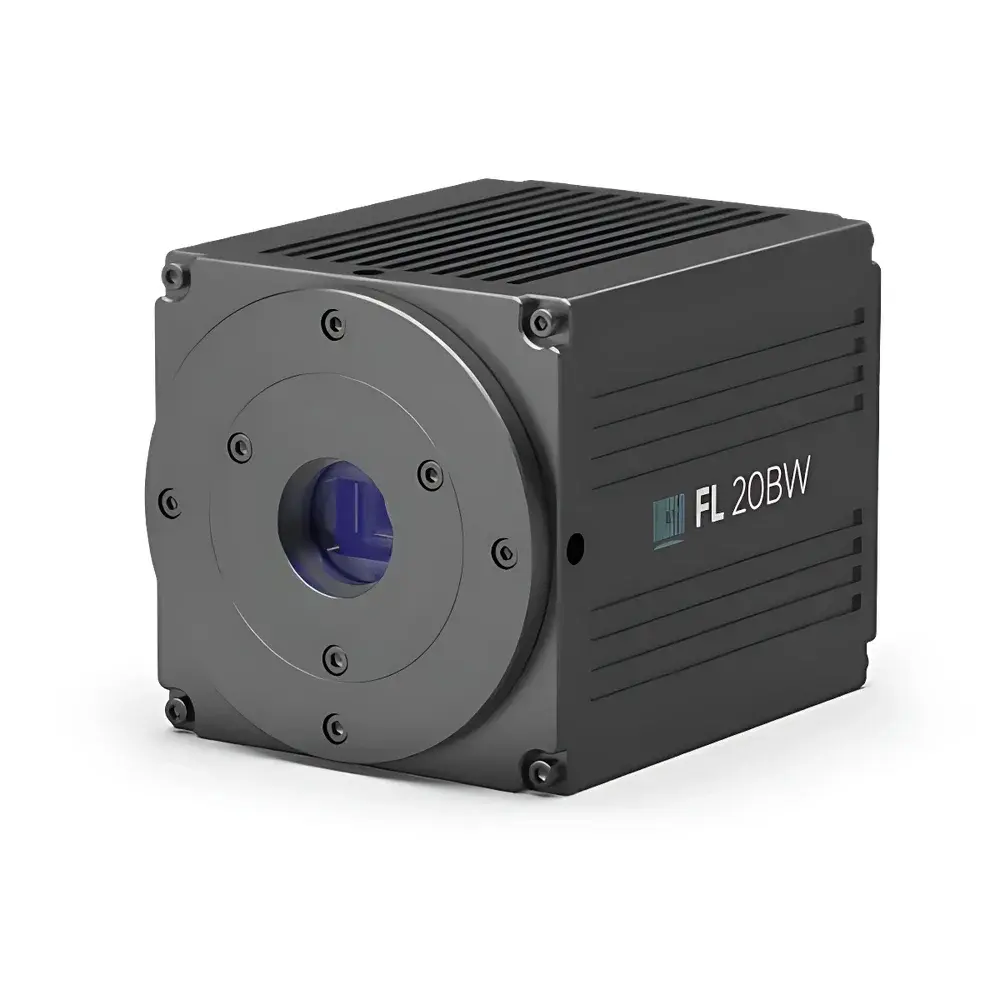
Tucsen FL20BW Scientific sCMOS Camera for Fluorescence Imaging, qPCR, dPCR & Chemiluminescence
| Brand | Tucsen |
|---|---|
| Origin | Fujian, China |
| Manufacturer Type | OEM Manufacturer |
| Region of Origin | Domestic (China) |
| Model | FL20BW |
| Image Resolution | 5472 × 3648 (20 MP) |
| Pixel Size | 2.4 µm × 2.4 µm |
| Sensor Format | 13.1 mm × 8.8 mm (1-inch diagonal) |
| Readout Speed | 67 fps @ 1824 × 1216 (8-bit) |
| Quantum Efficiency | 84% @ 495 nm |
| Dark Current | 0.001 e⁻/pixel/s |
| Bit Depth | 16-bit |
| Read Noise | 0.6 e⁻ |
| Shutter Type | Rolling |
| Exposure Range | 3 µs – 1 h |
| DSNU | 0.2 e⁻ |
| PRNU | 0.8% |
| Binning Modes | 2×2, 3×3, 4×4, 8×8 |
| Interface | USB 3.0 |
| Mount | C-mount |
| Power Supply | 12 V DC |
| Operating Temp. | 0–40 °C |
| Storage Temp. | −10–60 °C |
| Dimensions | 85 × 85 × 112 mm |
| OS Support | Windows, Linux |
| SDK | C/C++/C#, DirectShow, TWAIN |
| File Formats | TIFF, JPEG, PNG, DICOM |
Overview
The Tucsen FL20BW is a high-performance scientific back-illuminated sCMOS camera engineered for quantitative multimodal optical imaging in life science and clinical diagnostics laboratories. Designed specifically for fluorescence microscopy, real-time quantitative PCR (qPCR), digital PCR (dPCR), and low-light chemiluminescence detection, the FL20BW integrates a Sony IMX183CLK-J BSI CMOS sensor with advanced on-chip cooling architecture to deliver exceptional photon capture efficiency and temporal fidelity. Its 1-inch optical format (15.86 mm diagonal) provides optimal field-of-view coverage for standard 40×–100× microscope objectives while maintaining high spatial sampling density across the full 20-megapixel array. The camera operates on a true scientific imaging principle—leveraging high quantum efficiency (>84% at 495 nm), sub-electron read noise (0.6 e⁻), and ultra-low dark current (0.001 e⁻/pixel/s)—to ensure linear, reproducible intensity response across exposure durations from microseconds to one hour. This enables reliable quantification of weak chemiluminescent signals in Western blotting, precise cycle threshold (Ct) determination in qPCR assays, and statistically robust partition counting in dPCR workflows—all without saturation or nonlinearity artifacts.
Key Features
- Back-illuminated sCMOS sensor (Sony IMX183CLK-J) with 20 MP resolution (5472 × 3648) and 2.4 µm pixel pitch
- Peak quantum efficiency of 84% at 495 nm, optimized for common fluorophores (e.g., FITC, GFP, SYBR Green)
- Active semiconductor cooling achieving <0.001 e⁻/pixel/s dark current at ambient operating temperatures (0–40 °C)
- Dynamic range exceeding 85 dB (calculated from 16-bit full-well capacity and 0.6 e⁻ read noise)
- Flexible readout modes: up to 67 fps at binned 1824 × 1216 (8-bit), 16 fps at full-resolution 5472 × 3648 (8-bit), and 8 fps at 16-bit depth
- Rolling shutter with programmable exposure (3 µs – 1 h) and hardware-triggered acquisition for synchronization with thermal cyclers or light sources
- Low fixed-pattern noise: DSNU ≤ 0.2 e⁻ and PRNU ≤ 0.8%, critical for multi-frame averaging and ratiometric analysis
- C-mount interface compatible with standard inverted and upright microscopes, gel documentation systems, and PCR instrument integration modules
Sample Compatibility & Compliance
The FL20BW supports standardized sample formats used across molecular biology and histopathology workflows—including 96-well and 384-well PCR plates, mini-gels, blot membranes, and tissue sections mounted on standard glass slides. Its calibrated linearity and uniformity meet requirements for quantitative assay validation under ISO/IEC 17025 and CLIA guidelines. When deployed in regulated environments (e.g., clinical qPCR labs), the camera’s deterministic frame timing, audit-trail-capable SDK logging, and metadata-embedded TIFF/DICOM output facilitate compliance with FDA 21 CFR Part 11 for electronic records and signatures. Firmware and driver versions are version-controlled and traceable, supporting GLP/GMP documentation practices during method transfer and instrument qualification (IQ/OQ/PQ).
Software & Data Management
The FL20BW is fully supported by Tucsen’s Mosaic acquisition software (Windows/Linux), offering real-time histogram visualization, region-of-interest (ROI) intensity profiling, background subtraction, flat-field correction, and time-lapse sequence export in multi-page TIFF or DICOM series. For integration into custom pipelines, the cross-platform SDK provides native APIs in C, C++, and C#, along with wrappers for Python (via ctypes) and MATLAB. Simultaneous control of up to four FL20BW units is enabled via USB 3.0 bandwidth management—essential for multiplexed dPCR partition analysis or multi-channel fluorescence co-localization studies. All acquired images embed EXIF-compliant metadata (exposure time, gain, temperature, binning, timestamp), ensuring traceability and interoperability with LIMS and ELN systems.
Applications
- High-sensitivity fluorescence imaging of live-cell dynamics, immunofluorescence, and FISH assays
- Quantitative endpoint and real-time detection in SYBR Green- or probe-based qPCR systems
- Digital PCR droplet or chamber-based absolute nucleic acid quantification with single-molecule resolution
- Chemiluminescent detection of horseradish peroxidase (HRP)- or alkaline phosphatase (AP)-conjugated antibodies in Western blots and ELISAs
- Time-resolved bioluminescence imaging in reporter gene assays (e.g., luciferase)
- Automated colony counting and gel band densitometry in molecular biology core facilities
FAQ
Is the FL20BW suitable for FDA-regulated qPCR assay validation?
Yes—the camera’s linear response, low noise floor, and metadata-rich image output support analytical method validation per USP and ISO 13485 requirements when integrated into validated instrument platforms.
Does the SDK support trigger synchronization with thermal cyclers?
Yes—hardware TTL trigger input/output lines enable precise frame alignment with PCR cycle transitions, including denaturation, annealing, and extension phases.
Can the FL20BW be used for super-resolution microscopy techniques?
While not designed for STORM/PALM, its high QE, low noise, and 2.4 µm pixels make it suitable for structured illumination microscopy (SIM) and widefield deconvolution workflows requiring high SNR and stability.
What cooling mechanism does the FL20BW employ?
It uses solid-state thermoelectric (Peltier) cooling with closed-loop temperature monitoring—no liquid coolant or vacuum required—ensuring maintenance-free operation in shared lab environments.
Is DICOM export compliant with PACS integration standards?
Yes—DICOM files include modality-specific headers (MODALITY=OT, DETECTORTYPE=CCD/sCMOS) and are validated against DICOM PS3.10 file structure specifications for seamless import into hospital imaging archives.





