
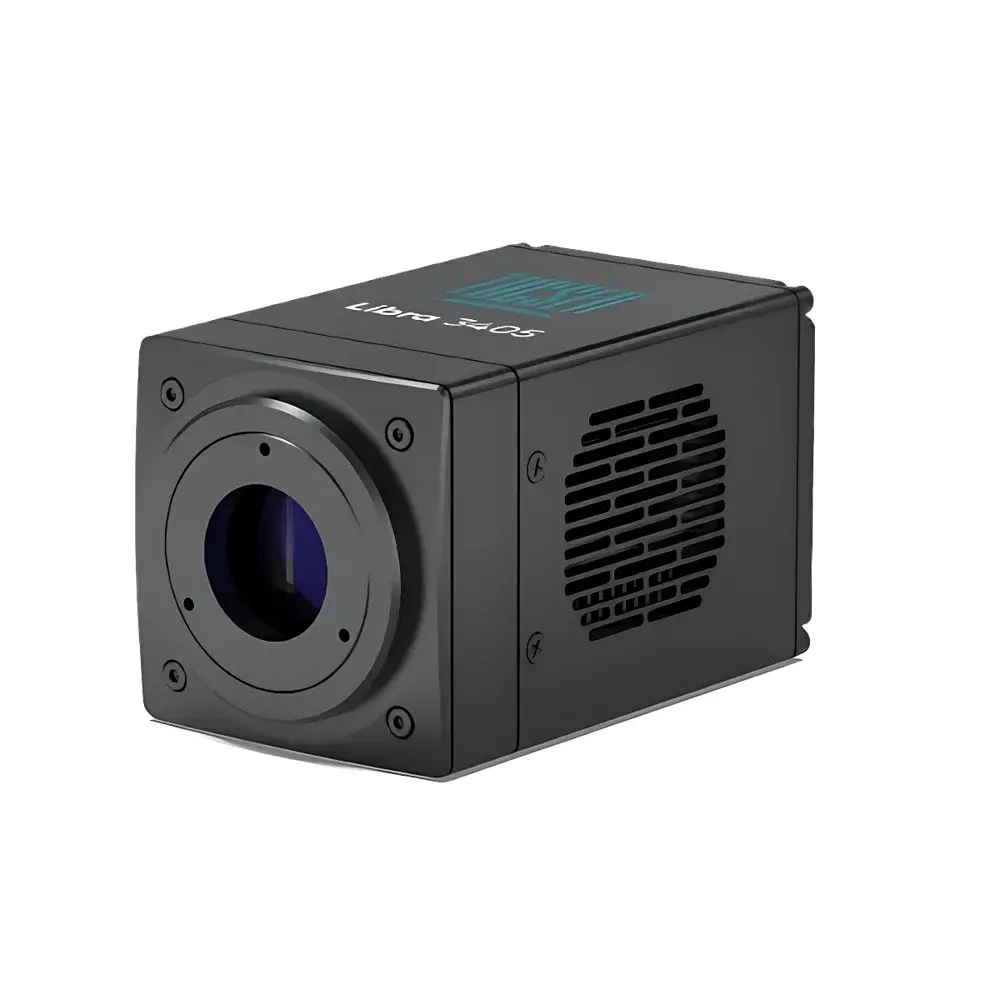
Tucsen Libra 3412M Scientific CMOS Camera for Whole-Slide Imaging, Microscopy, and Industrial Inspection
| Brand | Tucsen |
|---|---|
| Origin | Fujian, China |
| Manufacturer Type | OEM Manufacturer |
| Region of Origin | Domestic (China) |
| Model | Libra 3412M |
| Pricing | Upon Request |
| Image Resolution | 4096 (H) × 3072 (V) |
| Pixel Size | 3.4 µm × 3.4 µm |
| Sensor Active Area | 14.0 mm × 10.5 mm |
| Readout Speed | 98 fps @ 8-bit |
| Quantum Efficiency | 75% @ 540 nm |
| Sensor Type | Front-Side Illuminated (FSI) CMOS |
| Diagonal | 17.4 mm (1.1″ format) |
| Full-Well Capacity | 9 ke⁻ (High Full-Well mode, 12-bit) |
| Read Noise | 1.6 e⁻ (High Sensitivity mode, 12-bit) |
| Shutter Type | Global Shutter |
| Exposure Range | 1 µs – 10 s |
| Cooling Method | Air-Cooled to ΔT = −15°C below ambient (10°C @ 25°C ambient) |
| Dark Current | 0.5 e⁻/pixel/s @ 10°C |
| Interface | 10GigE Vision (Hirose 12-pin trigger + GPIO) |
| Optical Mount | C-Mount (customizable) |
| Bit Depth Options | 8-bit / 10-bit / 12-bit |
| Power | 12 V / 5 A (30 W) |
| Dimensions | 60 mm × 60 mm × 100 mm |
| Weight | 489 g |
| Software Support | SamplePro, MosaicV3, Micro-Manager 2.0 |
| SDK | C/C++/C#/Python |
| OS Compatibility | Windows & Linux |
| Operating Temp. | 0–40°C, Humidity: 10–85% RH |
Overview
The Tucsen Libra 3412M is a high-performance, air-cooled scientific CMOS camera engineered for demanding applications in digital pathology slide scanning, high-resolution fluorescence microscopy, and precision industrial inspection. Built around the Gpixel GMAX3412 front-side illuminated (FSI) sensor, it delivers exceptional quantum efficiency—75% at 540 nm and 33% at 850 nm—enabling robust multi-channel fluorescence capture across UV–NIR spectrum (350–1100 nm). Its global shutter architecture eliminates motion-induced distortion, making it ideal for time-critical imaging tasks such as dynamic tissue sectioning, real-time defect detection on moving conveyor belts, or synchronized multi-modal acquisition in automated inspection platforms. The 1.1″ optical format (17.4 mm diagonal), 4096 × 3072 resolution, and uniform 3.4 µm pixel pitch support high-fidelity spatial sampling without interpolation artifacts—critical for quantitative morphometric analysis in clinical diagnostics and metrology-grade surface evaluation.
Key Features
- Global shutter operation ensures pixel-synchronous exposure and readout, eliminating rolling shutter skew during rapid sample translation or stage movement.
- 10 Gigabit Ethernet Vision interface enables sustained full-frame throughput up to 98 fps at 8-bit depth—more than 3× faster than USB 3.0—reducing whole-slide scan times and improving system-level throughput in automated imaging workflows.
- Active air cooling stabilizes sensor temperature to 10°C (ΔT = −15°C vs. 25°C ambient), suppressing dark current to ≤0.5 e⁻/pixel/s and enabling long-exposure fluorescence imaging with low background variance.
- Triple gain modes (High Full-Well, Balanced, High Sensitivity) allow adaptive optimization: 9 ke⁻ full-well capacity for wide-dynamic-range brightfield imaging; sub-2 e⁻ read noise in High Sensitivity mode for photon-limited fluorescence applications.
- FPGA-based on-board image processing supports real-time binning (1×1, 2×2, 4×4), defect pixel correction (DPC), and ROI readout—minimizing host CPU load and latency in embedded or edge-computing architectures.
- C-mount standardization with mechanical customization options facilitates seamless integration into upright/digital microscopes, macro-inspection stations, or custom optical train assemblies.
Sample Compatibility & Compliance
The Libra 3412M supports diverse sample modalities—from formalin-fixed paraffin-embedded (FFPE) histology sections stained with H&E or multiplex immunofluorescence (IF), to semiconductor wafers, printed circuit boards (PCBs), and composite material surfaces. Its broad spectral response accommodates common fluorophores (DAPI, FITC, Cy3, Cy5, Alexa Fluor series) and NIR dyes (e.g., IRDye 800CW), while the high spatial fidelity meets ISO 10993-12 and ASTM E2818 requirements for quantitative tissue image analysis. For regulated environments, the camera’s deterministic trigger interface (hardware/software sync, exposure/ready/trigger-out signals), audit-ready metadata logging via GigE Vision, and compatibility with GLP/GMP-aligned software stacks (e.g., SamplePro with timestamped acquisition logs) support compliance with FDA 21 CFR Part 11 when deployed in IVD instrument systems.
Software & Data Management
The Libra 3412M ships with native drivers and APIs compatible with industry-standard acquisition frameworks: SamplePro (for clinical slide scanning pipelines), MosaicV3 (tile-based large-field stitching), and Micro-Manager 2.0 (open-source microscopy platform). Its GenICam-compliant GigE Vision interface ensures plug-and-play integration with HALCON, OpenCV, or custom Python-based vision algorithms using the official Tucsen SDK (C/C++, C#, Python bindings). All firmware and driver packages undergo continuous validation against Windows 10/11 LTS and Ubuntu 20.04/22.04 LTS kernels. Raw image data is output in uncompressed 12-bit linear TIFF or vendor-neutral HDF5 formats—preserving bit-depth integrity for downstream AI training or quantitative intensity calibration per ISO/IEC 17025 traceable protocols.
Applications
- Digital pathology: High-speed, high-fidelity whole-slide scanning for AI-assisted diagnosis, especially in multi-spectral IF workflows requiring simultaneous channel registration.
- Research microscopy: Live-cell calcium imaging, FRAP, and TIRF where global shutter synchronization and low read noise are essential for kinetic fidelity.
- Industrial metrology: Sub-micron defect detection on reflective or translucent substrates (glass, silicon, polymer films) using structured illumination or dark-field contrast.
- Quality assurance in additive manufacturing: In-situ melt pool monitoring and layer-wise porosity quantification under high-vibration conditions enabled by shock-resistant mechanical design and deterministic triggering.
- Remote field instrumentation: Low-power, compact form factor (60 × 60 × 100 mm, 489 g) and wide operating range (0–40°C) suit deployment in mobile lab vans or cleanroom-adjacent inspection booths.
FAQ
Does the Libra 3412M support hardware-triggered acquisition with precise exposure synchronization?
Yes—it features a Hirose 12-pin connector supporting TTL-compatible input triggers (exposure start, frame sync) and output signals (exposure active, readout complete, ready), enabling sub-microsecond timing alignment with external light sources or motion controllers.
Can the camera operate continuously at 98 fps with full-frame 12-bit output?
No—maximum frame rate at 12-bit depth is 62 fps. The 98 fps specification applies only to 8-bit mode; 10-bit yields 66 fps. Bandwidth constraints of the 10GigE interface govern this trade-off between bit depth and speed.
Is the air-cooling system sufficient for extended (>1 hr) fluorescence acquisitions at low light levels?
Yes—thermal stabilization to 10°C (±0.5°C) ensures dark current remains below 0.5 e⁻/pixel/s, preserving SNR in exposures up to 10 seconds without significant thermal drift or hot pixel accumulation.
Does the SDK include tools for non-uniformity correction (NUC) or flat-field calibration?
Yes—the Tucsen SDK provides programmable LUT mapping, pixel defect masking, and user-defined flat-field correction matrices, supporting ISO 15739-compliant calibration workflows.
What mounting options are available beyond standard C-mount?
Custom flange options (e.g., F-mount, M42, or proprietary lens adapters) and mechanical housing modifications (heat sink extensions, threaded mounting holes) are available under OEM agreement.




