
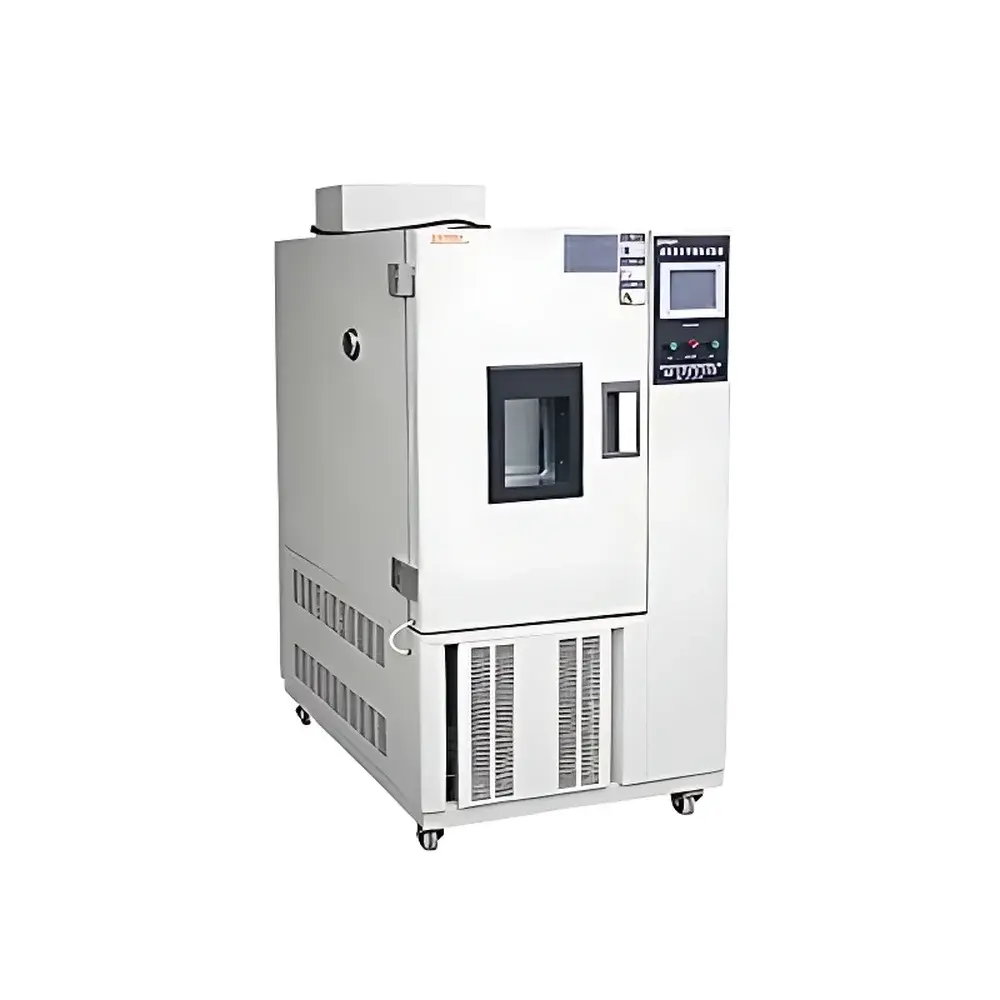
Tuofeng TF-312 Ozone Aging Test Chamber
| Brand | Tuofeng |
|---|---|
| Model | TF-312 |
| Chamber Internal Dimensions (W×D×H, mm) | 450×450×500 / 500×600×750 / 700×800×900 / 800×1000×1000 |
| External Dimensions (W×D×H, mm) | 1200×1000×1800 / 1300×1150×2050 / 1450×1400×2250 / 1520×1540×2300 |
| Temperature Range | 0°C to 70°C |
| Temperature Uniformity | ±0.5°C |
| Relative Humidity Range | 30–65% RH |
| Ozone Concentration Range | 50–500 pphm |
| Sample Rack Rotation | 360° continuous, 1 rpm |
| Gas Flow Velocity | 12–16 mm/s |
| Control System | Imported LED digital P.I.D. + S.S.R. microcomputer controller |
| Timer Resolution | 0.1 s (hour/minute/second) |
| Ozone Monitoring | Imported ozone concentration analyzer with 4–20 mA analog output and RS232 interface |
| Ozone Generator Type | Silent discharge tube or UV absorption (optional) |
| Safety Protections | Leakage protection, short-circuit protection, overtemperature cutoff, motor overheat protection, overcurrent protection |
| Power Consumption | 4.0 kW / 4.5 kW / 7.0 kW / 11.5 kW (model-dependent) |
| Compliance | GB/T 7762–2003, GB/T 2951.21–2008 |
Overview
The Tuofeng TF-312 Ozone Aging Test Chamber is an engineered environmental test system designed to evaluate the resistance of elastomeric and non-metallic materials—particularly vulcanized rubber compounds—to oxidative degradation induced by controlled ozone exposure under accelerated aging conditions. It operates on the principle of simulating atmospheric ozone stress in a precisely regulated thermal-humid environment, enabling quantitative assessment of surface cracking initiation and propagation. The chamber integrates real-time ozone concentration monitoring, programmable temperature and humidity control, and optional dynamic mechanical loading via rotating sample racks—facilitating both static and dynamic exposure protocols per international material testing standards. Its architecture supports reproducible, traceable, and auditable test execution, making it suitable for quality assurance laboratories, R&D centers, and third-party certification facilities operating under GLP or ISO/IEC 17025 frameworks.
Key Features
- Four standard internal volume configurations (from 101 L to 800 L), accommodating diverse sample geometries and throughput requirements
- High-stability ozone generation using silent discharge tube technology (UV absorption option available for low-interference applications)
- Real-time ozone concentration feedback loop with imported electrochemical sensor, delivering 4–20 mA analog output and RS232 serial communication for external data logging and SCADA integration
- Precision temperature control via PID + SSR microprocessor-based system with ±0.5°C uniformity across the working space
- Independent humidity regulation within 30–65% RH range, optimized to prevent condensation while maintaining oxidative reactivity
- Motor-driven 360° continuously rotating sample rack (1 rpm), ensuring uniform ozone exposure on all specimen surfaces—critical for evaluating directional vulnerability in anisotropic elastomers
- Dual-mode operation: static exposure (fixed specimens) and dynamic exposure (rotating or flexing samples), configurable per test method requirements
- Comprehensive safety architecture including leakage current detection, thermal cut-off at multiple zones, motor overheat sensing, and overcurrent circuit protection
Sample Compatibility & Compliance
The TF-312 accommodates flat sheet specimens, molded rings, tension strips, and extruded profiles commonly used in automotive sealing systems, cable insulation, conveyor belts, and footwear components. Specimen mounting fixtures are standardized for ASTM D1149 and ISO 1431-1 alignment, though primary compliance targets are Chinese national standards GB/T 7762–2003 (determination of ozone cracking resistance of vulcanized rubber) and GB/T 2951.21–2008 (electrical insulating materials — polymeric compounds — test methods for ozone resistance). The chamber’s control firmware and data recording modules support audit-ready timestamped logs, meeting foundational requirements for GLP documentation and internal QA traceability. While not inherently 21 CFR Part 11 compliant, its RS232 interface enables integration with validated LIMS or ELN platforms supporting electronic signature and change control workflows.
Software & Data Management
The TF-312 employs embedded firmware with no proprietary PC software dependency; all operational parameters—including setpoints, ramp rates, dwell times, and ozone concentration targets—are configured directly via the front-panel LED interface. Time-based test sequences (up to 999 hours) are stored in non-volatile memory with battery-backed retention. Real-time ozone concentration, chamber temperature, and relative humidity values are continuously output via 4–20 mA analog channels and RS232 serial port (ASCII protocol, 9600 baud, N-8-1), allowing seamless connection to programmable logic controllers (PLCs), industrial PCs, or centralized environmental monitoring systems. Optional data acquisition modules can log timestamped parameter histories at user-defined intervals (1 s to 60 min resolution), generating CSV-compatible files for post-test statistical analysis (e.g., crack density vs. exposure time, Arrhenius modeling of degradation kinetics).
Applications
- Evaluation of antioxidant package efficacy in synthetic rubber formulations (SBR, EPDM, CR, NBR)
- Comparative screening of halogenated vs. non-halogenated flame-retardant cable jackets under ozone-rich environments
- Validation of weather-resistant coatings applied to rubber-based gaskets and expansion joints
- Accelerated life-cycle testing of elastomeric vibration isolators used in rail and aerospace subsystems
- Supporting failure analysis investigations where field-exposed components exhibit premature surface fissuring attributable to ambient ozone exposure
- Pre-compliance verification for OEM supplier qualification programs requiring ozone resistance evidence per OEM-specific material specifications (e.g., Ford WSK-M4D485-B, GMW15634)
FAQ
What ozone concentration ranges does the TF-312 support, and how is stability maintained?
The chamber delivers 50–500 pphm (parts per hundred million) ozone with closed-loop feedback control; concentration drift is limited to ±5% of setpoint over 24-hour continuous operation when ambient air intake is filtered and temperature/humidity remain within specification.
Is calibration certification included with shipment?
A factory calibration report covering temperature uniformity, ozone sensor linearity (at three points: 100/250/400 pphm), and timer accuracy is provided. Full ISO/IEC 17025-accredited calibration requires third-party service and is recommended annually.
Can the TF-312 be integrated into an existing laboratory automation network?
Yes—via RS232 serial interface (Modbus RTU optional with firmware update) or 4–20 mA analog outputs. Digital I/O signals for start/stop and alarm status are available upon request for PLC interfacing.
Does the system meet CE or UL safety directives?
The TF-312 complies with GB 4793.1–2019 (equivalent to IEC 61010-1) for electrical safety. CE marking is not applied as the unit is designed for domestic Chinese market deployment; UL listing requires additional evaluation and is available under custom engineering engagement.
What maintenance intervals are recommended for the ozone generator and sensor?
Silent discharge tubes require cleaning every 6 months and replacement every 24 months under continuous use. Electrochemical ozone sensors should be zero-calibrated quarterly and replaced every 18–24 months depending on cumulative exposure hours and ambient particulate load.



