
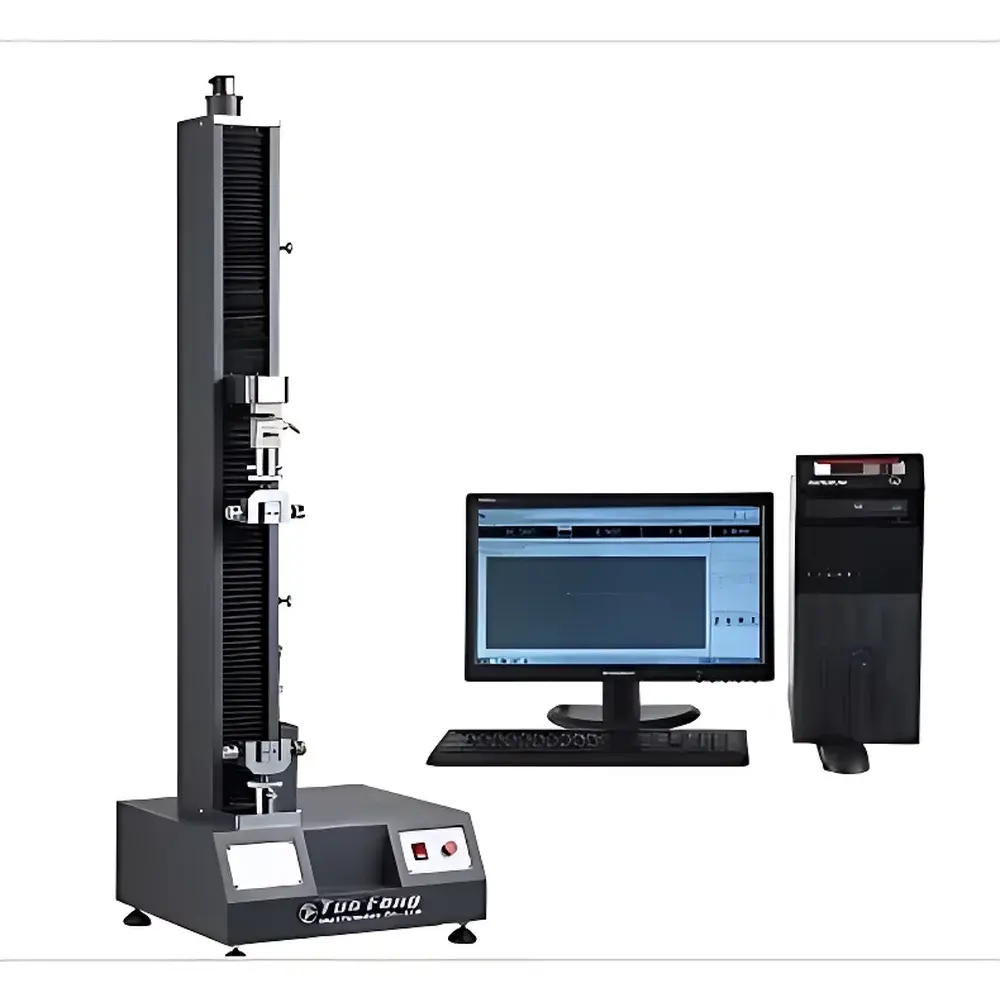
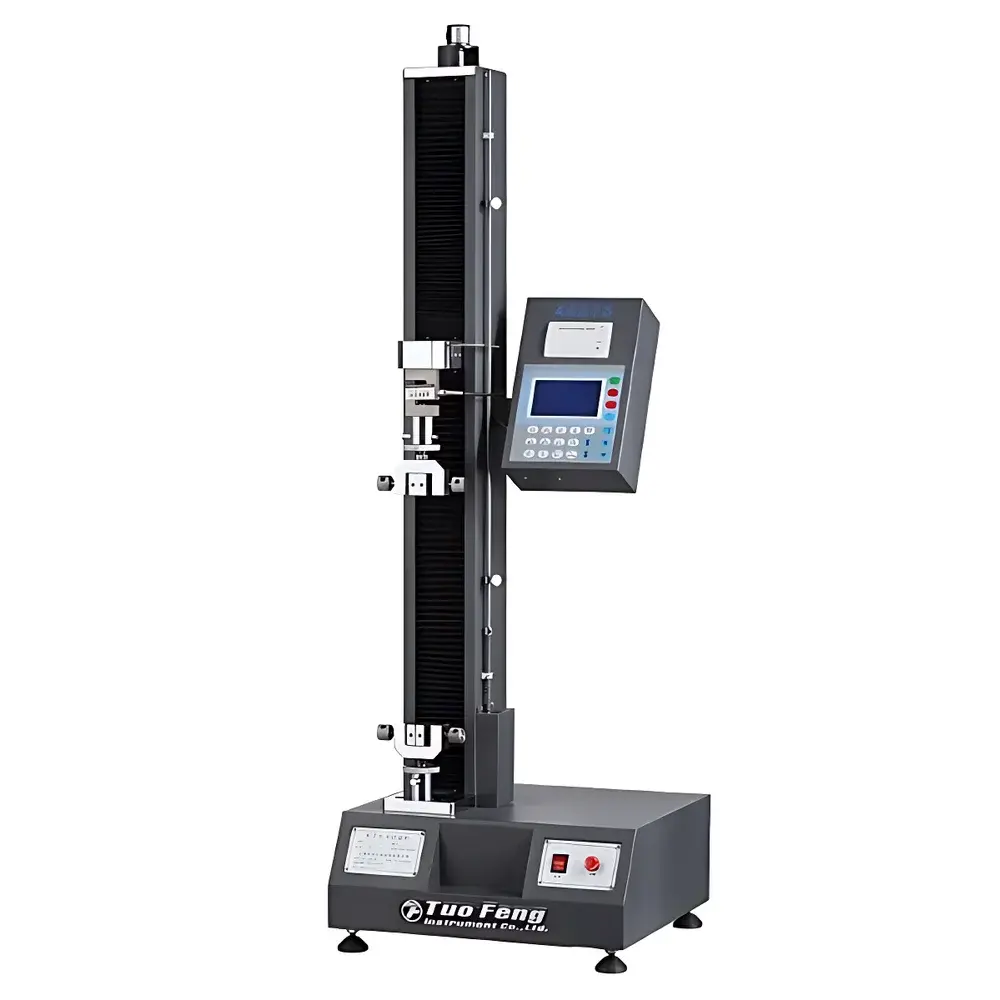
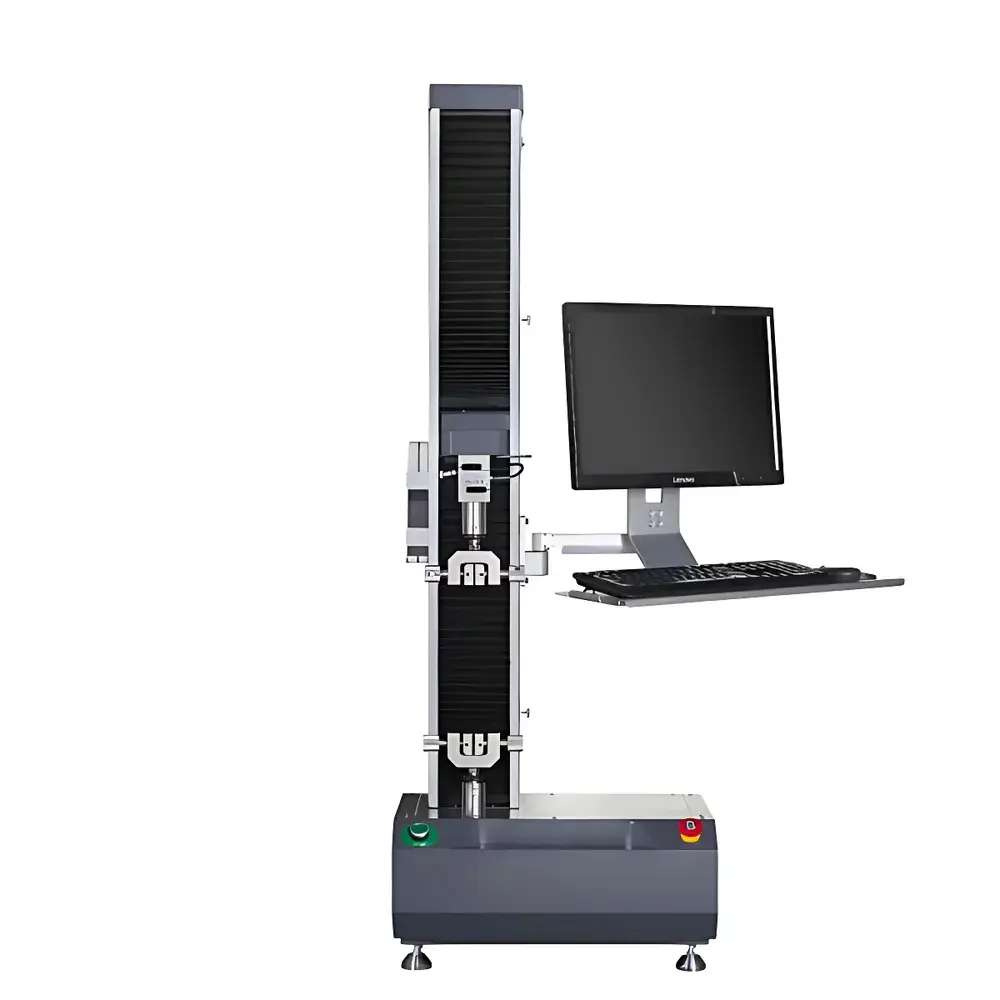
Tuofeng TFL-04 Single-Column Microcomputer-Controlled Electronic Tensile Testing Machine
| Brand | Tuofeng |
|---|---|
| Origin | Shanghai, China |
| Manufacturer Type | Direct Manufacturer |
| Model | TFL-04 |
| Instrument Type | Electronic Tensile Testing Machine |
| Maximum Test Load | 0.1 kN (100 N) |
| Force Measurement Range | 1–2000 N |
| Force Accuracy | ±0.5% of reading |
| Crosshead Travel | 700 mm |
| Displacement Resolution | 0.0001 mm |
| Compliance Standards | GB, ISO 527, ASTM D638/D882/D3330/D903, DIN 53455, JIS K6251/K6854 |
| Control System | PC-based Windows software with multi-mode control (load-controlled, displacement-controlled, time-controlled) |
| Data Output | Stress–strain, load–displacement, load–time, displacement–time curves |
| Safety Features | Electronic limit switches, emergency stop, overload protection (>110% F.S.), programmable return modes |
| Power Supply | 220 V, 50 Hz, 400 W |
Overview
The Tuofeng TFL-04 is a single-column, microcomputer-controlled electronic tensile testing machine engineered for precision mechanical property evaluation of low-force materials. Designed around a high-stiffness load frame and servo-controlled crosshead actuation, it operates on the fundamental principle of uniaxial force application under controlled displacement or load rate—enabling quantitative determination of tensile strength, elongation at break, modulus of elasticity, peel resistance, tear propagation, and adhesive bond integrity. Its 0.1 kN capacity and sub-micron displacement resolution (0.0001 mm) make it especially suited for thin, compliant, or low-modulus specimens where conventional universal testers lack sensitivity and stability. The system conforms to internationally recognized test methodologies—including ISO 527-1/2 (plastics), ASTM D638 (tensile properties of plastics), ASTM D882 (thin plastic sheeting), ASTM D3330 (peel adhesion), ASTM D903 (peel resistance of adhesives), and GB/T 1040 (Chinese national standard for tensile testing)—ensuring data traceability and inter-laboratory comparability.
Key Features
- Single-column rigid aluminum alloy frame with optimized vibration damping for stable low-load measurements
- High-resolution encoder-based displacement measurement system with ±0.5% accuracy and 0.0001 mm resolution
- Load cell calibrated to ISO 376 Class 0.5, delivering ±0.5% full-scale accuracy across 0.4–100% of rated capacity (1–2000 N)
- Programmable crosshead speed range: 0.01–500 mm/min, continuously variable via closed-loop servo control
- Triple-speed motorized crosshead positioning (fast/medium/slow) with jog functionality and programmable return-to-start
- Integrated safety architecture: dual electronic end-limit detection, hardware emergency stop, and automatic overload cutoff at 110% of maximum rated load
- Modular fixture interface supporting standardized grips (pneumatic, wedge, roller, peel, shear) and custom tooling per specimen geometry
Sample Compatibility & Compliance
The TFL-04 accommodates a broad spectrum of nonwoven and soft-material substrates—including spunbond, meltblown, needle-punched, and hydroentangled nonwovens—as well as polymer films, textile yarns, medical gauze, filtration membranes, laminated packaging, pressure-sensitive adhesives, and composite reinforcements. Its 700 mm vertical travel enables testing of extended specimens (e.g., roll goods, long-fiber bundles) without repositioning. All test protocols align with regulatory and quality assurance frameworks: data audit trails satisfy GLP/GMP documentation requirements; software supports user-level access control and electronic signature workflows compliant with FDA 21 CFR Part 11 (when configured with optional validation package); and raw data export (CSV, XML, PDF) facilitates integration into LIMS environments. Calibration certificates are traceable to CNAS-accredited national standards.
Software & Data Management
The embedded Windows-based testing software provides full IEC 62304-compliant operation across English, Simplified Chinese, and Traditional Chinese interfaces. It supports six real-time display modes (load–time, load–displacement, displacement–time, stress–strain, load–extension, and two-point extension), with on-screen overlay of current and peak values. Automated calculations include tensile strength (MPa), breaking elongation (%), Young’s modulus (MPa), peel strength (N/25 mm), tear strength (N), and adhesion energy (J/m²), all derived from user-input cross-sectional area and gauge length. Up to 20 test curves can be overlaid for comparative analysis; statistical summaries (mean, min, max, CV%) are generated per batch. Data is saved in encrypted local storage with timestamped metadata; reports comply with ISO/IEC 17025 reporting clauses and support direct printer output or PDF archival. Software updates are delivered remotely with version-controlled release notes and backward-compatible file handling.
Applications
- Quality control of spunlace and thermal-bonded nonwovens for hygiene products (diapers, wipes, surgical drapes)
- Validation of tensile anisotropy in carded web structures across machine and cross directions
- Peel strength assessment of laminated SMS (spunbond–meltblown–spunbond) composites used in PPE
- Adhesive bond durability testing under accelerated aging (humidity, temperature cycling)
- Comparative tear propagation resistance of biodegradable nonwovens (PLA, PHA, cellulose derivatives)
- Dynamic modulus profiling of elastic nonwovens (e.g., spandex-blended fabrics) via cyclic loading
- Regulatory submission support for EN 13726 (nonwoven medical packaging) and AAMI ST77 (barrier performance)
FAQ
What is the minimum measurable force resolution of the TFL-04?
The system achieves effective force resolution of ≤0.005 N (0.5% of 1 N) due to its 24-bit ADC and noise-immune signal conditioning—verified per ISO 7500-1 Annex B.
Can the TFL-04 perform creep or stress-relaxation tests?
Yes—via time-controlled mode with user-defined hold durations up to 999 hours; strain drift is monitored at ±0.01% per hour under constant load.
Is third-party calibration certification included?
A factory calibration report traceable to NIM (National Institute of Metrology, China) is supplied; optional CNAS-accredited calibration with uncertainty budget is available upon request.
How is data integrity ensured during long-duration tests?
The software implements cyclic redundancy checksums (CRC-32) on all acquired data packets and writes to non-volatile memory every 100 ms—preventing loss during unexpected power interruption.
Does the system support ASTM D5034 (grab test) or ISO 9073-3 (strip tensile)?
Yes—fixture kits and test method templates for both standards are preloaded; digital gauge length definition ensures compliance with required 100 mm or 200 mm spans.



