
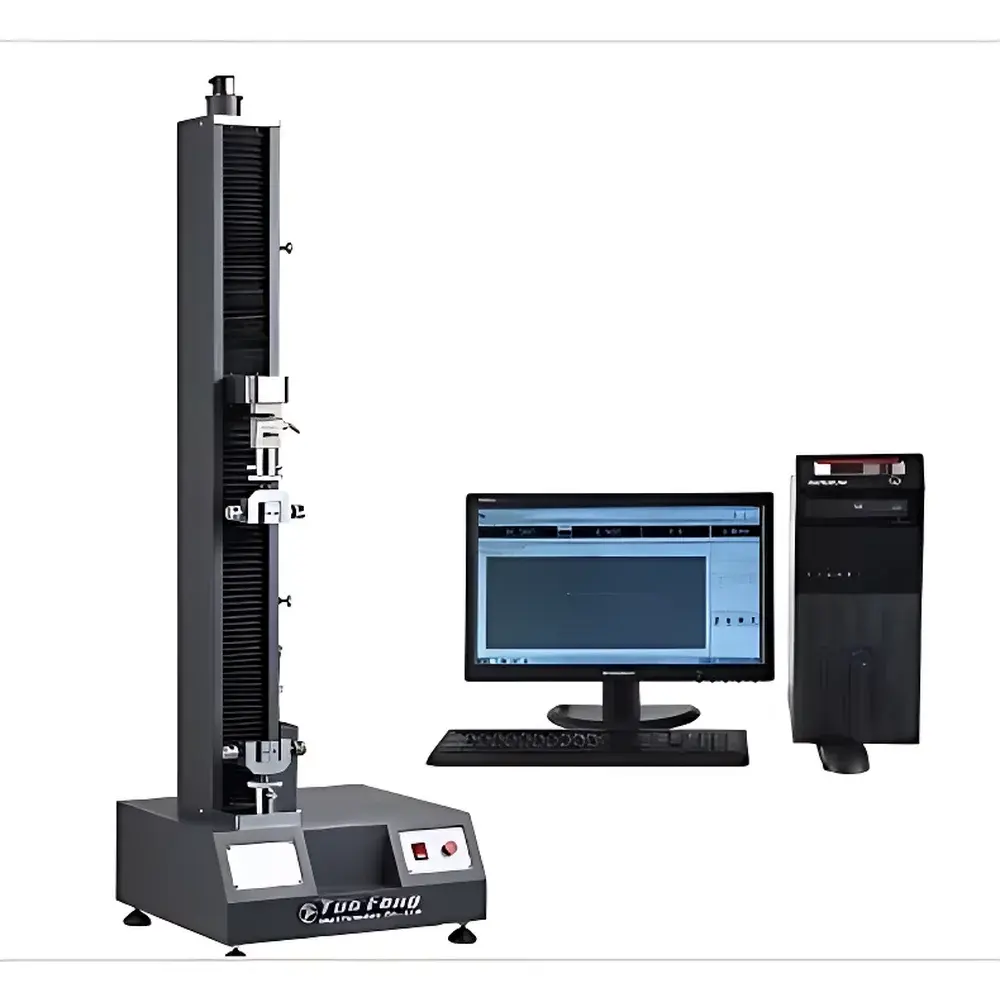
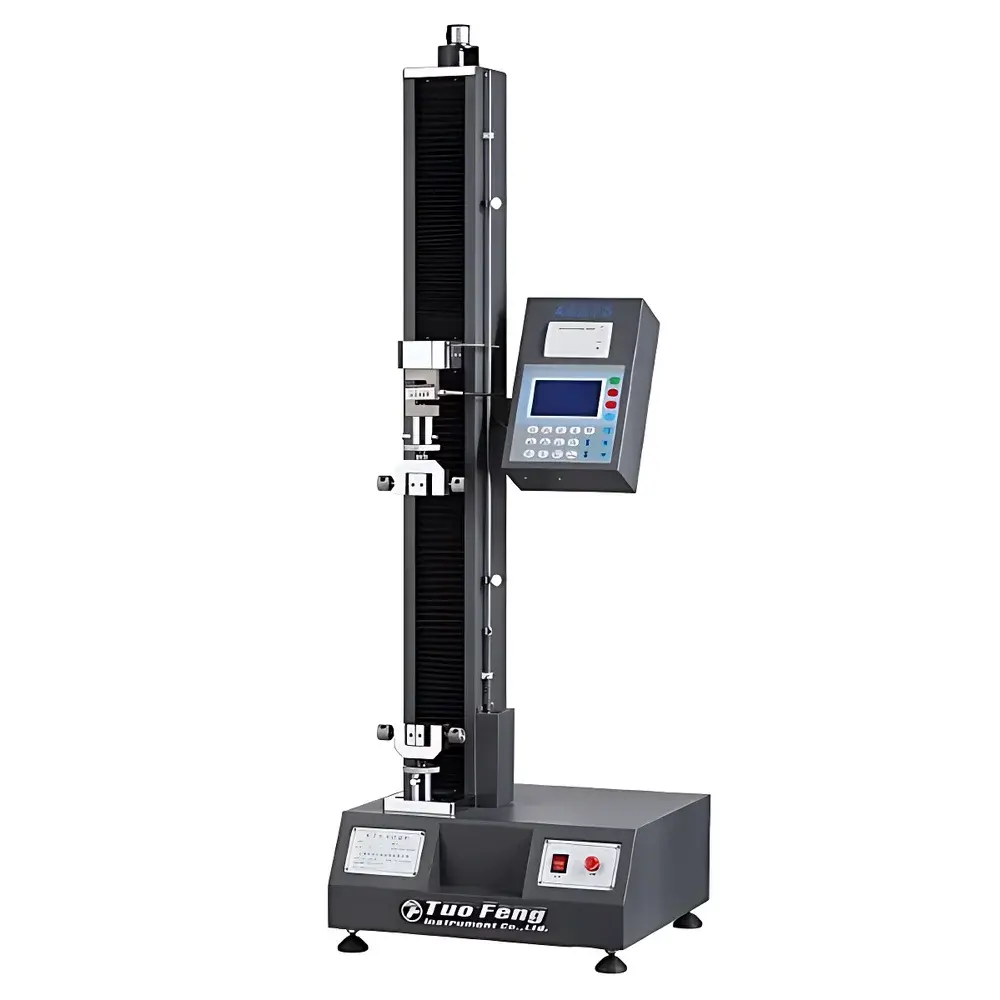
TuoFeng TFL-19 Single-Column Microcomputer-Controlled Electronic Tensile Testing Machine
| Brand | TuoFeng |
|---|---|
| Origin | Shanghai, China |
| Manufacturer Type | Direct Manufacturer |
| Country of Origin | China |
| Model | TFL-19 |
| Instrument Type | Electronic Tensile Testing Machine |
| Maximum Test Load | 0.1 kN (100 N) |
| Force Measurement Range | 1–1000 N |
| Force Accuracy | ±0.5% of reading |
| Crosshead Travel | 700 mm |
| Displacement Resolution | 0.0001 mm |
| Compliance Standards | GB, ISO 6892-1, ASTM E8/E21, DIN 50125, JIS Z2241 |
| Control System | PC-based Windows software with multi-mode control (constant load, constant displacement, constant rate) |
| Safety Features | Electronic limit switches, emergency stop, overload protection (≥110% FS) |
| Drive Motor | 400 W AC servo motor, 220 V / 50 Hz |
| Dimensions (W×D×H) | ≈460×460×1500 mm |
| Weight | ≈120 kg |
Overview
The TuoFeng TFL-19 is a single-column, microcomputer-controlled electronic tensile testing machine engineered for precision mechanical property evaluation of low-force specimens in research laboratories, quality control departments, and R&D facilities. It operates on the fundamental principle of uniaxial static loading, applying controlled tensile, peel, tear, or flexural forces to specimens while continuously measuring force response and axial displacement. Designed for compliance with internationally recognized mechanical testing standards—including ISO 6892-1 (metallic materials), ASTM E8/E21 (tension testing of metallic materials), ASTM D882 (thin plastic sheeting), ASTM D638 (plastics), and ISO 527—the TFL-19 delivers repeatable, traceable, and audit-ready data essential for material qualification, process validation, and regulatory submissions.
Key Features
- Single-column rigid frame architecture with high-stiffness aluminum alloy crosshead and precision-ground lead screw, ensuring minimal deflection under load and long-term dimensional stability.
- High-resolution force measurement system calibrated to ±0.5% of full scale, utilizing a strain-gauge-based load cell with internal temperature compensation and digital filtering to suppress noise.
- Displacement sensing via high-resolution optical encoder (0.0001 mm resolution), synchronized with force acquisition at ≥1 kHz sampling rate for accurate stress–strain curve construction.
- AC servo-driven crosshead with smooth, backlash-free motion across a continuous speed range of 0.01–500 mm/min—enabling both quasi-static and accelerated testing protocols without gear shifting or mechanical intervention.
- Integrated safety architecture: dual-channel electronic limit switches, hardware-level emergency stop circuitry, and automatic overload cutoff (>110% FS) compliant with IEC 61800-5-2 functional safety requirements.
- Modular fixture interface supporting standardized wedge, pneumatic, peel, and custom-designed grips—compatible with ISO 204, ASTM E8, and ISO 11339 specimen geometries.
Sample Compatibility & Compliance
The TFL-19 accommodates a broad spectrum of low-force specimens including metallic wires (diameters ≤0.5 mm), thin foils (Al, Cu, Ni), polymer films (PET, PE, PP), textile yarns and nonwovens, adhesive tapes, laminated packaging substrates, biomedical sutures, and elastomeric seals. Its 100 N maximum capacity and sub-micron displacement resolution make it especially suitable for brittle or highly compliant materials where conventional universal testers lack sensitivity. All test methods are implemented in strict alignment with ISO/IEC 17025 calibration traceability pathways. The system supports GLP/GMP-compliant workflows through configurable user access levels, electronic signatures, and audit-trail-enabled test records—fully compatible with FDA 21 CFR Part 11 requirements when deployed with validated software configurations.
Software & Data Management
The embedded Windows-based testing software provides full control over test execution, real-time visualization, and post-processing analytics. It supports seven programmable control modes: constant rate of extension (CRE), constant load, constant displacement, ramp-to-load, ramp-to-displacement, hold-at-load, and hold-at-displacement. Real-time plotting includes force–time, force–displacement, stress–strain, and displacement–time curves—with on-the-fly switching between display formats. Calculated outputs include tensile strength, yield strength (with offset method), elongation at break, modulus of elasticity, peel adhesion (N/mm), tear resistance (kN/m), and bond strength (MPa). Data export is supported in CSV, XML, and PDF formats; all raw datasets retain timestamped metadata, operator ID, environmental conditions (optional sensor integration), and instrument calibration status. Software updates are delivered remotely with version-controlled release notes and documented change logs.
Applications
- Quality assurance of medical device components: suture tensile integrity, catheter shaft stiffness, and balloon burst pressure pre-screening.
- Characterization of flexible electronics substrates: adhesion strength of conductive inks on PET films, delamination resistance of multilayer laminates.
- Food packaging R&D: seal strength evaluation per ASTM F88, puncture resistance of pouches, and peel force quantification of heat-sealed joints.
- Textile and nonwoven performance testing: breaking tenacity of spunbond PP, elongation recovery of elastic knits, and seam slippage resistance.
- Electrical connector validation: terminal crimp pull-out force, contact retention testing per USCAR-21 and ISO/TS 16949.
- Academic materials science: comparative mechanical behavior of biodegradable polymers, nanocomposite thin films, and hydrogel networks under hydrated conditions.
FAQ
What standards does the TFL-19 support out-of-the-box?
The system includes preconfigured test templates for ISO 6892-1, ASTM D638, ASTM D882, ASTM F88, ISO 11339, and GB/T 228.1—with customizable parameter sets for method-specific ramp rates, dwell times, and acceptance criteria.
Can the TFL-19 be integrated into an existing LIMS or MES environment?
Yes—via OPC UA or TCP/IP protocol interfaces, enabling bidirectional data exchange with laboratory information management systems (LIMS) and manufacturing execution systems (MES) for automated result ingestion and certificate generation.
Is third-party calibration certification available?
TuoFeng provides ISO/IEC 17025-accredited calibration certificates issued by CNAS-recognized labs, covering force (NIST-traceable deadweight standards), displacement (laser interferometer verification), and timing accuracy.
Does the software meet FDA 21 CFR Part 11 requirements?
When deployed with enabled electronic signature modules, role-based access control, and immutable audit trails—including operator actions, parameter changes, and report generation events—the validated software configuration satisfies 21 CFR Part 11 Subpart B for electronic records and signatures.
What is the warranty and service coverage?
The TFL-19 carries a 24-month parts-and-labor warranty, inclusive of remote diagnostics, firmware updates, and priority technical support. Extended service contracts include annual on-site calibration, preventive maintenance, and IQ/OQ documentation support.



