
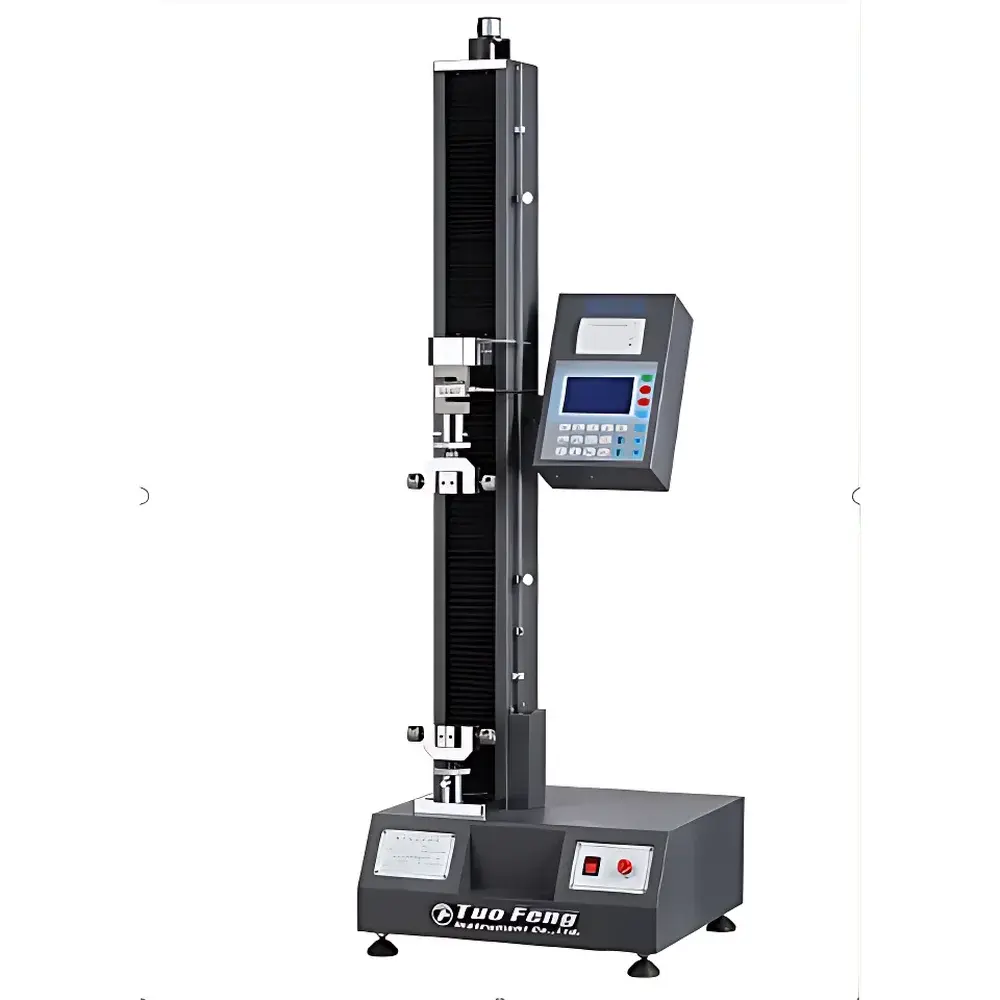
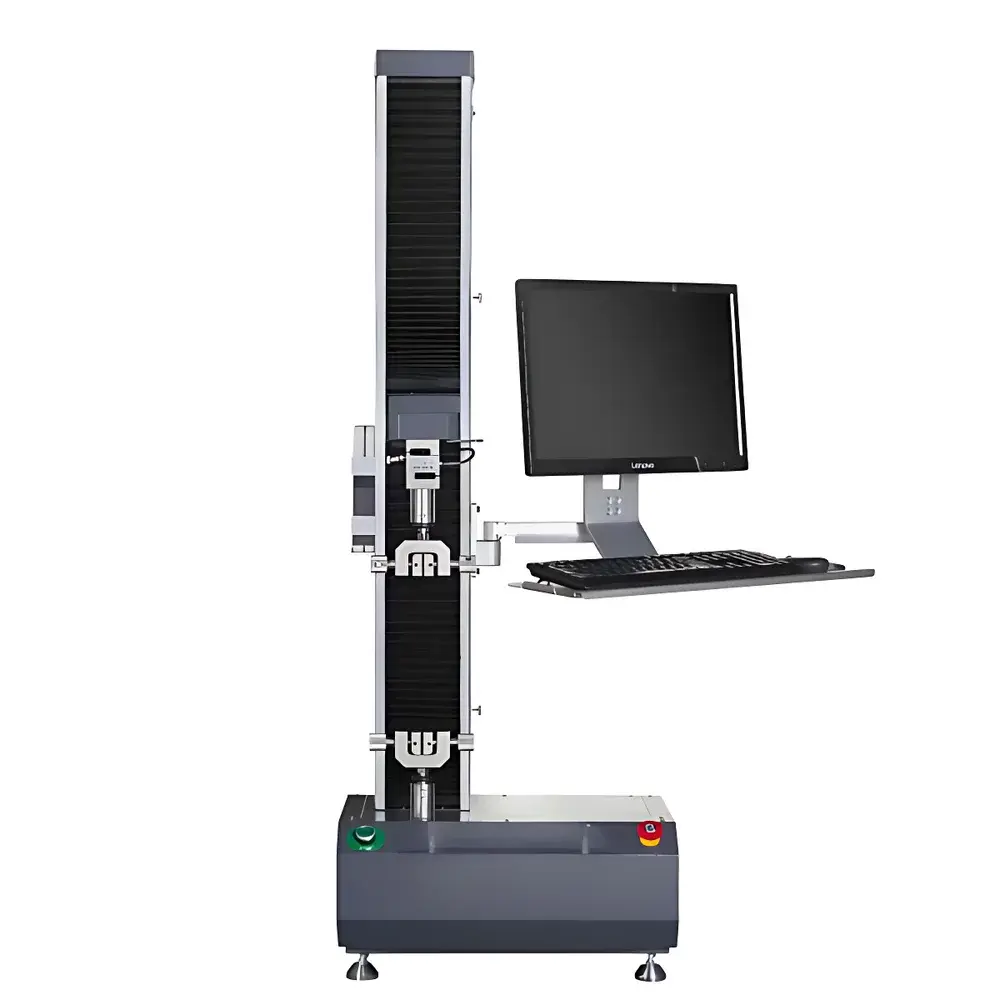
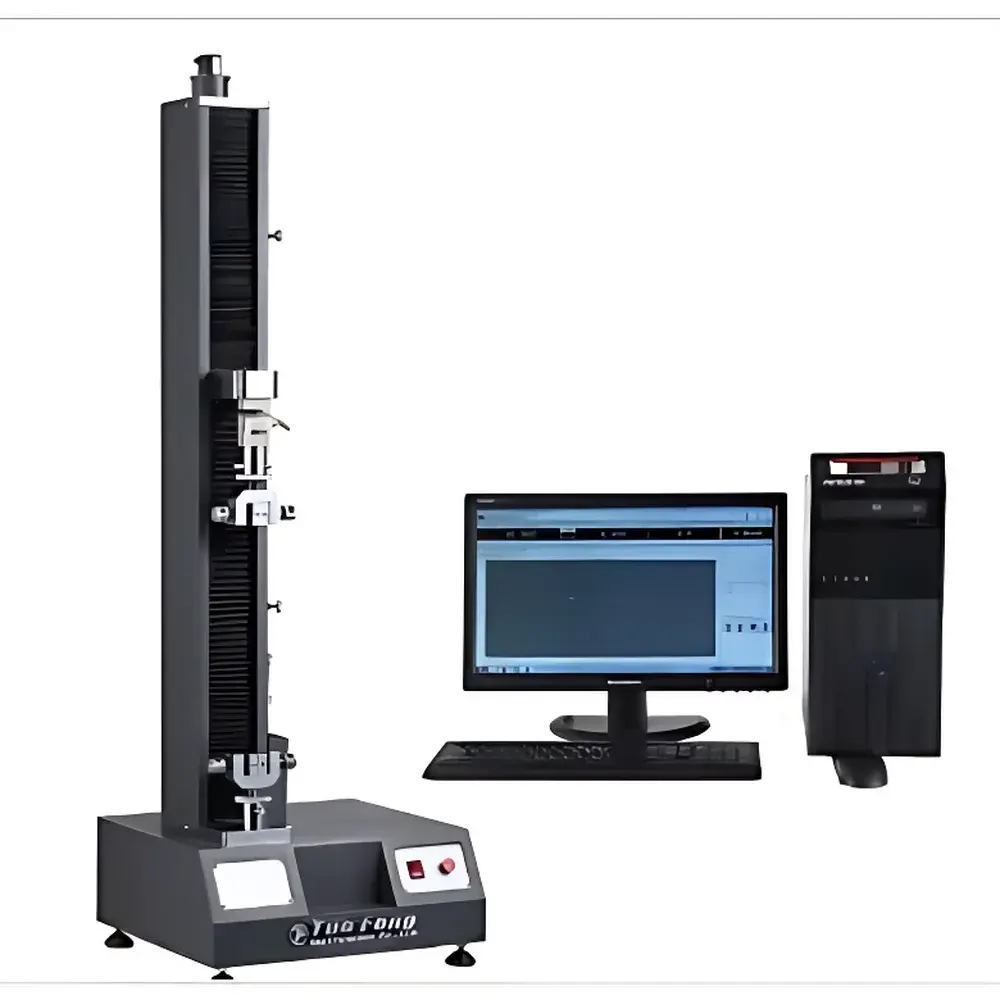
Tuofeng TFL-31S Computer-Controlled Electronic Tensile Testing Machine
| Brand | Tuofeng |
|---|---|
| Origin | Shanghai, China |
| Manufacturer Type | Direct Manufacturer |
| Model | TFL-31S |
| Instrument Type | Electronic Tensile Testing Machine |
| Maximum Test Load | 5 kN |
| Force Measurement Range | 0.4%–100% of Full Scale (FS) |
| Force Accuracy | ±0.5% of reading |
| Crosshead Travel | 700 mm |
| Displacement Resolution | ±0.5% of reading |
Overview
The Tuofeng TFL-31S is a precision-engineered computer-controlled electronic tensile testing machine designed for static mechanical property evaluation of flexible and semi-rigid materials under uniaxial loading conditions. It operates on the fundamental principle of controlled displacement actuation via a servo-motor-driven crosshead, with real-time acquisition of load (via high-stability S-type load cell) and displacement (via optical encoder) data. The system complies with core mechanical testing standards—including ISO 6892-1 (metallic materials), ASTM D638 (plastics), ASTM D882 (thin plastic sheeting), ISO 1798 (flexible cellular materials), and GB/T 228.1 (Chinese national standard for metallic tensile testing)—enabling traceable, repeatable, and auditable test execution in quality control, R&D, and regulatory compliance environments.
Key Features
- Robust dual-column steel frame architecture with reinforced base and precision-ground guide rails, ensuring minimal deflection (<0.02 mm under full 5 kN load) and long-term geometric stability.
- High-resolution force measurement system calibrated to ISO 376 Class 0.5 accuracy, delivering ±0.5% full-scale repeatability across the entire 0.4–100% FS range without range switching or manual recalibration.
- Optically encoded crosshead displacement feedback with ≤±0.5% linearity error, supporting accurate strain calculation when used with extensometers or video-based strain measurement systems (optional).
- Programmable speed control from 0.01 to 500 mm/min (infinitely variable), enabling precise replication of standardized test rates—for example, 1 mm/min for peel adhesion per ASTM D903 or 50 mm/min for tensile strength of woven polypropylene sacks per GB/T 8946.
- Integrated safety architecture including dual-channel electronic limit switches, hardware emergency stop circuitry, overload protection (>110% FS), and automatic return-to-initial-position functionality post-test.
- Modular fixture interface compatible with pneumatic, wedge-action, and custom-designed grips—validated for textile fibers, polymer films, laminated packaging, wire terminations, and woven/flexible composite substrates.
Sample Compatibility & Compliance
The TFL-31S accommodates specimens ranging from fine-diameter monofilaments (<0.1 mm) to wide-format woven bags (up to 600 mm width with extended gauge length configuration). Its 700 mm vertical travel supports both short-gauge (e.g., 25 mm for thin films) and long-gauge (e.g., 200 mm for sack seam integrity testing) applications. The machine meets essential requirements for GLP-compliant laboratories: audit-trail-enabled software logging (user actions, calibration events, test parameters), electronic signature support, and data immutability upon finalization. All test reports include metadata compliant with ISO/IEC 17025 documentation requirements, and raw data export (CSV, XML) facilitates integration into LIMS or statistical process control platforms.
Software & Data Management
The embedded Windows-based testing software (v5.2+) provides multi-mode control—load-controlled, displacement-controlled, and time-controlled protocols—with preconfigured templates aligned to ASTM, ISO, GB, DIN, and JIS methodologies. Real-time plotting includes synchronized load–displacement, stress–strain, and load–time curves, with on-screen display of peak load, yield point, modulus (secant/tangent), elongation at break, and energy absorption (area under curve). Data processing supports automatic calculation of tensile strength (MPa), elongation (%), tear resistance (N/mm), peel adhesion (N/25 mm), and bond strength (kPa), based on user-input specimen geometry (width, thickness, gauge length). All results are timestamped, digitally signed, and archived with SHA-256 hash verification. Software updates are delivered via secure HTTPS channel with version-controlled release notes—no subscription required.
Applications
- Quality assurance of woven polypropylene (PP) and polyethylene (PE) bulk bags and FIBCs—evaluating seam strength, top lift loop integrity, and base stitching performance per ISO 21898 and EN 1898.
- Mechanical characterization of flexible packaging laminates—including peel strength of aluminum foil–polymer composites (ASTM F904), seal strength of heat-sealed pouches (ASTM F88), and puncture resistance of stretch films (ASTM D3770).
- Raw material qualification for textile yarns, geotextiles, and technical fabrics—determining breaking tenacity (cN/tex), extension at break, and load–elongation hysteresis.
- R&D validation of adhesive formulations and bonding processes—measuring lap-shear strength (ASTM D1002), T-peel (ASTM D1876), and cleavage resistance of structural tapes and labels.
- Regulatory submission support for medical device packaging (ISO 11607-1), food contact materials (FDA 21 CFR Part 177), and pharmaceutical secondary packaging (USP ).
FAQ
What standards does the TFL-31S natively support?
It includes built-in test methods for ASTM D638, D882, D903, D1876, ISO 6892-1, 1798, 21898, GB/T 1040, GB/T 8946, and EN 1898—with customizable parameter sets for non-standard protocols.
Can the system be integrated into an existing LIMS or MES environment?
Yes—via OPC UA or RESTful API interfaces; raw data export supports CSV, XML, and PDF/A-2 compliant reporting formats with embedded digital signatures.
Is third-party calibration certification available?
Tuofeng provides factory calibration certificates traceable to NIM (National Institute of Metrology, China); optional UKAS-accredited calibration services are available through authorized partners.
Does the software comply with FDA 21 CFR Part 11 requirements?
Full Part 11 compliance is enabled via optional audit trail module, role-based access control, electronic signatures, and data integrity safeguards—including write-once-read-many (WORM) archiving.
What is the recommended maintenance schedule?
Biannual verification of load cell linearity and encoder resolution is advised; annual mechanical inspection (guide rail lubrication, belt tension, electrical grounding) ensures sustained metrological performance over >10,000 test cycles.



