
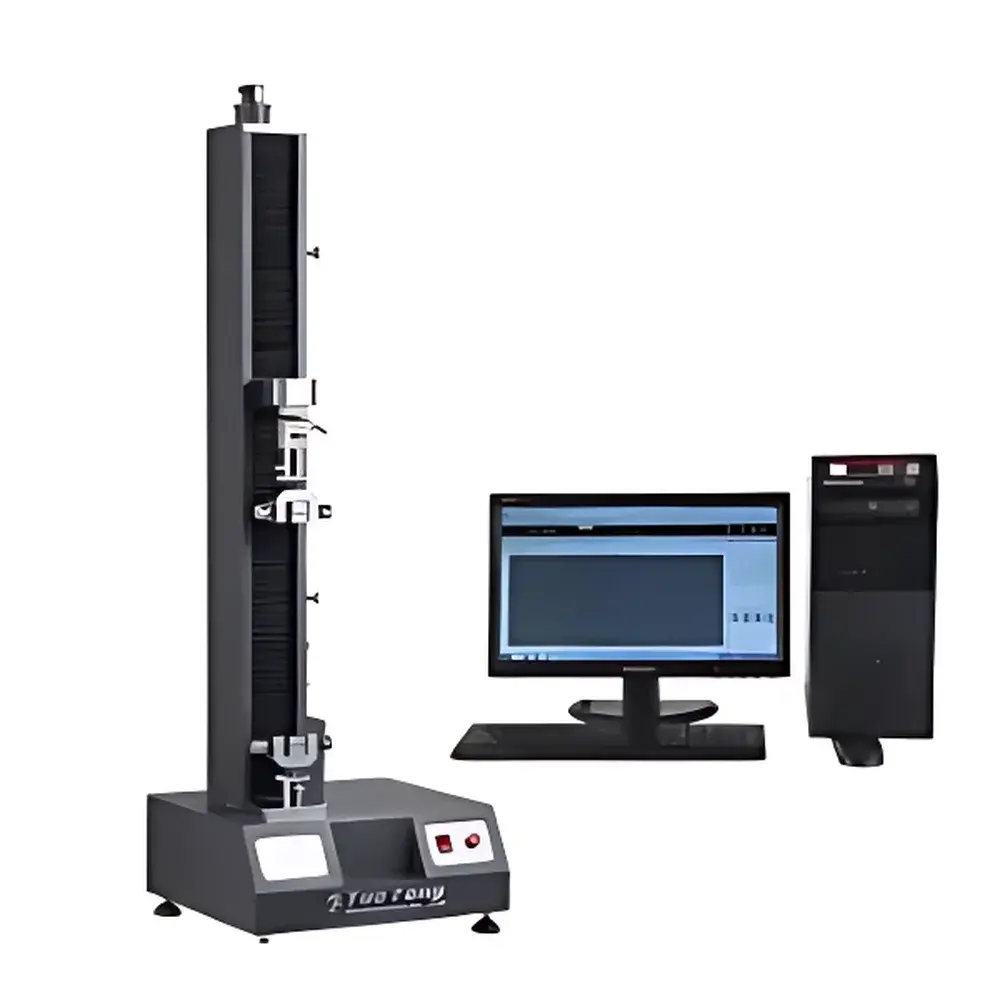
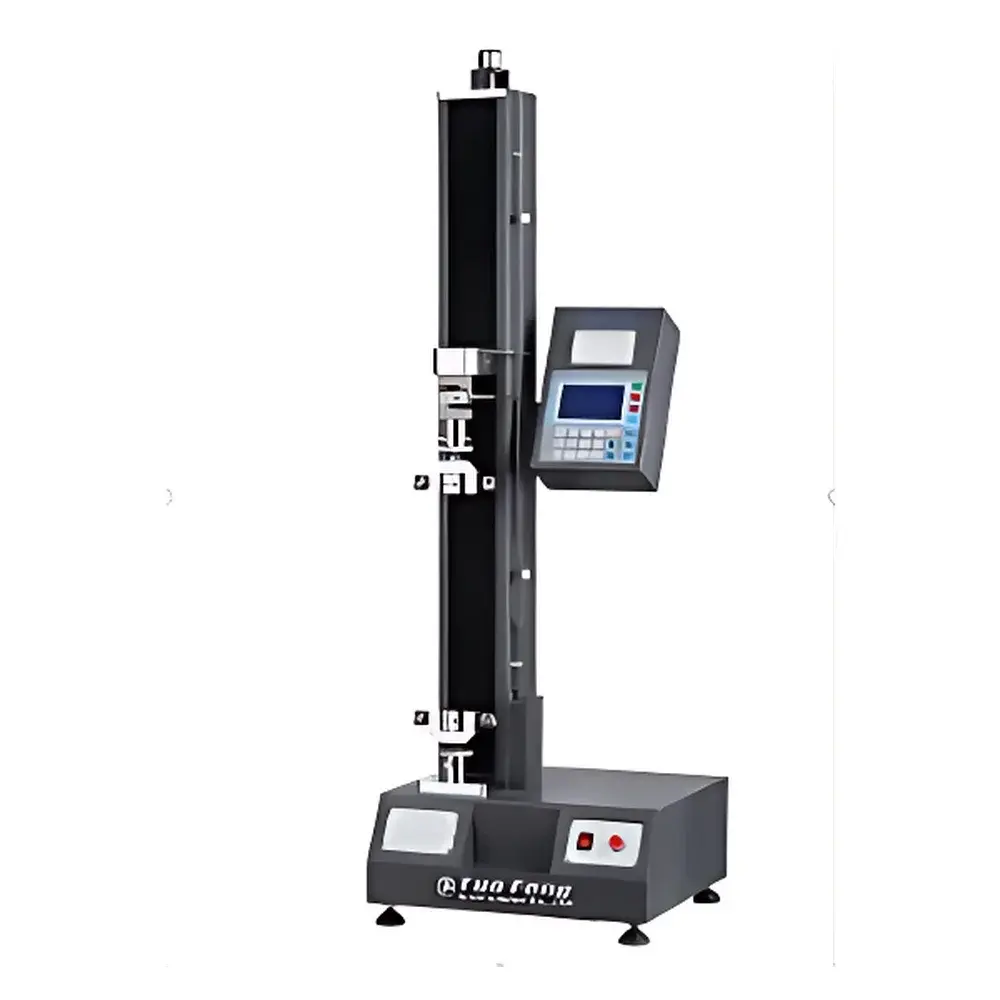
Tuofeng TFL-4S Computer-Controlled Tensile Testing Machine
| Brand | Tuofeng |
|---|---|
| Origin | Shanghai, China |
| Manufacturer Type | Direct Manufacturer |
| Instrument Type | Electronic Tensile Testing Machine |
| Model | TFL-4S |
| Max Test Load | 5 kN |
| Force Measurement Range | 0.4%–100% FS |
| Force Accuracy | ±0.5% of reading |
| Crosshead Travel | 700 mm |
| Displacement Resolution | ±0.5% of reading |
| Test Speed Range | 0.01–500 mm/min (infinitely variable) |
| Position Sensing | Optical Encoder |
| Overload Protection | Automatic shutdown at >110% of full scale |
| Safety Features | Dual electronic limit switches, emergency stop button |
| Power Supply | 220 V, 50 Hz, 400 W |
| Dimensions (W×D×H) | ~460 × 460 × 1500 mm |
| Weight | ~120 kg |
Overview
The Tuofeng TFL-4S Computer-Controlled Tensile Testing Machine is an electromechanical universal testing system engineered for precision mechanical property characterization under uniaxial loading conditions. It operates on the principle of servo-controlled crosshead displacement, where a high-resolution optical encoder tracks position and a calibrated load cell measures applied force in real time. Designed to meet international standards including ASTM E4, ASTM D638, ISO 6892-1, GB/T 228.1, JIS Z 2241, and DIN 50125, the TFL-4S delivers repeatable, traceable data for tensile, peel, tear, and flexural evaluations across diverse material classes — from metallic wires and thin foils to polymeric films, elastomers, adhesives, paperboard, and biomedical packaging substrates.
Key Features
- High-fidelity force measurement with ±0.5% accuracy over a wide dynamic range (0.4%–100% of full scale), enabled by a temperature-compensated, digital signal-conditioned load cell.
- Full-scale resolution of 1 part in 300,000 counts — maintained uniformly across the entire 5 kN capacity without range switching or hardware reconfiguration.
- Precisely regulated test speed control from 0.01 to 500 mm/min via closed-loop AC servo motor and planetary gear reduction, supporting both quasi-static and high-speed rate-dependent analysis.
- Robust dual-safety architecture: programmable electronic end-stop limits combined with a hardware-based emergency stop circuit compliant with IEC 60204-1.
- Intelligent crosshead movement logic enabling three-speed manual jog (fast/medium/slow), automatic return-to-start post-test, and position-hold functionality during multi-step protocols.
- Modular fixture interface accommodating standardized grips (pneumatic, wedge, vise, peel, shear) and custom-engineered fixtures per ASTM D1876 (T-peel), ASTM D903 (adhesion), or ISO 11339 (bond strength).
Sample Compatibility & Compliance
The TFL-4S supports specimens ranging from sub-millimeter-diameter filaments to 20 mm-thick structural composites. Its 700 mm vertical travel accommodates elongation-sensitive materials (e.g., thermoplastic elastomers with >500% strain-at-break) and tall assemblies such as crimped terminals or laminated food pouches. All mechanical and software functions comply with GLP and GMP documentation requirements, including audit-trail-enabled user authentication, parameter locking, and timestamped raw-data export. The system is fully compatible with FDA 21 CFR Part 11-ready configurations when deployed with validated software modules and networked server environments.
Software & Data Management
The embedded Windows-based testing platform (compatible with Windows 10/11 LTSB editions) provides six standard control modes: constant rate of extension (CRE), constant load ramp, constant strain rate, hold-to-load, hold-to-strain, and cyclic loading. Real-time visualization includes synchronized overlays of load–time, load–displacement, stress–strain, and displacement–time curves. Calculated outputs include tensile strength, yield point (0.2% offset), Young’s modulus, elongation at break, peel strength (N/mm), tear resistance (kN/m), and adhesive bond energy (J/m²). Data export supports CSV, XLSX, PDF report generation, and XML-based interchange for LIMS integration. Software updates are delivered via secure HTTPS channels with version-controlled changelogs and backward-compatible binary archives.
Applications
- Metallic materials: Wire drawing validation, foil tensile uniformity assessment, spring wire fatigue pre-screening.
- Polymers & elastomers: Melt-blown nonwoven tensile integrity, TPU film biaxial strength mapping, silicone sealant cohesive failure analysis.
- Packaging: Seal strength verification per ASTM F88, pouch burst pressure correlation, laminated barrier film delamination onset detection.
- Electronics: PCB trace pull strength, solder joint shear evaluation, flexible printed circuit (FPC) bend endurance profiling.
- Biomedical: Suture tensile performance per USP , hydrogel compression modulus, wound dressing adhesion kinetics.
- Textiles: Yarn tenacity grading, woven fabric tear propagation resistance (Elmendorf method), geotextile puncture resistance calibration.
FAQ
What standards does the TFL-4S support out-of-the-box?
The system includes pre-configured test methods aligned with ASTM D638, ISO 527-2, GB/T 1040.2, JIS K7113, and DIN EN ISO 179-1 — all accessible via intuitive template selection in the software interface.
Can the TFL-4S be integrated into an automated QA lab environment?
Yes. It features RS-232, USB 2.0, and optional Ethernet (TCP/IP) communication ports, enabling bidirectional command scripting, remote calibration status polling, and scheduled test execution via external MES or SCADA systems.
Is third-party calibration certification available?
Tuofeng provides NIST-traceable factory calibration certificates (ISO/IEC 17025 accredited laboratories upon request), including uncertainty budgets for force, displacement, and speed axes.
Does the system support extensometer integration?
The TFL-4S offers analog and digital input channels for clip-on or video-based extensometers (e.g., ISO 9513-compliant devices), enabling true strain measurement independent of crosshead displacement.
How is data integrity ensured during long-duration creep or relaxation tests?
Raw sensor data is logged at ≥100 Hz with microsecond-level timestamping; all intermediate calculations (e.g., engineering vs. true stress) are stored in native binary format with checksum validation to prevent silent corruption.



