
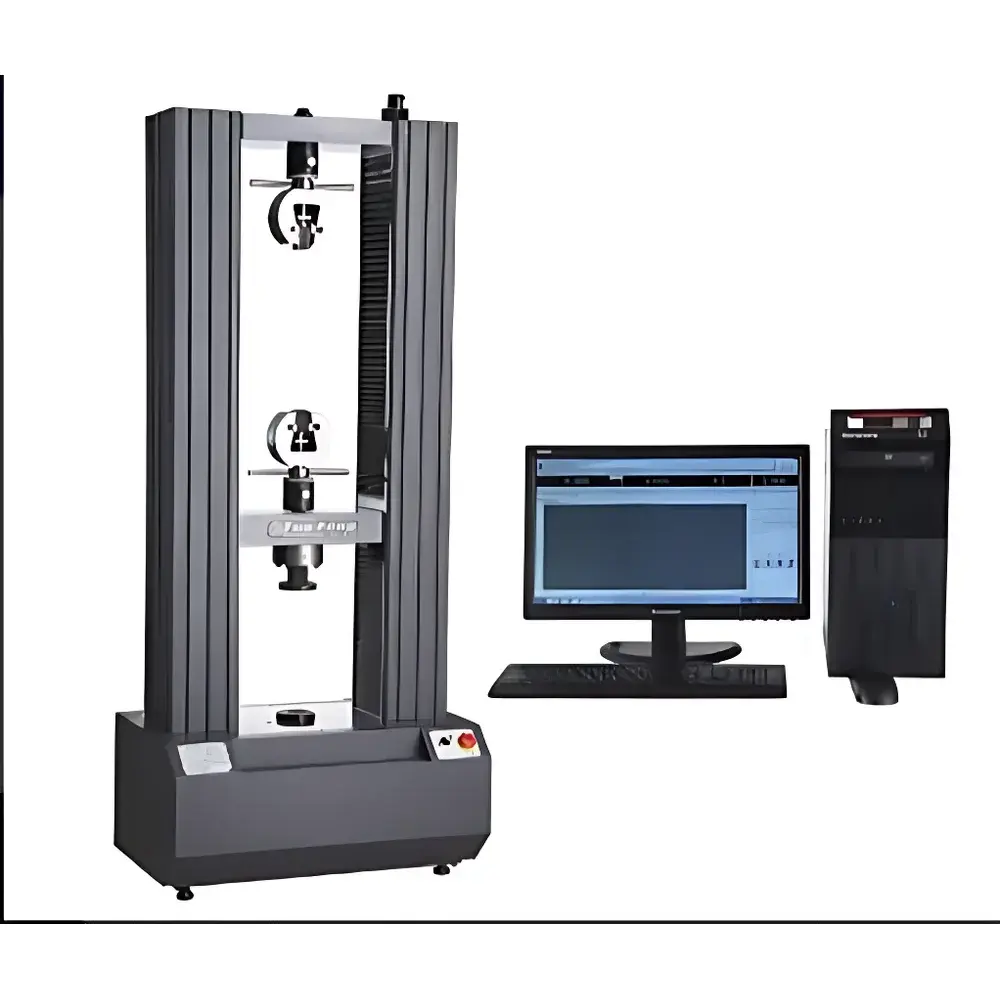
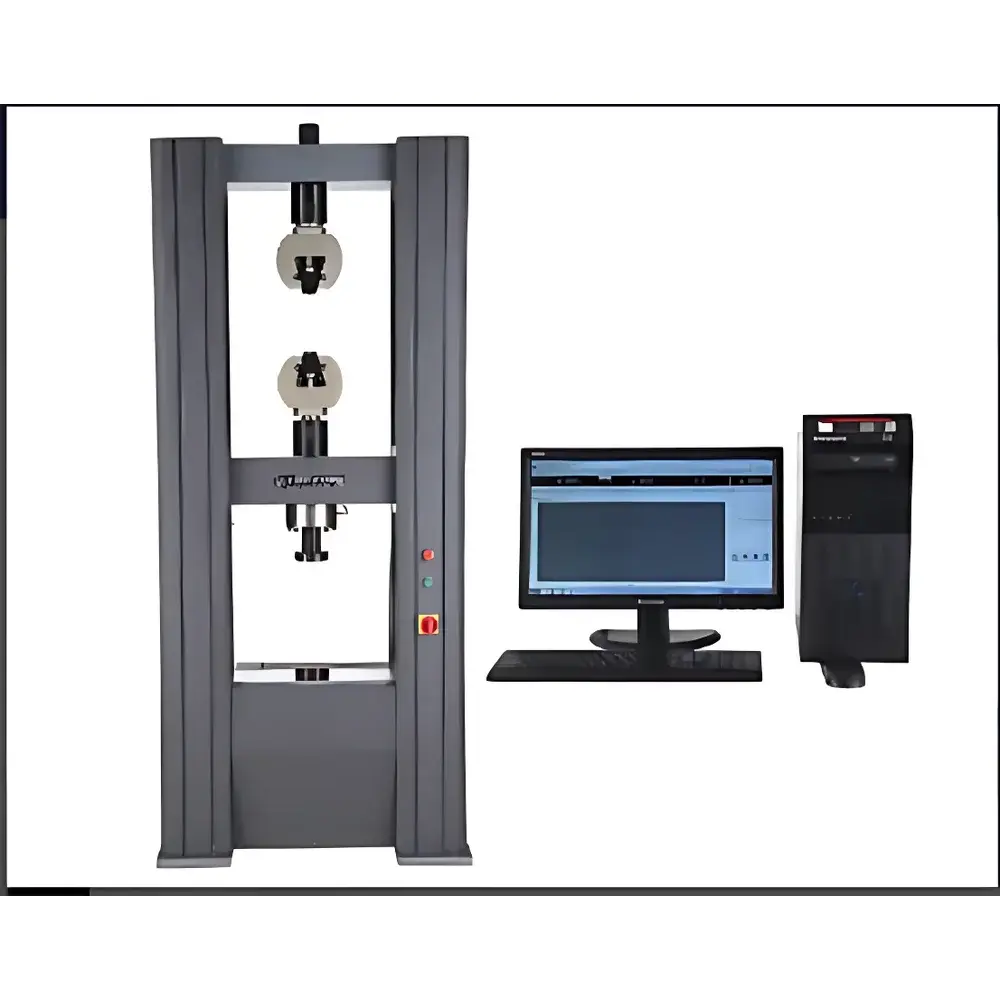
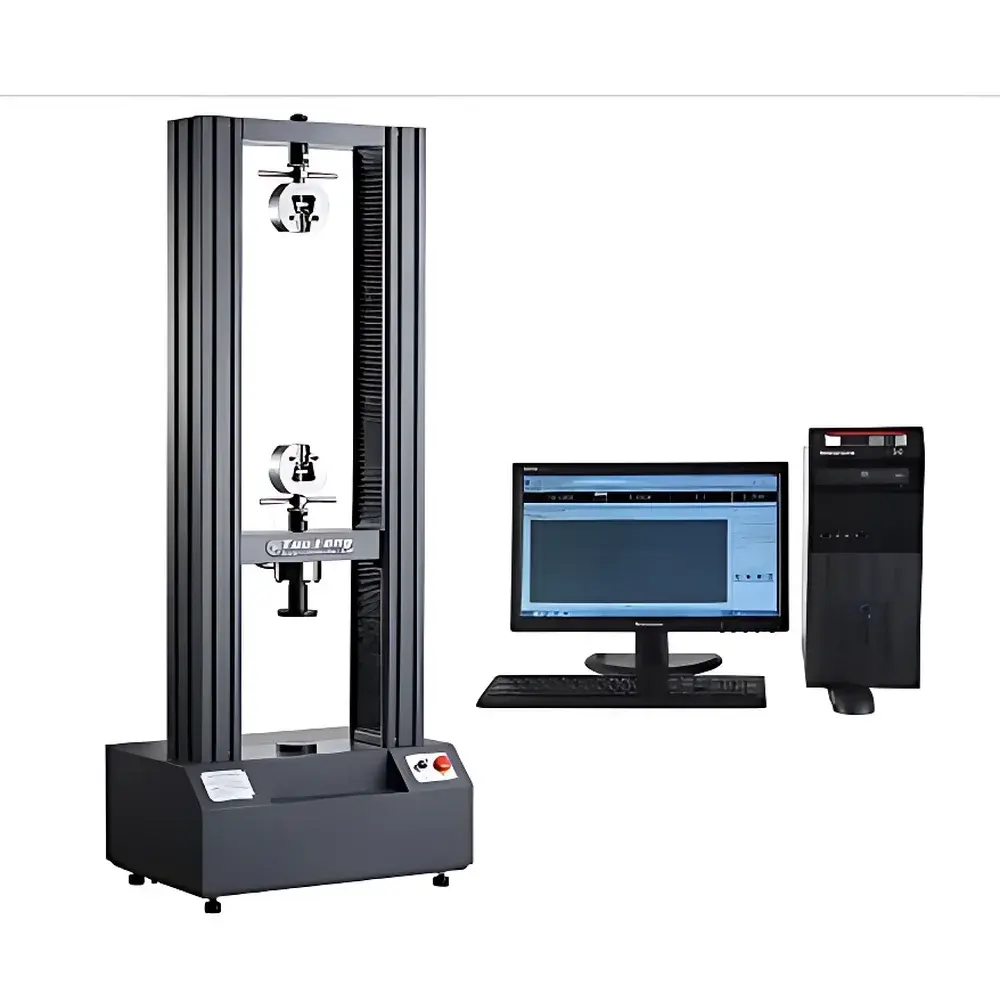
Tuofeng TFW-107 Microcomputer-Controlled Electromechanical Universal Tensile Testing Machine
| Brand | Tuofeng |
|---|---|
| Origin | Shanghai, China |
| Manufacturer Type | Direct Manufacturer |
| Model | TFW-107 |
| Max Test Load | 200 kN |
| Force Measurement Range | 1 kg to 200 kN (0.2%–100% FS) |
| Force Accuracy | ±0.5% of reading |
| Crosshead Travel | 1000 mm |
| Displacement Resolution | 0.001 mm |
| Test Speed Range | 0.001–500 mm/min (infinitely variable) |
| Effective Test Width | 400 mm (customizable up to 600 mm) |
| Load Frame Precision Class | ISO 7500-1 / ASTM E4 Class 0.5 |
| Displacement Measurement Accuracy | ±0.005% of reading |
| Strain Measurement | Compatible with extensometers (standard or large-deformation types) |
| Safety Protection | Dual-limit electronic positioning, emergency stop, overload cutoff (>110% full scale) |
| Drive System | Imported servo motor + precision worm-gear reducer |
| Lead Screw | High-precision preloaded ball screw |
| Software Compliance | Supports ASTM D638, D790, D3039 |
Overview
The Tuofeng TFW-107 Microcomputer-Controlled Electromechanical Universal Tensile Testing Machine is a high-precision static mechanical testing system engineered for standardized uniaxial mechanical characterization of metallic, polymeric, composite, ceramic, and elastomeric materials. Based on the fundamental principles of Hooke’s law and quasi-static load application, it applies controlled axial force via a servo-driven crosshead and measures resulting deformation with sub-micron displacement resolution. Its rigid four-column load frame, preloaded ball-screw transmission, and real-time closed-loop control architecture ensure high reproducibility (<0.5% force error), minimal thermal drift, and long-term stability—critical for R&D validation, quality assurance, and regulatory submissions in regulated industries.
Key Features
- Class 0.5 force accuracy per ISO 7500-1 and ASTM E4, verified across 0.2%–100% of full scale without range switching
- True 200 kN capacity with seamless low-force sensitivity down to 1 kg (0.01% FS), eliminating manual range changes
- High-resolution displacement measurement at 0.001 mm, traceable to NIST-calibrated encoders
- Dual-speed automatic crosshead adjustment (fast return + fine positioning) with programmable soft-start/stop profiles
- Integrated safety architecture: dual electronic limit switches, hardware-based emergency stop circuit, and over-load cutoff at 110% FS
- Modular extensometer interface supporting clip-on, non-contact (video or laser), and large-deformation systems for strain-critical applications (e.g., rubber, textiles)
- Industrial-grade servo drive with dynamic response time <10 ms, enabling precise creep, stress-relaxation, and hold-mode testing
Sample Compatibility & Compliance
The TFW-107 accommodates specimens ranging from thin films (≥0.05 mm thickness) to structural steel coupons (up to 60 mm width × 25 mm thickness), with customizable grips—including wedge-action, pneumatic, hydraulic, and custom-fabricated fixtures—for tensile, compression, bend, shear, peel, tear, and puncture configurations. It meets essential metrological and procedural requirements for ISO/IEC 17025-accredited laboratories and complies with test method standards including ASTM D638 (tensile plastics), D790 (flexural), D3039 (composite tension), ISO 6892-1 (metal tensile), ISO 178 (flexural), GB/T 228.1 (Chinese metal standard), and JJG 475–2008 (verification regulation for electromechanical testing machines). Its mechanical design conforms to GB/T 16491–2008, and software functionality supports FDA 21 CFR Part 11-compliant audit trails when configured with user authentication and electronic signature modules.
Software & Data Management
The Windows-based TensilePro™ v4.2 software provides full IEC 62304-compliant control and analysis. It supports multi-mode testing protocols—including constant rate of extension (CRE), constant load ramping, displacement-controlled hold, and load cycling—with real-time switching between force–displacement, stress–strain, and time-based plots. All curves are mathematically derived using raw encoder and load cell data—not interpolated—and stored in HDF5 format for long-term integrity. The system enables automated report generation (PDF/Excel), batch statistical comparison (max/min/mean/std dev), curve overlay with delta-offset correction, and export of raw ASCII datasets for third-party FE simulation input. Calibration parameters are digitally signed and version-locked; firmware and software updates retain full backward compatibility and include documented change logs for GxP traceability.
Applications
This instrument serves as a primary mechanical testing platform across aerospace (e.g., titanium alloy tensile yield verification per AMS 2300), automotive (rubber bushing compression set, composite leaf spring fatigue pre-screening), medical device manufacturing (suture tensile strength per ISO 10993-12), wire & cable (conductor elongation and proof loading), and construction materials (rebar yield point determination per ASTM A615). Academic users leverage its open API for custom algorithm integration—such as digital image correlation (DIC) synchronization or machine learning–based fracture onset detection. In QC labs, it performs routine incoming inspection against material certifications and supports supplier qualification under AS9100 or IATF 16949 frameworks.
FAQ
What international standards does the TFW-107 support out-of-the-box?
It natively implements test sequences and reporting templates for ASTM D638, ISO 6892-1, GB/T 228.1, and ISO 178, with optional add-ons for JIS Z2241, DIN 50125, and BS EN 10002-1.
Can the system be integrated into an existing LIMS or MES environment?
Yes—via OPC UA or TCP/IP socket interface; full schema documentation and RESTful API endpoints are provided for bidirectional data exchange.
Is strain measurement included by default?
No—extensometers are optional accessories; however, the controller features two dedicated analog inputs and digital trigger ports for seamless plug-and-play connectivity with ASTM E83-compliant devices.
Does the software meet FDA 21 CFR Part 11 requirements?
When deployed with role-based access control, electronic signatures, and audit-log archiving enabled, it satisfies core Part 11 criteria; formal validation support packages are available upon request.
What maintenance intervals are recommended for certified operation?
Annual calibration verification per ISO/IEC 17025 is advised; load cell and encoder recalibration every 12 months, with preventive maintenance (lubrication, belt tension, thermal drift check) every 6 months.



