
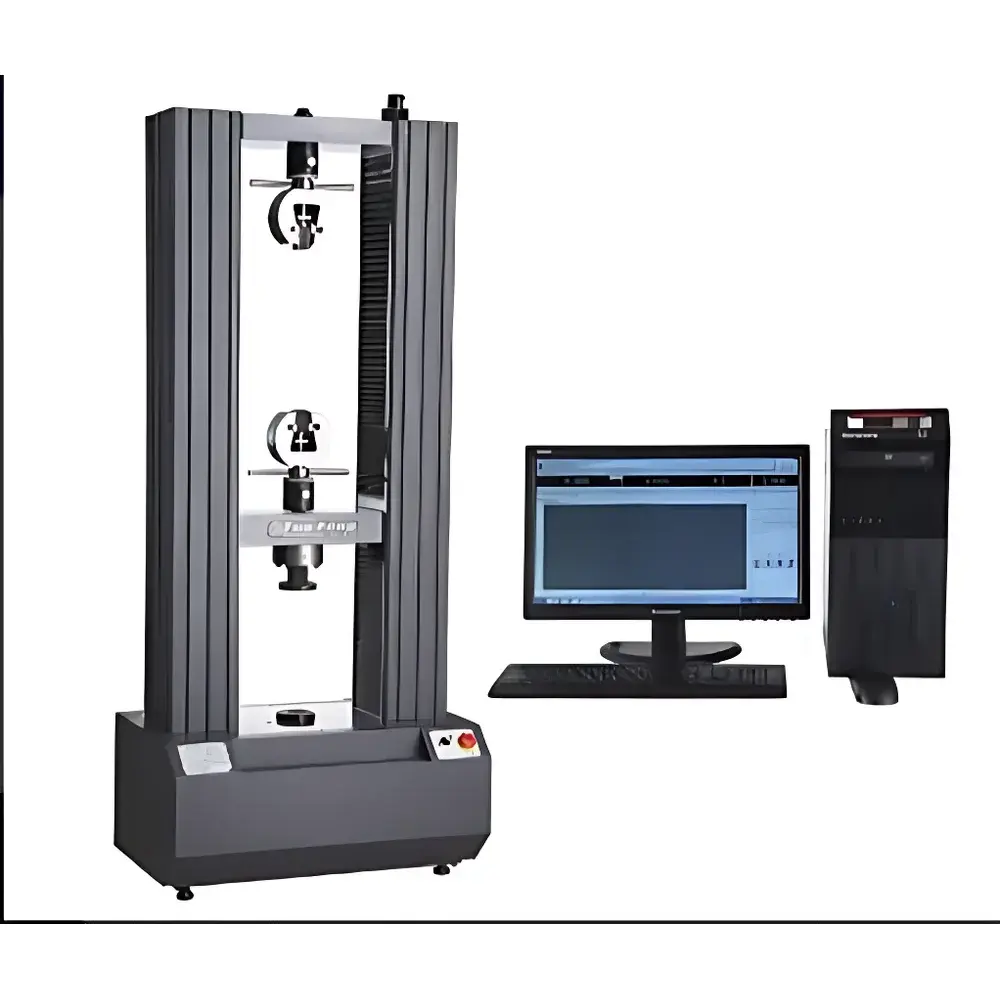
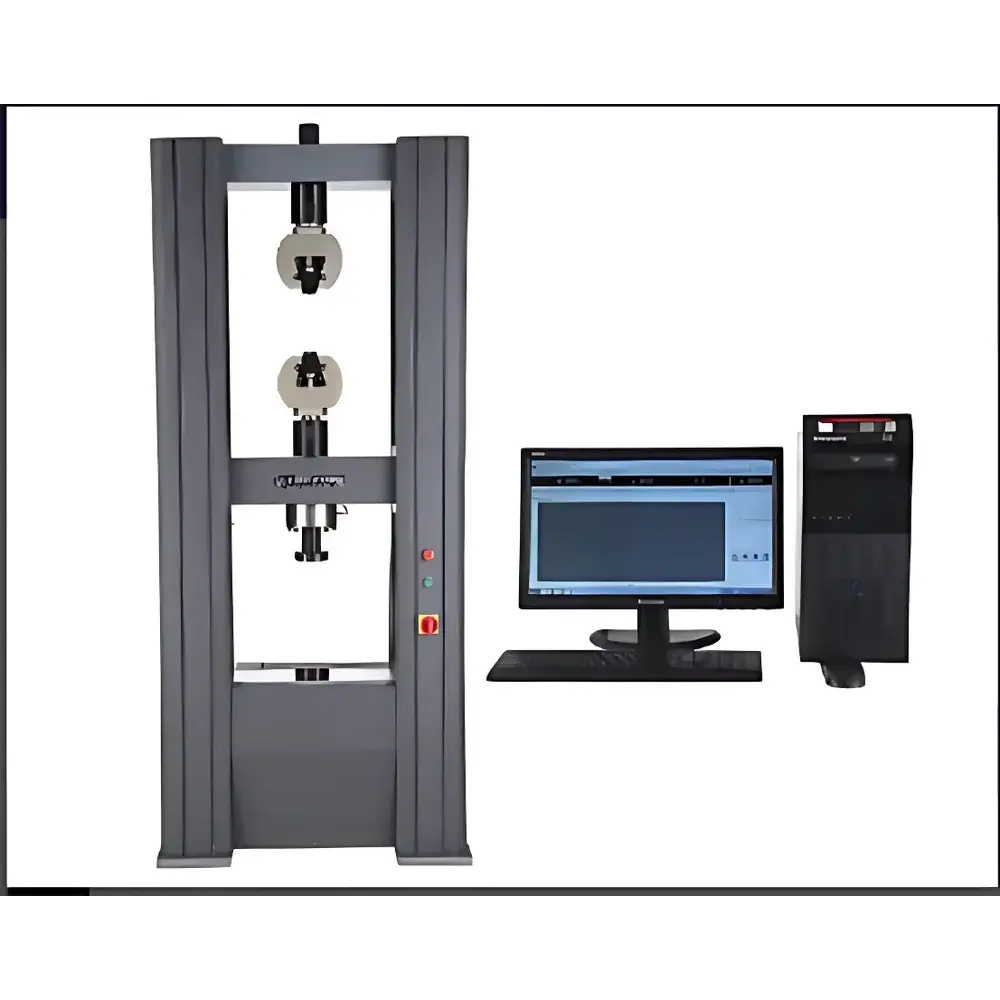
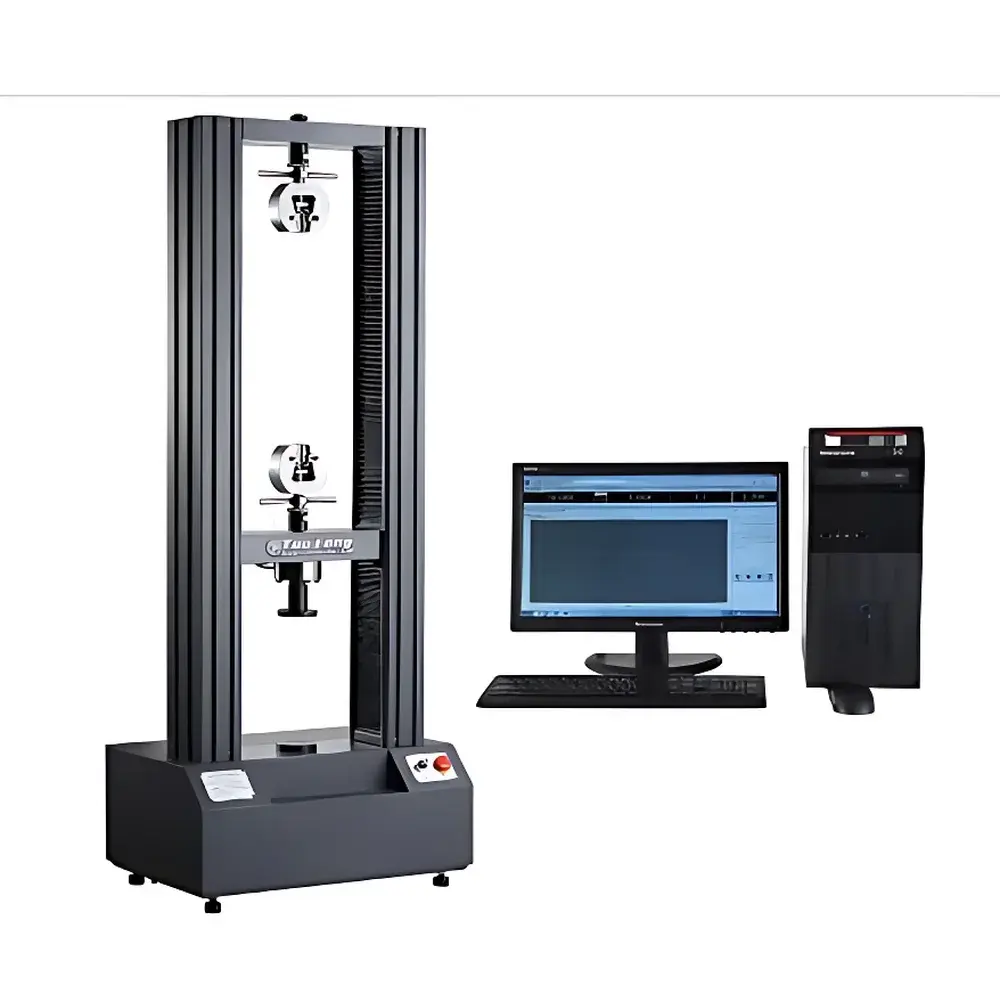
Tuofeng TFW-110 Advanced Electromechanical Universal Testing Machine
| Brand | Tuofeng |
|---|---|
| Origin | Shanghai, China |
| Manufacturer Type | Direct Manufacturer |
| Model | TFW-110 |
| Max Test Load | 200 kN |
| Force Measurement Range | 1 kg to 200 kN (0.2%–100% FS) |
| Force Accuracy | ±0.5% of reading |
| Crosshead Travel | 1000 mm |
| Displacement Resolution | 0.001 mm |
| Test Speed Range | 0.001–500 mm/min (infinitely variable) |
| Effective Test Width | 400 mm (customizable up to 600 mm) |
| Load Frame Precision Class | ISO 7500-1 Class 0.5 |
| Displacement Measurement Accuracy | ±0.005% of reading |
| Force Resolution | 1 part in 500,000 full scale (fixed resolution, no range switching) |
| Drive System | Imported servo motor with precision worm-gear reducer |
| Lead Screw | High-precision preloaded ball screw |
| Safety Protection | Dual electronic limit switches, emergency stop button, overload protection (>110% FS), automatic return after test |
Overview
The Tuofeng TFW-110 Advanced Electromechanical Universal Testing Machine is a high-accuracy, microprocessor-controlled static mechanical testing system engineered for rigorous tensile, compression, bending, shear, tear, peel, and puncture evaluation of metallic, polymeric, composite, ceramic, and elastomeric materials. Built upon a rigid dual-column load frame architecture and driven by a closed-loop servo-controlled electromechanical actuation system, the TFW-110 conforms to fundamental principles of uniaxial quasi-static mechanical testing as defined in ISO 6892-1, ASTM E8/E21, and GB/T 228.1. Its force transduction system utilizes a high-stability load cell calibrated traceably to national standards, while displacement is measured via high-resolution optical encoder feedback—ensuring metrological integrity across the full operational envelope. Designed for laboratory, quality control, and R&D environments, the system delivers repeatable, auditable mechanical property data required for material qualification, process validation, and regulatory submissions.
Key Features
- Rigid, thermally stable dual-column steel frame with reinforced base and crosshead—minimizing deflection under maximum 200 kN loading
- High-precision preloaded ball screw drive with zero-backlash transmission, enabling smooth, low-noise operation across the full speed range (0.001–500 mm/min)
- Class 0.5 force measurement accuracy per ISO 7500-1, supported by real-time digital filtering and temperature-compensated signal conditioning
- Fixed-resolution force acquisition at 1 part in 500,000 full scale—eliminating range-switching artifacts and ensuring consistent sensitivity from 1 kg to 200 kN
- Dual-mode displacement measurement: high-speed optical encoder for crosshead position (0.001 mm resolution) and optional extensometer interface (ASTM E83-compliant) for true strain measurement
- Integrated safety architecture: programmable electronic limits, hardware-based emergency stop circuitry, mechanical overload cutoff, and auto-return functionality post-test
- Modular fixture interface compliant with ISO 26203-2 and ASTM D3574 mounting standards—supporting standardized grips, compression platens, bend fixtures, and custom tooling
Sample Compatibility & Compliance
The TFW-110 accommodates specimens ranging from thin polymer films (<0.1 mm thick) to structural steel coupons (up to 50 mm diameter or 100 mm width), with adjustable test width (standard 400 mm, extendable to 600 mm) and vertical clearance (1000 mm travel). It supports standardized specimen geometries per ASTM E8, ISO 6892-1, GB/T 228.1, DIN 50145, JIS Z 2241, and BS EN 10002-1. The system meets statutory requirements for mechanical testing instrumentation under JJG 475–2008 (Chinese verification regulation) and GB/T 16491–2008 (electronic universal testing machine manufacturing standard). All force and displacement calibration records are retained in accordance with GLP and GMP documentation practices; audit trails comply with FDA 21 CFR Part 11 when configured with password-protected user roles and electronic signature modules.
Software & Data Management
The Windows-based Tuofeng TestSuite software provides ISO/IEC 17025-aligned test execution and reporting. It supports multiple control modes—including load-controlled, displacement-controlled, strain-controlled, and hold (constant load/displacement/time) protocols—with programmable ramp rates and dwell segments. Real-time visualization includes synchronized plots of load vs. time, load vs. displacement, stress vs. strain, and extension vs. time. The software automatically calculates and reports key mechanical parameters: ultimate tensile strength (UTS), yield strength (0.2% offset), Young’s modulus, elongation at break, reduction in area, compressive strength, flexural modulus, tear strength, peel adhesion, and puncture resistance. Data export is available in CSV, XML, and PDF formats; batch analysis enables statistical comparison (max/min/mean/stdev) across multiple specimens. All test configurations, raw data, and metadata are stored in a structured database with configurable retention policies and role-based access control.
Applications
The TFW-110 serves as a core mechanical characterization platform in diverse sectors: aerospace component certification (e.g., aluminum alloys per AMS 4027, titanium per AMS 4911), automotive material validation (steel sheets per VDA 238-100, composites per SAE J2334), medical device polymer testing (ISO 5832-1, USP ), wire & cable tensile integrity assessment (IEC 60811), rubber vulcanizate evaluation (ASTM D412), geotextile strength verification (ASTM D4595), and additive manufacturing post-process QA (ASTM F3122). Its modular design allows integration into automated production line QC cells via Ethernet/IP or Modbus TCP interfaces, supporting Industry 4.0 data workflows.
FAQ
Does the TFW-110 support ASTM E83-compliant extensometry?
Yes—via dedicated analog/digital input channels compatible with clip-on and non-contact extensometers meeting Class 1 or Class 2 accuracy per ASTM E83.
Can test methods be exported and imported between instruments?
Yes—test method definitions (.tmd files) are portable across Tuofeng systems running identical firmware versions, enabling method harmonization across multi-site labs.
Is the system validated for use in regulated pharmaceutical or medical device environments?
When deployed with IQ/OQ documentation packages, 21 CFR Part 11-compliant audit trail, and periodic calibration certificates traceable to NIST or equivalent NMIs, it satisfies GxP requirements for mechanical testing of packaging and components.
What maintenance intervals are recommended for long-term accuracy stability?
Annual force calibration and biannual mechanical inspection (lead screw lubrication, alignment verification, encoder belt tension check) are advised per the manufacturer’s maintenance schedule.
Can the software generate reports compliant with ISO/IEC 17025 accreditation requirements?
Yes—reports include instrument ID, operator ID, environmental conditions (optional sensor input), calibration dates, uncertainty statements, and digital signatures, fulfilling clause 7.8.2 of ISO/IEC 17025:2017.



