
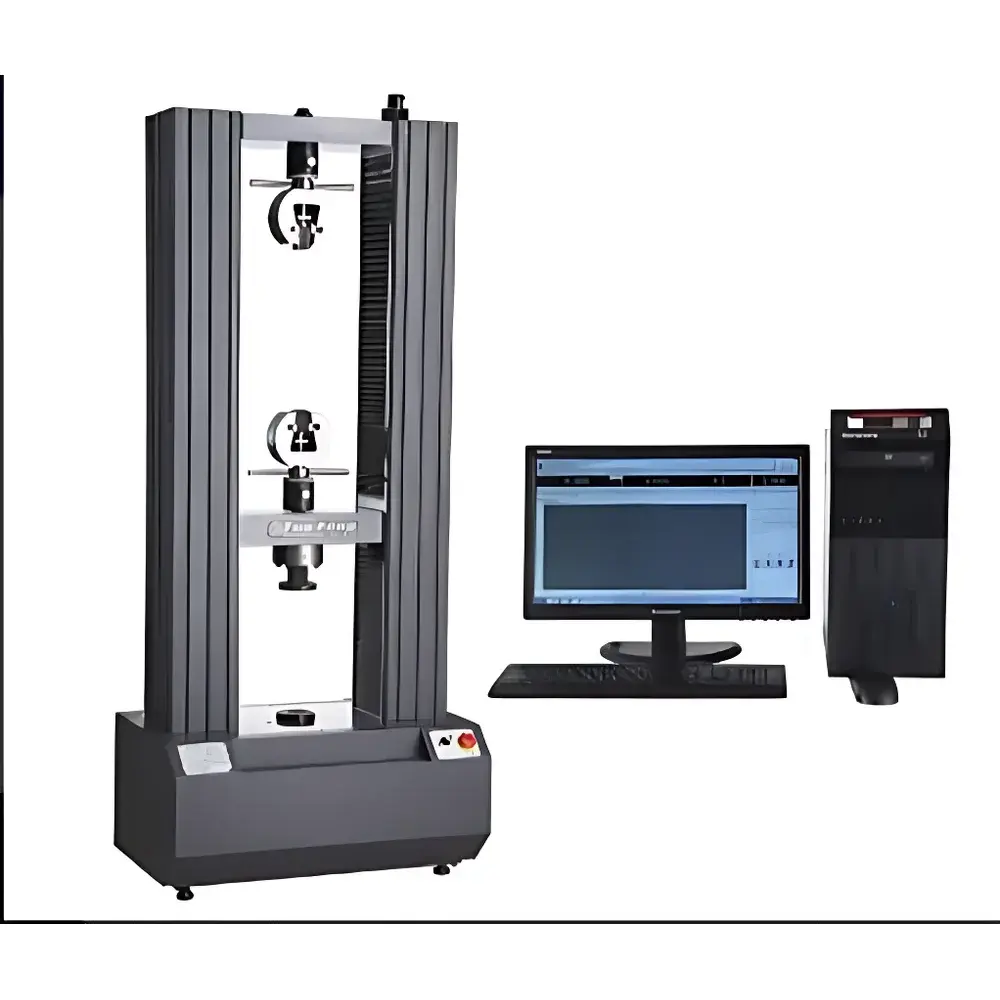
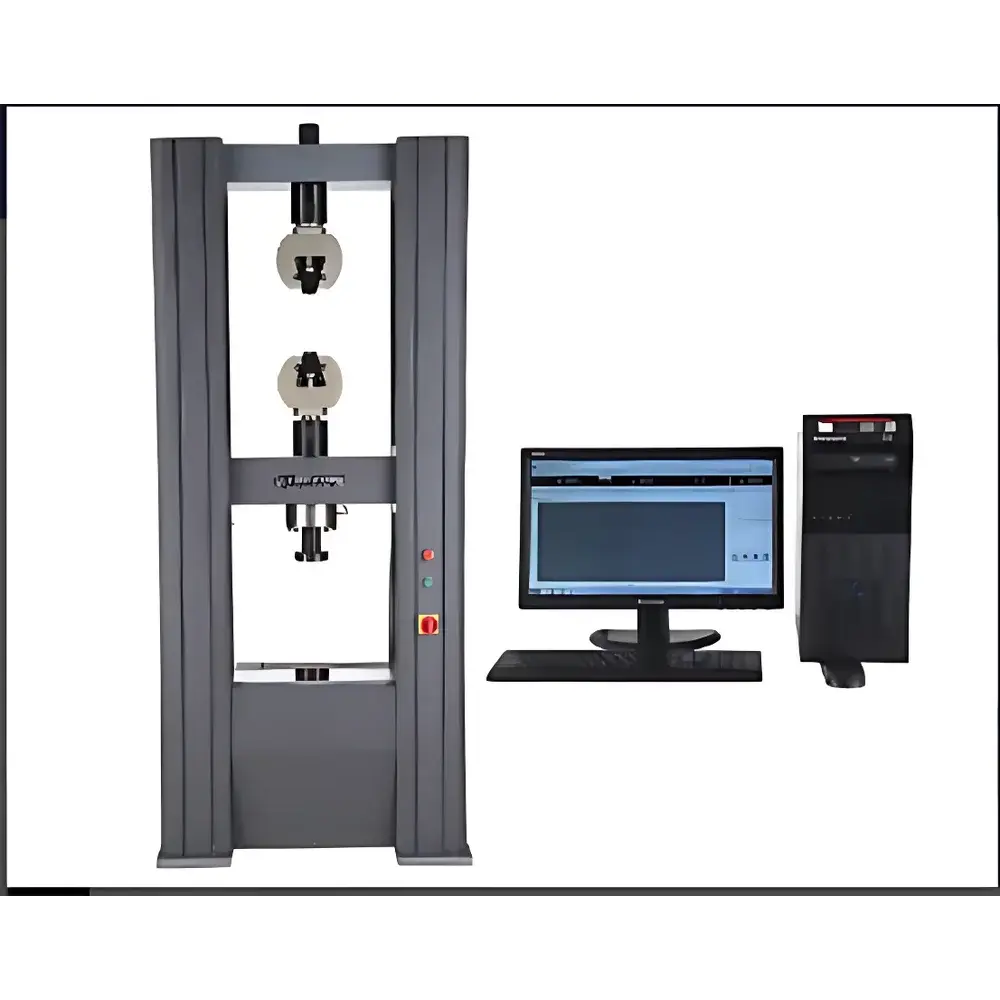
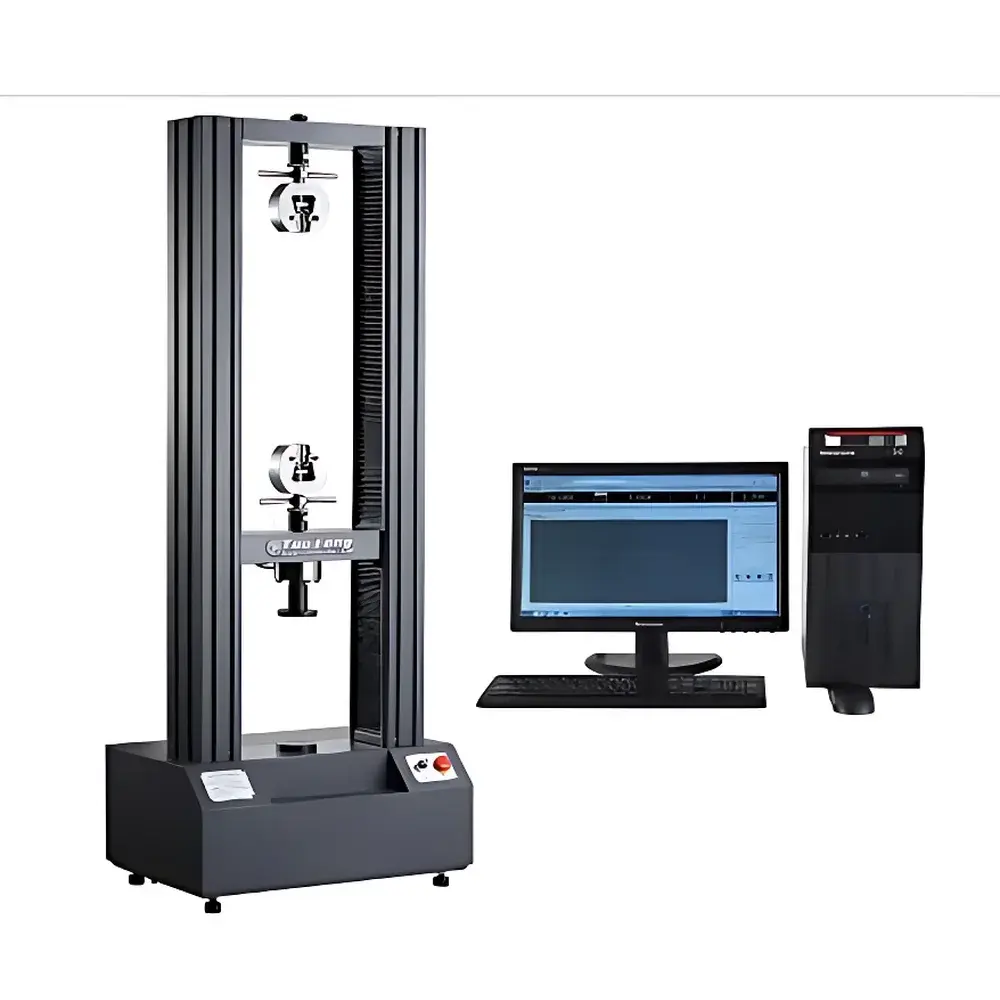
Tuofeng TFW-113 Electronic Universal Tensile Testing Machine
| Brand | Tuofeng |
|---|---|
| Origin | Shanghai, China |
| Manufacturer Type | Direct Manufacturer |
| Model | TFW-113 |
| Maximum Test Load | 200 kN |
| Force Measurement Range | 1 kg to 200 kN (0.2%–100% of full scale) |
| Force Accuracy | ±0.5% of reading |
| Crosshead Travel | 1000 mm |
| Displacement Resolution | 0.001 mm |
| Test Speed Range | 0.001–500 mm/min (infinitely variable) |
| Effective Test Width | 400 mm (customizable up to 600 mm) |
| Position Measurement System | High-resolution optical encoder |
| Deformation Measurement | Optional extensometer or large-deformation sensor |
| Protection Features | Dual-limit electronic travel protection, emergency stop, overload cutoff (>110% FS), automatic return after test |
| Power Supply | 220 V AC, 3.0 kW |
| Machine Weight | ~1500 kg |
| Accuracy Class | ISO 7500-1 / ASTM E4 Class 0.5 |
| Compliance | GB/T 16491-2008, JJG 475-2008, ASTM E4, ASTM D638, ASTM D790, ISO 527, ISO 178, ISO 6892-1, EN 10002-1 |
Overview
The Tuofeng TFW-113 Electronic Universal Tensile Testing Machine is a high-precision, servo-controlled mechanical testing system engineered for static mechanical property characterization of metallic, polymeric, composite, and engineered wood-based materials—including particleboard, MDF, plywood, and laminated veneer lumber. Based on the principle of controlled displacement actuation via precision ball-screw transmission and closed-loop load feedback, the system delivers repeatable force application across a wide dynamic range (1 kg to 200 kN) with traceable metrological performance compliant with ISO 7500-1 Class 0.5 and ASTM E4 Class 0.5 standards. Its rigid dual-column frame, integrated thermal-stable load cell, and real-time digital signal processing architecture ensure minimal hysteresis and long-term stability—critical for accredited material certification workflows in R&D labs, QC departments, and third-party testing laboratories.
Key Features
- Servo-driven motion control with imported AC servo motor and precision worm-gear reduction gearbox, enabling smooth, low-noise operation across the full speed range (0.001–500 mm/min)
- High-rigidity cast-iron base and reinforced steel column structure, optimized for minimal deflection under peak 200 kN loading conditions
- Optical encoder-based displacement measurement with 0.001 mm resolution and ±0.005% accuracy (per JJG 475-2008)
- Integrated overload protection: automatic shutdown at >110% of full-scale load, plus mechanical emergency stop and programmable software limits
- Dual-speed crosshead control (fast/slow modes) with manual jog function and post-test auto-return to initial position
- Modular fixture interface supporting standardized grips for tensile, compression, bending, shear, peel, tear, and puncture tests per ASTM, ISO, and GB protocols
- Real-time dual-channel data acquisition (load + displacement) at ≥1 kHz sampling rate, synchronized with video-capable test logging
Sample Compatibility & Compliance
The TFW-113 accommodates specimens from thin films (<0.1 mm) to structural timber elements (up to 600 mm wide × 1000 mm tall), with customizable jaw geometries (pneumatic, wedge, hydraulic, or custom-machined). It supports standard specimen configurations defined in ASTM D1037 (wood-based panels), ASTM D638 (plastics), ASTM C109 (mortar), ISO 527-2 (tensile testing of plastics), ISO 178 (flexural properties), and GB/T 17657-2022 (formaldehyde emission and mechanical performance of wood-based panels). The system meets mandatory requirements for GLP-compliant environments: audit-trail-enabled software, user-access-level management, electronic signature support, and 21 CFR Part 11–ready configuration options (available upon request). Calibration certificates are traceable to NIM (National Institute of Metrology, China) and internationally recognized NMIs via ISO/IEC 17025-accredited calibration providers.
Software & Data Management
Powered by Windows-native test control software, the TFW-113 supports multi-mode testing protocols—including constant-rate-of-extension (CRE), constant-load hold, constant-strain-rate, and stepwise cyclic loading. The interface offers real-time visualization of up to four simultaneous curves (e.g., stress–strain, load–time, displacement–time, and strain–time), with on-the-fly unit conversion (N/kN/lbf, mm/inch, MPa/psi) and automatic calculation of ISO/ASTM-defined parameters: tensile strength, yield point (0.2% offset), modulus of elasticity, elongation at break, compressive strength, flexural modulus, peel adhesion, and tear resistance. All raw data are stored in open CSV and XML formats; test reports comply with ISO 14253-1 and GB/T 228.1–2021 formatting conventions. Data export includes metadata tagging (operator ID, calibration date, environmental conditions), version-controlled test method templates, and batch comparison tools for statistical process control (SPC) analysis.
Applications
- Mechanical qualification of engineered wood products per EN 312, EN 622, and JIS A 5908 standards
- Quality assurance of adhesive bond integrity in laminated panels and structural composites
- Validation of fire-retardant-treated lumber tensile retention after accelerated aging
- Research-grade deformation mapping of bio-based fiber-reinforced boards under monotonic and fatigue loading
- Regulatory submission testing for CE marking (EN 13986), EPA TSCA Title VI compliance, and CARB ATCM verification
- Teaching laboratory use in materials science curricula covering Hooke’s law, plasticity theory, and fracture mechanics fundamentals
FAQ
What international standards does the TFW-113 support out of the box?
The system includes preloaded test method templates for ASTM D638, ASTM D790, ISO 527-2, ISO 178, GB/T 228.1, and GB/T 17657, with editable parameters to accommodate lab-specific deviations.
Can the machine be integrated into an existing LIMS or MES environment?
Yes—via optional OPC UA or TCP/IP API modules, enabling bidirectional data exchange with LabWare, Thermo Fisher SampleManager, or Siemens Opcenter.
Is third-party calibration and ISO/IEC 17025 certification available?
Tuofeng provides factory calibration with NIM-traceable documentation; external 17025 accreditation services are coordinated through authorized regional partners.
What is the lead time for custom fixtures or elevated-temperature test chambers?
Standard fixtures ship within 5 business days; custom tooling and environmental chambers require 4–6 weeks depending on complexity and validation scope.
Does the software support multi-user role-based access control?
Yes—administrator, technician, and viewer roles with configurable permissions for method editing, test execution, report generation, and audit log review.



