
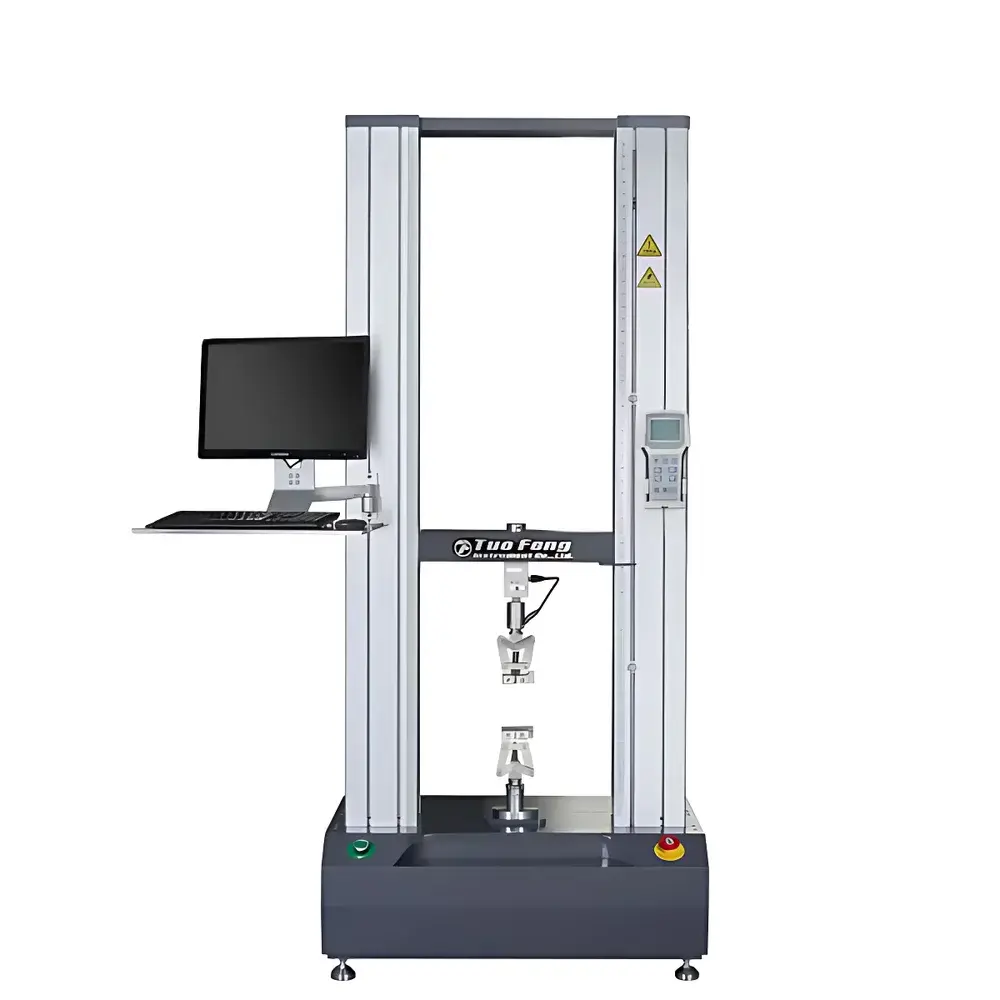
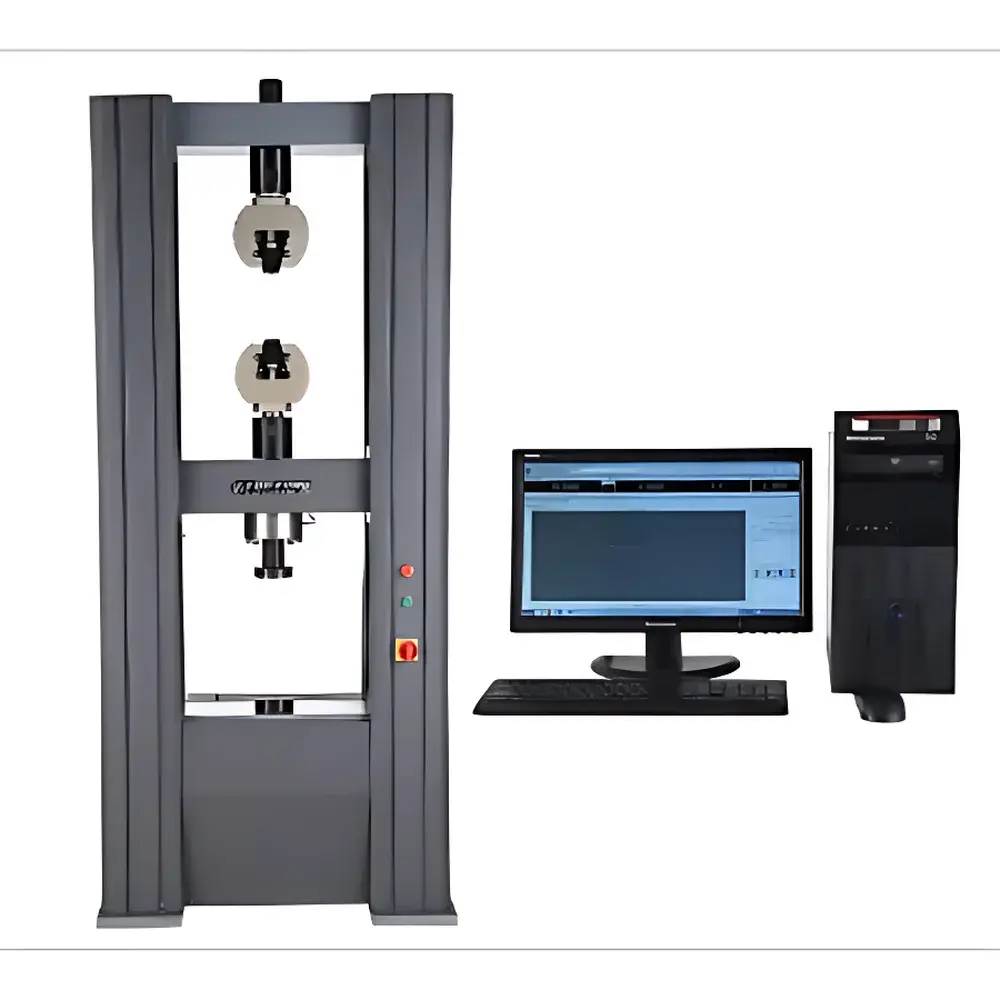
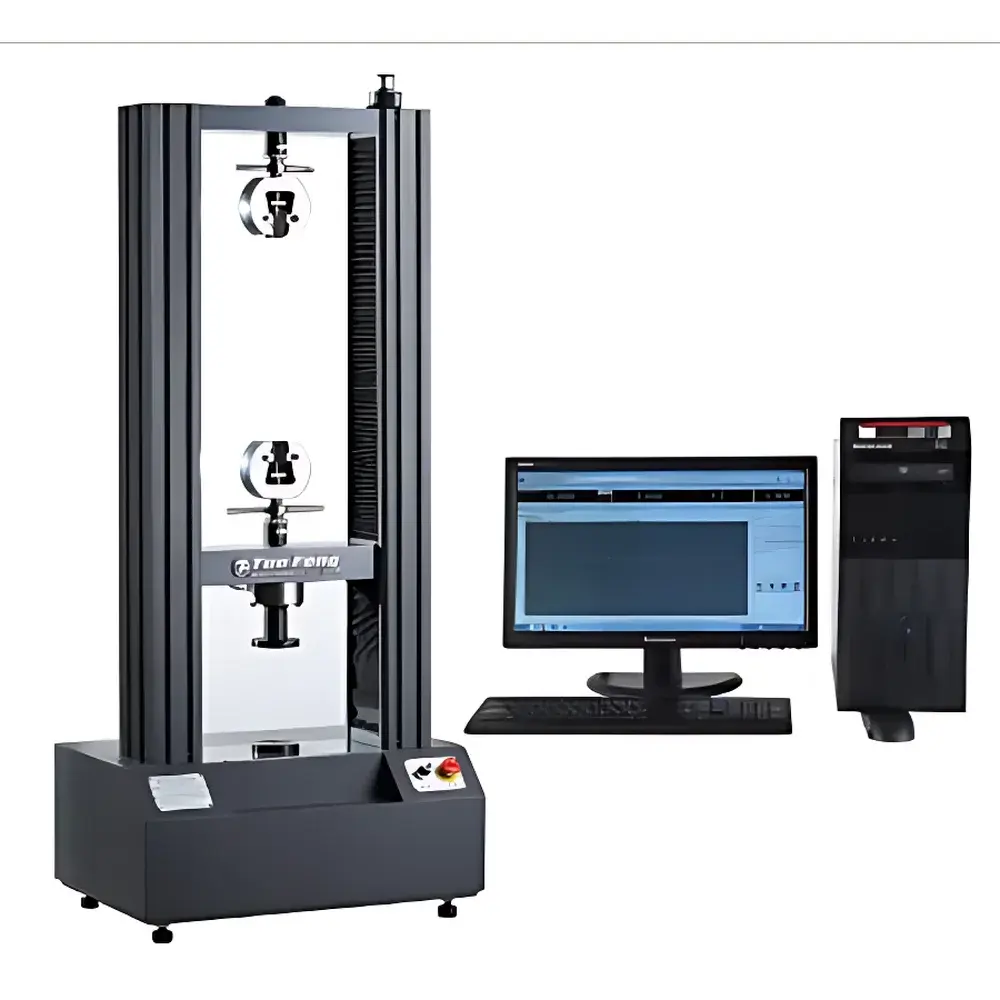
Tuofeng TFW-131 Electronic Universal Tensile Testing Machine
| Brand | Tuofeng |
|---|---|
| Origin | Shanghai, China |
| Manufacturer Type | Direct Manufacturer |
| Product Category | Domestic |
| Model | TFW-131 |
| Price Range | USD 2,800 – 7,000 |
| Instrument Type | Electronic Universal Testing Machine |
| Maximum Test Load | 200 kN |
| Force Measurement Range | 0.2%–100% of Full Scale (FS) |
| Force Accuracy | ±0.5% of reading |
| Crosshead Travel | 1000 mm |
| Displacement Resolution | 0.001 mm |
| Control System | PC-based Closed-loop Servo Control |
| Standards Compliance | GB/T 16491-2008, JJG 475-2008, ASTM E4, ASTM E8, ISO 6892-1, ISO 7500-1, DIN 51221, JIS Z2241 |
| Load Frame Accuracy Class | 0.5 |
| Effective Test Width | 400 mm (customizable up to 600 mm) |
| Speed Range | 0.001–500 mm/min (infinitely variable) |
| Displacement Measurement Accuracy | ±0.005% of reading |
| Encoder Type | High-resolution optical encoder |
| Drive System | Imported servo motor with precision worm gear reducer |
| Lead Screw | Preloaded high-precision ball screw |
| Safety Protection | Dual electronic limit switches, emergency stop button, overload protection (110% FS), automatic return after test |
| Software | Multi-language (English/Chinese/Traditional Chinese), real-time curve display (load-time, load-displacement, stress-strain, displacement-time), automated parameter calculation (tensile strength, yield strength, elongation at break, Young’s modulus, compressive strength, flexural strength, tear strength, peel strength, shear strength), batch comparison, statistical reporting, GLP-compliant data audit trail, export to CSV/PDF/Excel |
Overview
The Tuofeng TFW-131 Electronic Universal Tensile Testing Machine is a high-precision, microprocessor-controlled mechanical testing system engineered for static mechanical characterization of metallic, polymeric, composite, and elastomeric materials. Based on closed-loop servo control architecture and compliant with ISO 7500-1 Class 0.5 accuracy requirements, the TFW-131 delivers traceable force measurement across its full 200 kN capacity with a validated resolution of 0.001 mm in crosshead displacement. Its modular design supports standardized tensile, compression, bending, shear, tear, peel, and puncture tests—enabling quantitative evaluation of fundamental mechanical properties including ultimate tensile strength (UTS), yield strength (0.2% offset), elastic modulus, fracture strain, compressive yield, flexural modulus, and interfacial adhesion performance. The system operates under deterministic real-time control, ensuring repeatability ≤ ±0.5% across identical test protocols—a critical requirement for QC laboratories subject to ISO/IEC 17025 accreditation or GMP-regulated environments.
Key Features
- High-stiffness dual-column load frame with preloaded ball screws and low-backlash worm gear reduction for minimal deflection and consistent load transmission
- Imported industrial-grade servo motor delivering precise speed control from 0.001 to 500 mm/min without gear shifting or torque discontinuity
- Force transducer calibrated to ISO 376:2011 standards, offering linear response over 0.2–100% FS with verified ±0.5% uncertainty
- Optical encoder-based displacement measurement system with ±0.005% reading accuracy and sub-micron positional repeatability
- Dual-mode safety architecture: hardware-level electronic limits + software-enforced overload cutoff (110% FS activation threshold)
- Motorized crosshead with independent fast/slow speed selection and programmable auto-return function post-test
- Modular fixture interface accommodating ASTM-standard grips, wedge-action clamps, compression platens, bend fixtures, and peel jigs
Sample Compatibility & Compliance
The TFW-131 accommodates specimens ranging from thin polymer films (≥0.05 mm thickness) to structural steel coupons (up to 60 mm width × 25 mm thickness). Standard configurations support ASTM D638 Type I–V, ISO 527-2, ISO 604, ISO 178, ASTM D790, ASTM D624, ASTM D3330, and ASTM D1876 test geometries. All mechanical calibrations are traceable to national metrology institutes via certified reference load cells and displacement standards. The system conforms to GB/T 16491-2008 (Chinese national standard for electronic universal testers), JJG 475-2008 (verification regulation), and international harmonized requirements of ISO 7500-1:2018 (static calibration) and ISO 5893:2016 (dynamic verification). Optional add-ons include extensometers (contact and non-contact) compliant with ISO 9513:2012 for strain measurement down to ±1 µm resolution.
Software & Data Management
The embedded Windows-based testing software provides full GLP/GMP-aligned data governance. It supports multi-language UI (English, Simplified/Traditional Chinese), configurable unit systems (N/kN/lbf, mm/in, MPa/psi), and real-time synchronized plotting of up to four independent axes (e.g., stress–strain, load–time, displacement–time). Automated calculations include tensile strength, yield point (0.2% offset method), elongation at break, modulus of elasticity (secant/tangent), compressive yield stress, flexural modulus, tear propagation resistance, and peel adhesion energy. Each test generates an immutable digital record containing operator ID, timestamp, environmental metadata (optional temperature/humidity input), raw sensor data (500 Hz sampling), and audit-trail logs compliant with FDA 21 CFR Part 11 requirements. Reports export natively to PDF, CSV, and Excel formats; historical datasets are indexed by batch ID, material grade, and test standard for rapid traceability.
Applications
This instrument serves as a primary mechanical characterization platform in R&D labs and QA/QC departments across regulated and non-regulated sectors. In polymer science, it quantifies tensile behavior of thermoplastics (PP, PE, PET), engineering resins (PC, PEEK), elastomers (EPDM, silicone), and biodegradable films per ISO 527 and ASTM D882. In aerospace composites, it validates fiber-reinforced laminates under ASTM D3039 and ISO 527-4. Automotive suppliers use it for rubber bushing compression hysteresis (ISO 48), brake pad shear strength (SAE J276), and seat belt webbing tensile integrity (FMVSS 209). Wire & cable manufacturers rely on its peel strength mode (ASTM D903) for jacket adhesion validation. Additionally, it supports powder metallurgy green strength testing (ASTM B964), medical device suture tensile analysis (ISO 10993-12), and packaging film seal integrity (ASTM F88).
FAQ
What international standards does the TFW-131 support out-of-the-box?
The base configuration complies with ASTM E4 (force verification), ASTM E8/E21 (tensile testing of metals), ISO 6892-1 (metallic materials), ISO 527-1 (plastics), and GB/T 16491-2008. Custom test methods can be programmed via the software’s script editor.
Is the system compatible with external extensometers?
Yes—both clip-on axial extensometers (ISO 9513 Class 1) and video-based non-contact systems (DIC-ready) can be integrated via analog/digital I/O ports and synchronized in real time.
Can test data be exported for LIMS integration?
All raw and processed data export in ASTM E1434-compliant XML format, enabling direct ingestion into laboratory information management systems (LIMS) without manual re-entry.
What maintenance intervals are recommended for long-term accuracy?
Annual force calibration using NIST-traceable deadweight standards and biannual mechanical inspection (lead screw lubrication, alignment verification, encoder cleaning) are advised per ISO/IEC 17025 Clause 6.4.
Does the software support multi-user role-based access control?
Yes—administrator, technician, and viewer roles enforce differential permissions for method editing, test execution, and report generation, satisfying 21 CFR Part 11 §11.200(a) requirements.



