
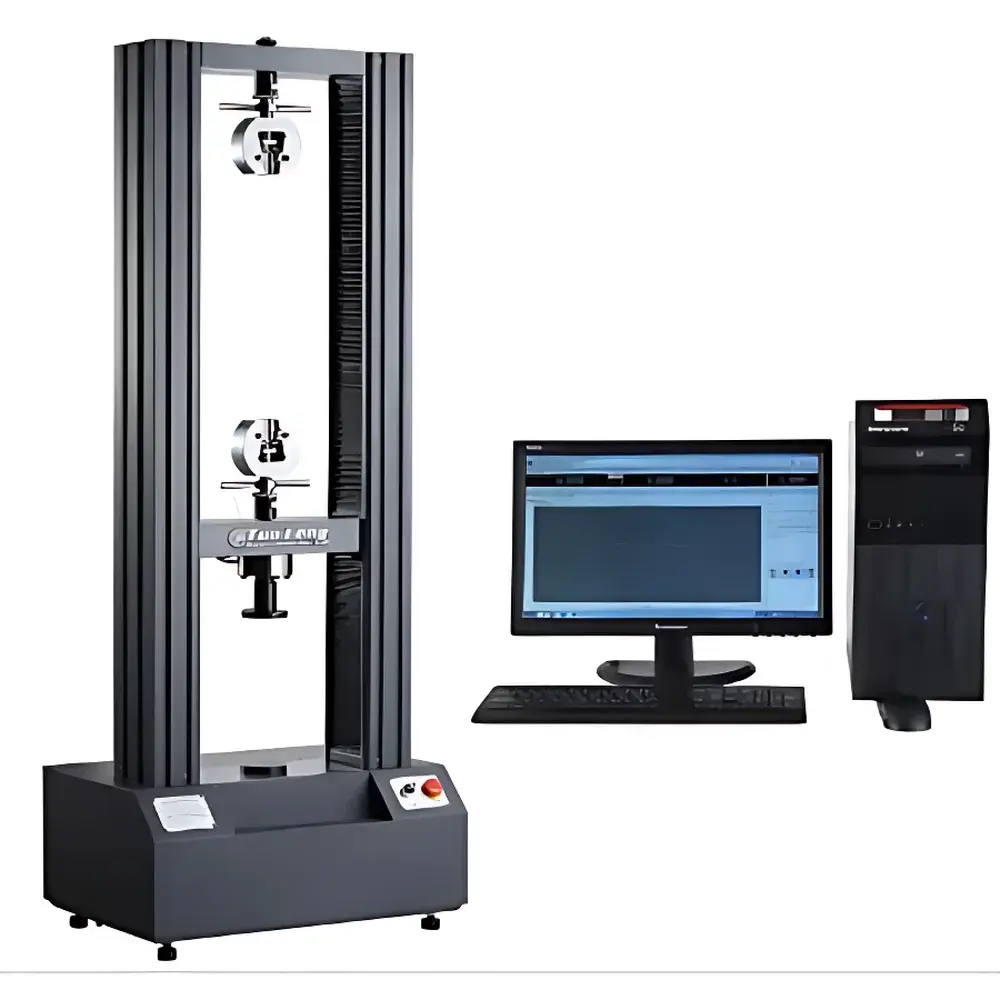
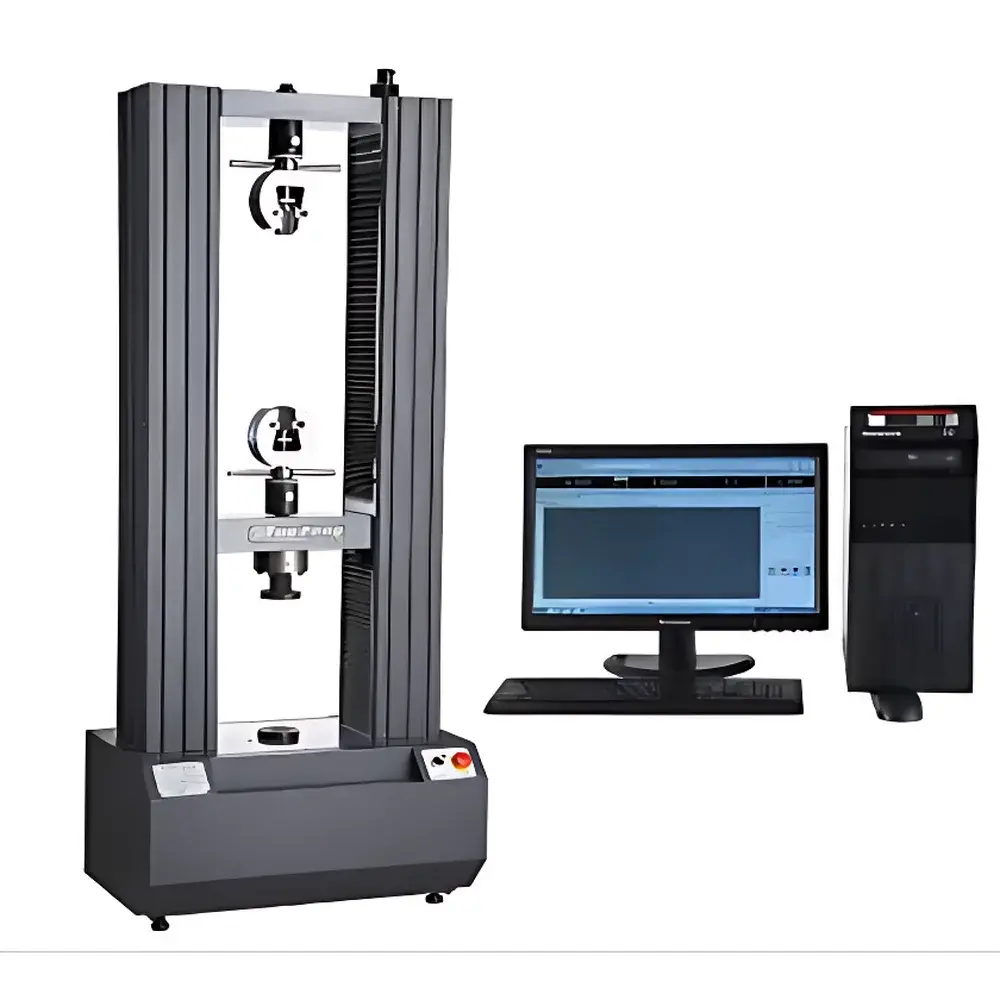
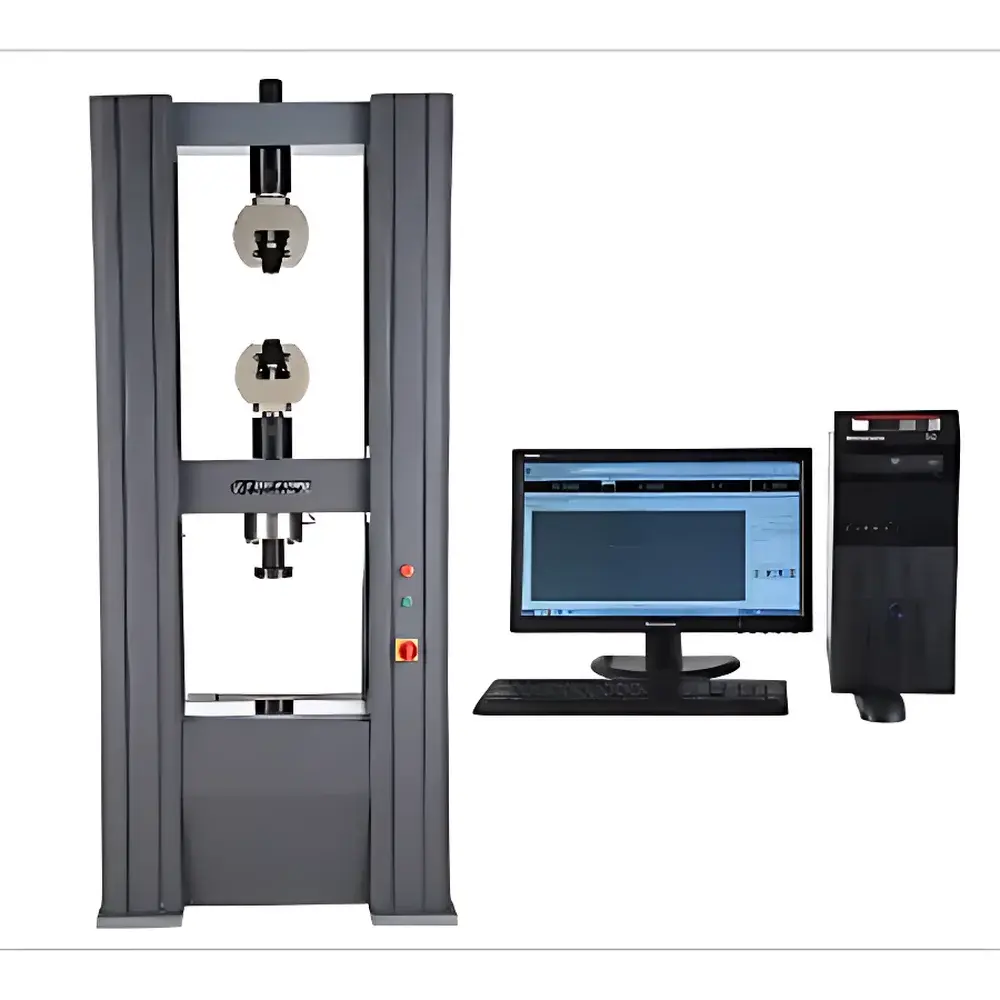
Tuofeng TFW-148 Microcomputer-Controlled Servo-Powered Universal Testing Machine
| Brand | Tuofeng |
|---|---|
| Origin | Shanghai, China |
| Manufacturer Type | Direct Manufacturer |
| Instrument Type | Electromechanical Universal Testing Machine |
| Model | TFW-148 |
| Compliance | GB/T 16491–2008, JJG 475–2008, ASTM E4, ISO 7500-1, DIN 51221, JIS B 7721 |
| Load Capacity | 148 kN (customizable variants: 5–200 kN) |
| Accuracy Class | 0.5 |
| Effective Force Range | 0.2%–100% of full scale |
| Force Measurement Uncertainty | ±0.005% of reading |
| Resolution | 1 part in ±500,000 full-scale counts (single-range, no auto-ranging) |
| Drive System | Imported AC servo motor with precision worm-gear reducer |
| Actuation Mechanism | High-precision preloaded ball screw |
| Effective Test Width | 600 mm (expandable) |
| Max Stroke | 800 mm (height-adjustable) |
| Speed Range | 0.001–500 mm/min (infinitely variable, closed-loop controlled) |
| Displacement Measurement | Optical encoder, accuracy ±0.005% of reading |
| Strain Measurement | Optional extensometer (clip-on or non-contact) or large-deformation transducer, accuracy ±0.005% of reading |
| Safety Systems | Dual electronic limit switches, emergency stop button, overload protection (110% F.S.), automatic return after test |
| Crosshead Control | Dual-speed (fast/slow) motorized positioning with jog function |
| Return Mode | Programmable high-speed return to initial position |
| Fixture Customization | Application-specific grips (tensile, compression, bend, shear, peel, tear, puncture) available per ASTM/ISO specimen geometry |
| Dimensions (W×D×H) | 1000 × 700 × 2000 mm |
| Weight | ~450 kg |
| Power Supply | 220 V AC, 1.0 kW |
Overview
The Tuofeng TFW-148 is a microcomputer-controlled, electromechanical universal testing machine engineered for high-fidelity mechanical property characterization of metallic, polymeric, ceramic, composite, and elastomeric materials. Based on closed-loop servo control architecture and calibrated force transduction via high-stability load cells, the system implements standardized quasi-static uniaxial loading protocols defined in ISO 6892-1 (tensile), ISO 14577 (hardness-indentation correlation), ASTM D638/D695/D790 (plastics), and ASTM E8/E9 (metals). Its modular design supports interchangeable test configurations—including tension, compression, flexure, shear, peel, tear, and puncture—enabling full compliance with multi-standard workflows required by GLP-certified labs, ISO/IEC 17025-accredited testing facilities, and R&D departments operating under FDA 21 CFR Part 11 data integrity requirements.
Key Features
- Precision-engineered dual-stage drive system: Imported AC servo motor coupled with zero-backlash worm-gear reduction and preloaded ground ball screw ensures smooth, low-noise actuation across the full 0.001–500 mm/min speed range.
- Class 0.5 force measurement performance per ISO 7500-1: Achieved through temperature-compensated, hermetically sealed load cells with resolution of 1:500,000 full-scale counts and linearity error ≤ ±0.005% of reading.
- Single-range, no-switching architecture: Eliminates range-change hysteresis and calibration discontinuity—critical for creep, relaxation, and cyclic loading studies requiring consistent resolution from 0.2% to 100% of full-scale capacity.
- Integrated safety triad: Independent hardware-based electronic limit switches, front-panel emergency stop, and real-time overload cutoff (triggered at 110% F.S.) conform to EN ISO 13857 and IEC 61508 functional safety principles.
- Motorized crosshead with dual-speed jog control: Enables rapid specimen alignment (fast mode) and micron-level positioning (slow mode), reducing setup time without compromising repeatability.
- Modular fixture interface: Standard M6/M8 threaded mounting plates accommodate ASTM-compliant tensile grips (pneumatic/hydraulic wedge, screw-type), compression platens, 3-/4-point bend fixtures, and specialized tooling for peel (T-peel, 90°/180°), tear (Trouser, Elmendorf), and puncture tests.
Sample Compatibility & Compliance
The TFW-148 accommodates specimens ranging from miniature coupons (e.g., ASTM E8M subsize, ISO 6892-2 Type A80) to structural components up to 600 mm wide and 800 mm stroke depth. It supports standardized test geometries per ASTM D3039 (composite tensile), ISO 527-2 (plastics), GB/T 228.1 (metallic materials), and JIS Z 2241. All force, displacement, and strain measurements are traceable to national standards via factory calibration certificates compliant with ISO/IEC 17025. The machine satisfies metrological verification requirements per JJG 475–2008 and manufacturing specifications per GB/T 16491–2008. Optional NIST-traceable calibration kits and third-party accreditation support are available for regulated environments requiring audit-ready documentation.
Software & Data Management
The embedded Windows-based test software provides full IEC 62304-compliant control architecture with configurable test sequences, real-time data acquisition at ≥1 kHz sampling rate, and automated parameter derivation—including tensile strength, yield point (0.2% offset), Young’s modulus, fracture strain, compressive yield, flexural modulus, peel adhesion energy, and tear propagation resistance. Multi-curve overlay, statistical reporting (mean, min, max, SD), and batch export to CSV, PDF, or XML formats ensure interoperability with LIMS and ELN systems. Audit trail functionality logs all user actions, method changes, and calibration events in accordance with 21 CFR Part 11 requirements. Language localization (English, Simplified/Traditional Chinese), unit conversion (N/kN/lbf, mm/in, MPa/psi), and customizable report templates facilitate global deployment and regulatory submissions.
Applications
This system serves as a primary mechanical characterization platform across industrial QA/QC laboratories and academic research centers. In aerospace, it validates titanium alloy sheet formability and carbon fiber prepreg interlaminar shear strength. In medical device manufacturing, it verifies tensile integrity of suture threads (ISO 10555-1) and compression resilience of orthopedic polymer implants (ISO 7206-4). Automotive suppliers use it for rubber bushing hysteresis analysis and battery pack structural frame crush testing. Wire & cable producers rely on its peel strength module for insulation adhesion assessment (UL 1581 §1060), while packaging engineers apply its 180° peel protocol to quantify seal integrity of sterile barrier systems (ASTM F88). Universities deploy it for teaching fundamental mechanics-of-materials concepts and validating constitutive models under controlled boundary conditions.
FAQ
Does the TFW-148 support ASTM E23 standard impact testing?
No—this is a quasi-static electromechanical UTM; Charpy/Izod impact testing requires dedicated pendulum or drop-weight systems.
Can the system perform cyclic fatigue testing?
Yes, with optional high-cycle fatigue module (up to 5 Hz) and waveform generator for sinusoidal, triangular, or block-loading profiles.
Is third-party ISO/IEC 17025 calibration available?
Yes—certified calibration services including uncertainty budgets and traceable certificates are offered annually or per audit cycle.
What extensometer options are compatible?
Standard clip-on axial extensometers (10–50 mm gauge length, ±0.5% accuracy), non-contact video extensometry (for brittle or high-temp samples), and large-deformation transducers (up to 1000% strain) are supported.
How is software validation handled for regulated environments?
IQ/OQ documentation packages, 21 CFR Part 11 configuration files, and electronic signature workflows are provided upon request for GxP implementation.



