
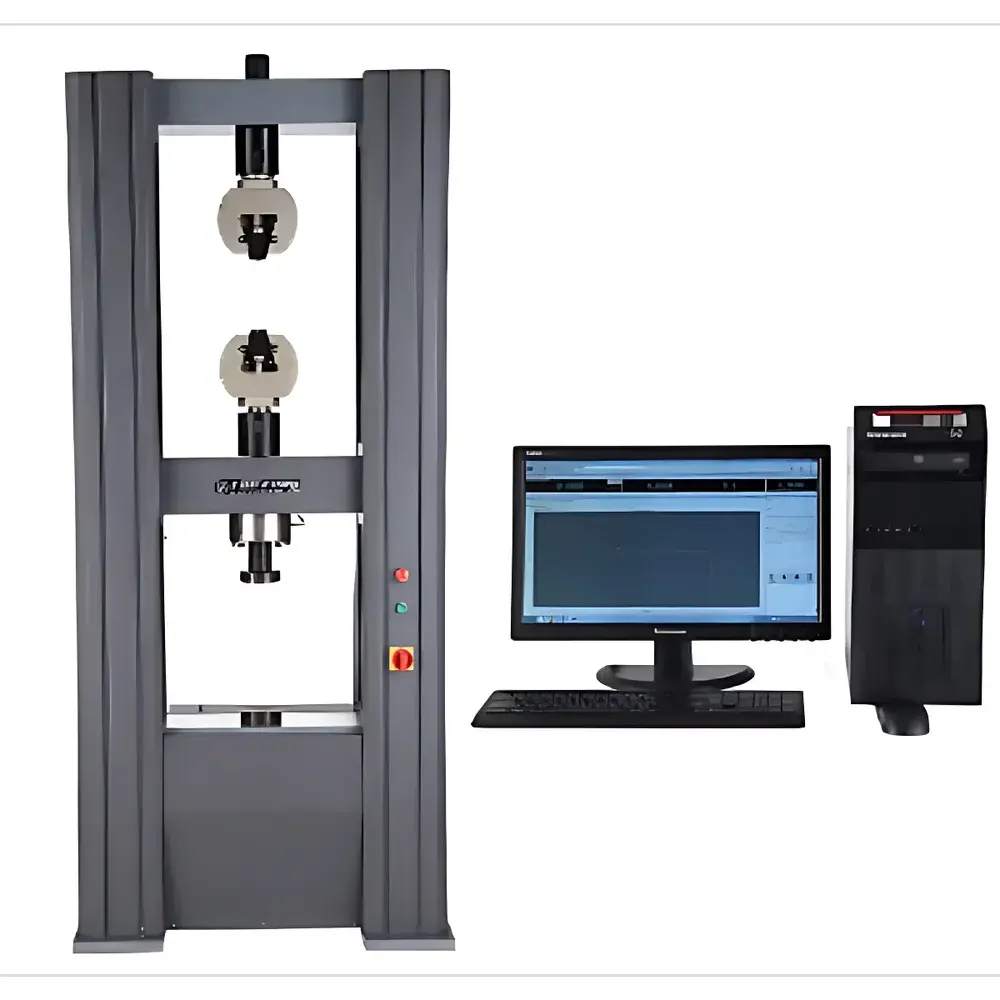
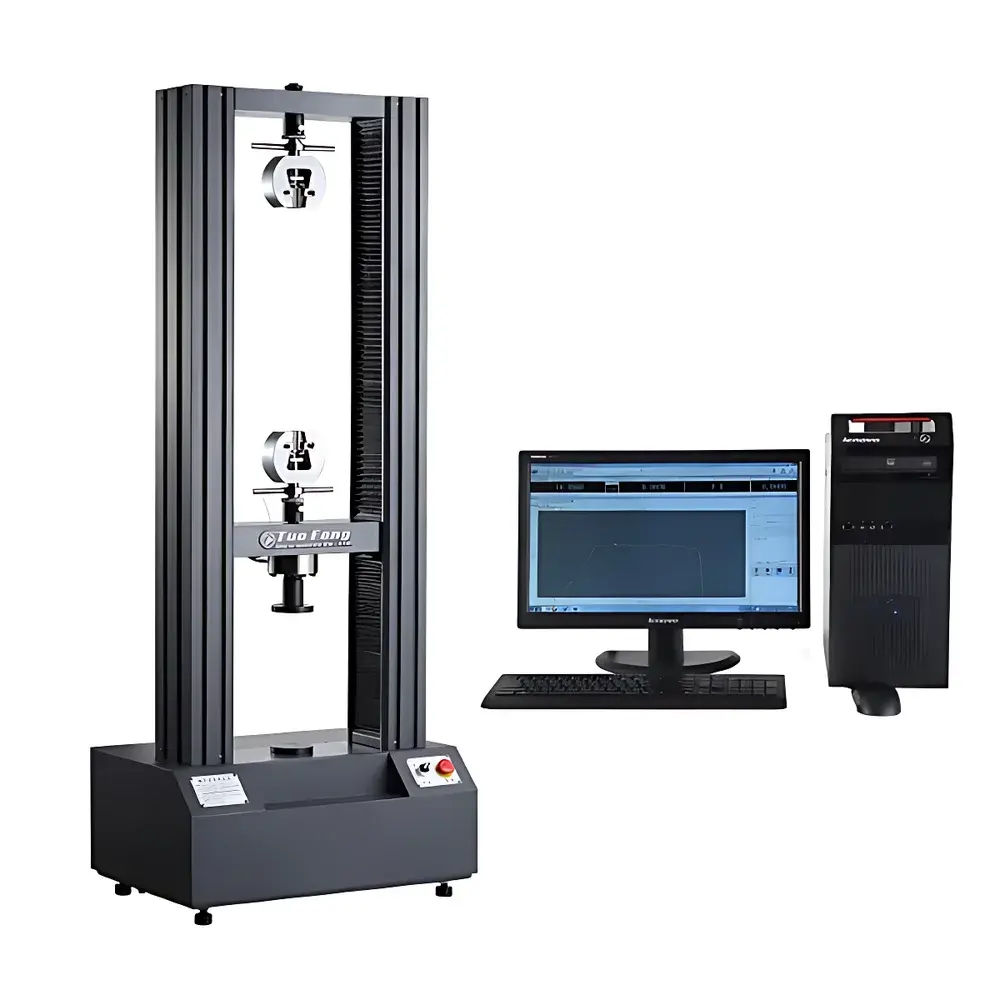
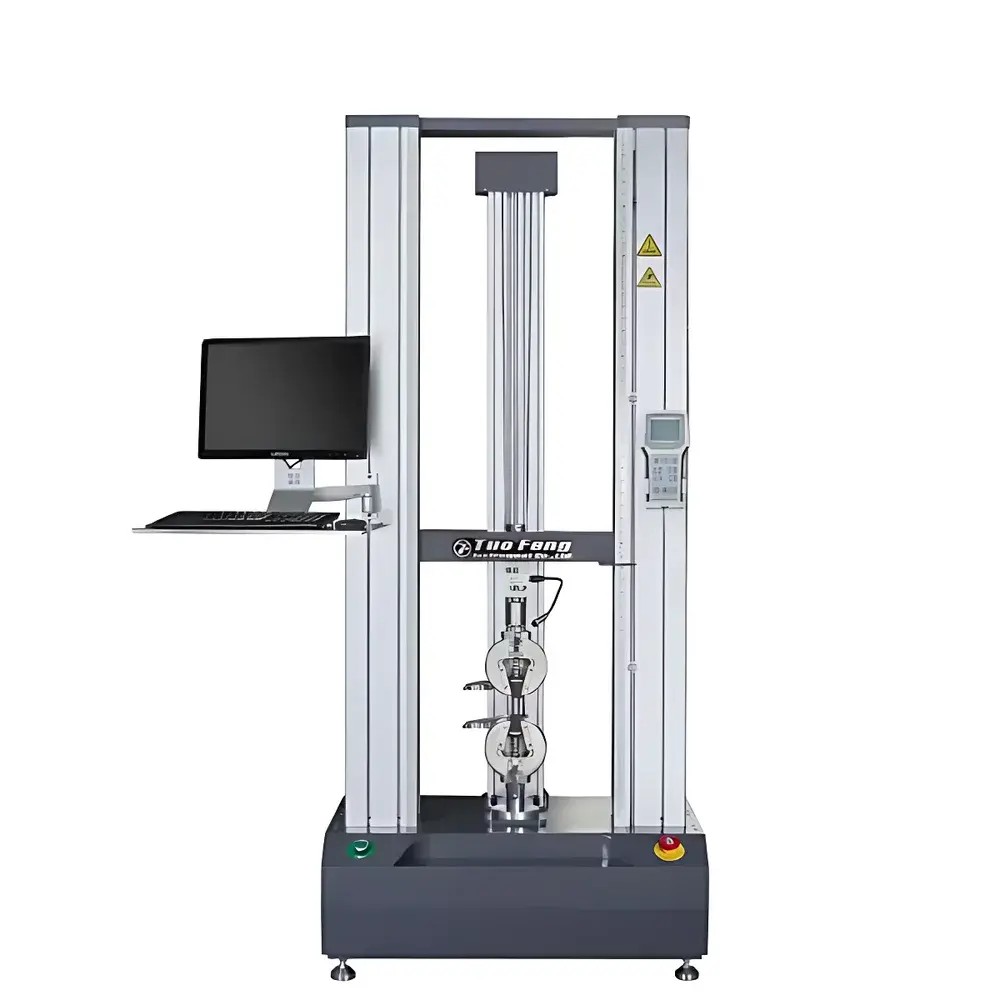
Tuofeng TFW-255 Microcomputer-Controlled Electronic Universal Testing Machine
| Brand | Tuofeng |
|---|---|
| Origin | Shanghai, China |
| Manufacturer Type | Direct Manufacturer |
| Product Category | Domestic |
| Model | TFW-255 |
| Instrument Type | Electromechanical Universal Testing Machine |
| Standard Compliance | GB/T 16491-2008, JJG 475-2008, ASTM E4, ASTM E8, ISO 6892-1, ISO 7500-1, DIN 51221, JIS Z 2241, BS EN 10002-1 |
| Accuracy Class | 0.5 |
| Effective Force Range | 0.2%–100% of Full Scale |
| Force Measurement Accuracy | ±0.005% of reading |
| Load Cell Resolution | 1 part in ±500,000 full-scale codes (no range switching, constant resolution) |
| Drive System | Imported servo motor with precision worm-gear reducer |
| Lead Screw | High-precision preloaded ball screw |
| Effective Test Width | 400 mm (customizable up to 600 mm) |
| Max Travel | 800 mm (extendable) |
| Speed Range | 0.001–500 mm/min (infinitely variable, programmable) |
| Displacement Measurement | Optical encoder |
| Displacement Accuracy | ±0.005% of reading |
| Strain Measurement | Optional extensometer or large-deformation sensor (ASTM E83 Class B-1 compliant) |
| Strain Accuracy | ±0.005% of reading |
| Safety Protection | Dual electronic limit switches, emergency stop button, overload cutoff (>110% FS), mechanical hard stops |
| Crosshead Control | Dual-speed (fast/slow) motorized adjustment with jog function |
| Return Function | Automatic high-speed return to initial position post-test |
| Overload Protection | Automatic shutdown at >110% full-scale load |
| Fixture Customization | Application-specific grips and fixtures available per ISO/ASTM standards |
| Dimensions (W×D×H) | 780 × 560 × 1700 mm |
| Power Supply | 220 V AC, 750 W |
| Net Weight | ~280 kg |
Overview
The Tuofeng TFW-255 Microcomputer-Controlled Electronic Universal Testing Machine is an electromechanical static testing system engineered for high-precision mechanical property characterization of metallic, non-metallic, and composite materials. Based on the fundamental principles of uniaxial force application and displacement-controlled loading, the machine implements closed-loop servo control to deliver repeatable, traceable, and metrologically validated measurements across tensile, compression, flexural, shear, tear, peel, and puncture test modes. Its structural architecture adheres to ISO 7500-1:2018 (static calibration of force-proving instruments) and GB/T 16491-2008 (design and performance requirements for electronic universal testers), ensuring compliance with international laboratory accreditation frameworks including ISO/IEC 17025. The system is designed for integration into quality control laboratories, R&D centers, and third-party testing facilities operating under GLP, GMP, or ISO 9001 environments.
Key Features
- 0.5-class accuracy certified per ISO 7500-1 and JJG 475-2008, with force measurement uncertainty ≤ ±0.005% of reading across the full dynamic range (0.2–100% FS)
- True single-range, high-resolution load cell (1:500,000 internal resolution) eliminating range-switching artifacts and ensuring consistent sensitivity from low-force polymer testing to high-load structural composites
- Precision preloaded ball screw transmission coupled with imported servo drive and worm-gear reduction for smooth, backlash-free motion control and long-term dimensional stability
- Dual-speed crosshead actuation (jog + auto-return) with programmable positioning repeatability ≤ ±0.01 mm
- Modular fixture interface supporting standardized ASTM E8/E21/E23 grips, ISO 527-2 clamps, and custom-designed tooling for wood-based panels, fiber-reinforced plastics, and elastomeric laminates
- Integrated safety architecture including hardware-based emergency stop, dual electronic limit switches, real-time overload detection (>110% FS), and mechanical end-stops
Sample Compatibility & Compliance
The TFW-255 accommodates specimens ranging from thin films (≥0.1 mm thickness) to structural timber panels (up to 600 mm wide × 800 mm height). It supports standardized test configurations per ASTM D1037 (wood-based panels), ASTM D3043 (structural composite lumber), ISO 13968 (rigid polyurethane foams), ISO 527-2 (plastics tensile), ISO 604 (plastics compression), and EN 310 (wood-based panel bending). All mechanical calibrations are traceable to national metrology institutes via NIST-traceable reference load cells and displacement standards. The system meets mandatory requirements for CE marking (EMC Directive 2014/30/EU, Machinery Directive 2006/42/EC) and supports audit-ready documentation for FDA 21 CFR Part 11-compliant environments when paired with optional electronic signature and audit trail modules.
Software & Data Management
The Windows-based TFW-TestSuite v4.2 software provides fully configurable test method templates aligned with ASTM, ISO, GB, and JIS standards. It supports multiple control modes—including load-controlled, displacement-controlled, strain-controlled, and hold (constant load/strain) protocols—with real-time PID tuning. Data acquisition operates at ≥1 kHz sampling rate, enabling accurate capture of transient events such as yield point detection and fracture initiation. The software generates synchronized multi-channel plots (force–time, stress–strain, displacement–time, force–extension) with automatic parameter extraction: ultimate tensile strength (UTS), yield strength (0.2% offset), modulus of elasticity, elongation at break, compressive strength, flexural modulus, peel adhesion energy, and tear propagation resistance. Raw data exports to CSV, XML, and PDF formats; test reports include operator ID, calibration certificate IDs, environmental conditions (optional hygrothermal logging), and digital signatures. Audit trails record all user actions, method changes, and result modifications per ALCOA+ principles.
Applications
The TFW-255 serves as a primary mechanical characterization platform in diverse industrial and academic settings. In building materials laboratories, it performs routine evaluation of particleboard, MDF, plywood, OSB, and LVL panels per EN 310, EN 319, and GB/T 17657. Aerospace suppliers utilize it for qualifying carbon-fiber prepreg laminates under ASTM D3039 and D6641. Automotive Tier-1 manufacturers apply it to validate thermoplastic composites (e.g., PP-glass fiber) per ISO 527 and ISO 604. Rubber and elastomer producers rely on its high-resolution tear and peel modules (ASTM D624, D903) for QC release testing. Universities employ the system for graduate-level mechanics of materials instruction and fracture mechanics research, particularly where controlled strain-rate experiments (e.g., quasi-static vs. creep-loaded tests) are required. Its modular design allows seamless integration with environmental chambers (-70°C to +300°C), video extensometry, and acoustic emission sensors.
FAQ
What international standards does the TFW-255 support out-of-the-box?
The system includes preloaded test methods for ASTM E8, ASTM D638, ISO 6892-1, ISO 527-2, EN 10002-1, GB/T 228.1, and GB/T 16491—covering over 95% of routine mechanical testing applications.
Is the force transducer calibrated and traceable?
Yes. Each unit ships with a factory calibration certificate traceable to CNAS-accredited laboratories (equivalent to ISO/IEC 17025), with optional NIST-traceable recalibration services available annually.
Can the system be integrated into an existing LIMS or MES environment?
Yes. TFW-TestSuite supports OPC UA and TCP/IP-based data export, enabling bidirectional communication with LabWare LIMS, Thermo Fisher SampleManager, and Siemens Opcenter Execution.
Does the software meet FDA 21 CFR Part 11 requirements?
Base software complies with electronic record retention; optional 21 CFR Part 11 module adds role-based access control, biometric or PKI-based e-signatures, and immutable audit trails.
What is the warranty and service coverage?
Standard 24-month parts-and-labor warranty; extended service plans include remote diagnostics, annual on-site verification, and priority firmware updates.



