
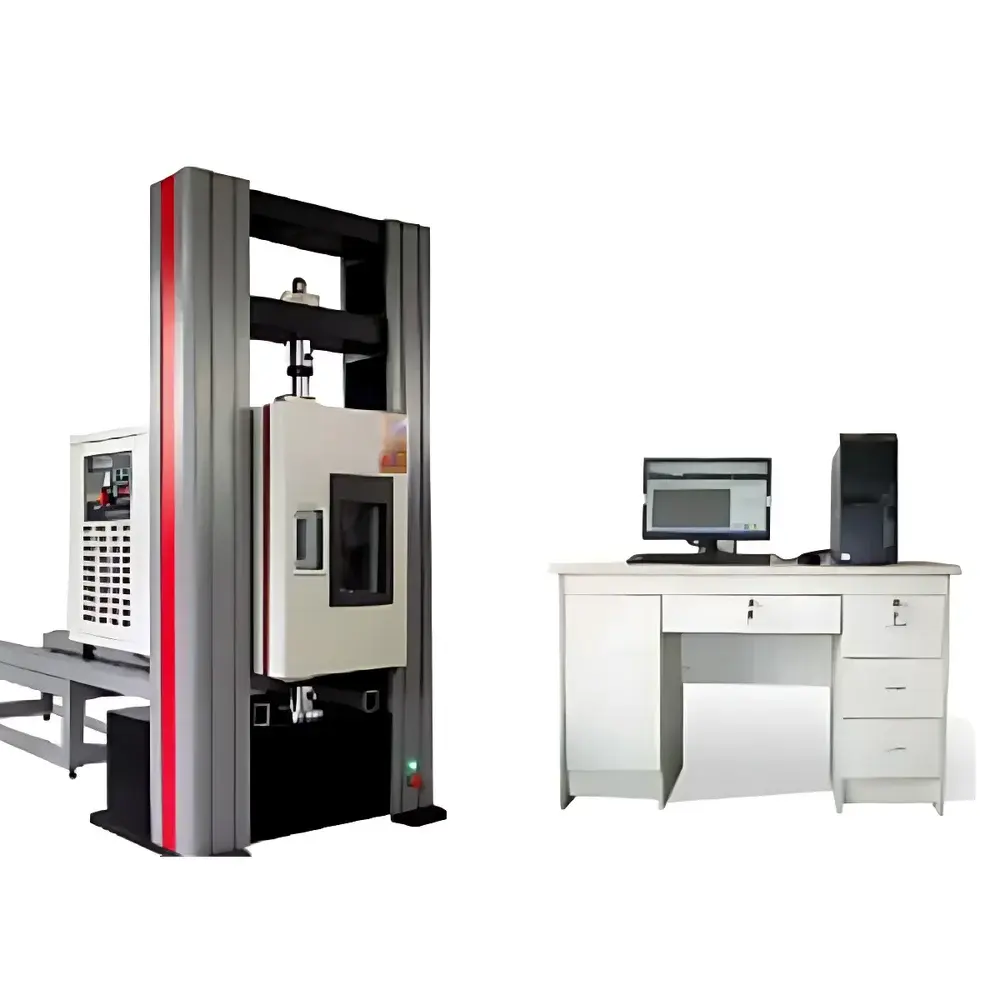
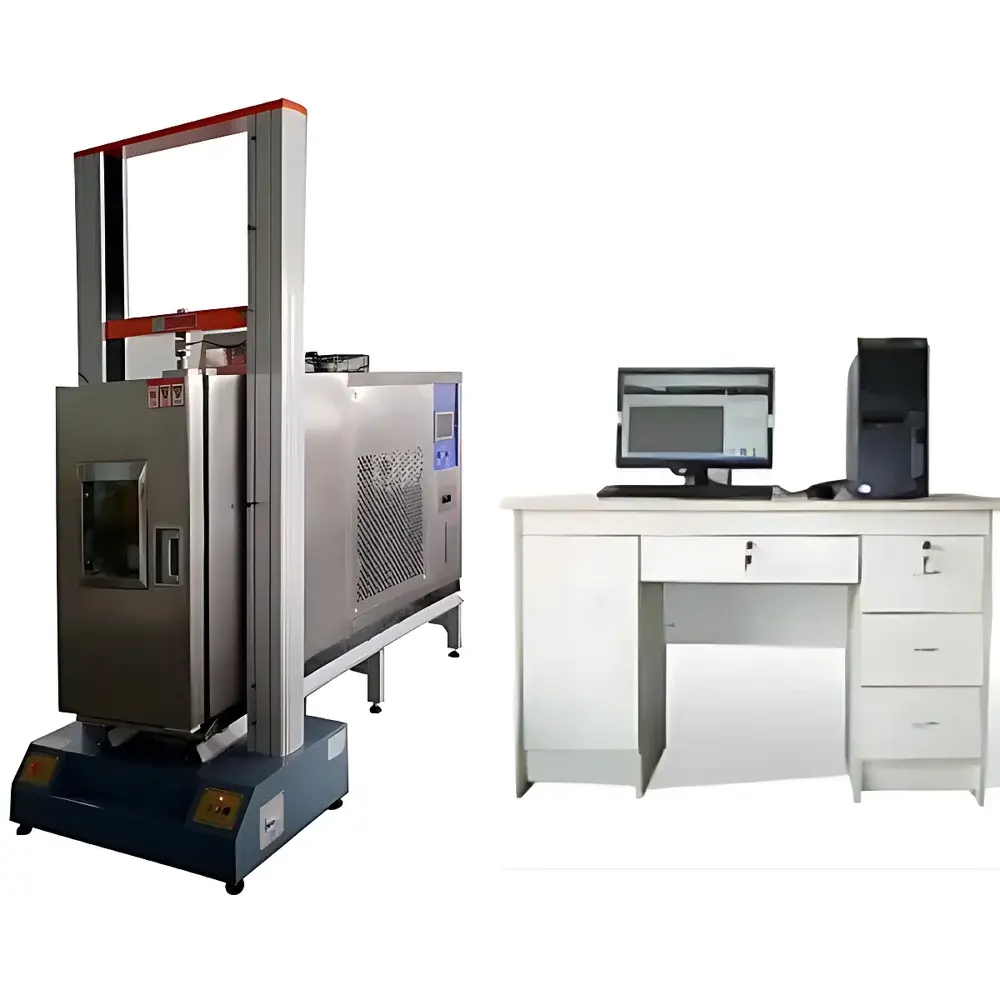
Tuofeng TFW-260 High-Low Temperature Universal Testing Machine
| Brand | Tuofeng |
|---|---|
| Model | TFW-260 |
| Type | Electromechanical Universal Testing Machine |
| Max Test Load | 5–300 kN (configurable) |
| Accuracy Class | 0.5 |
| Force Measurement Range | 0.4–100% FS |
| Force Resolution | 1/500,000 of full scale |
| Deformation Measurement Range | 0.2–100% FS |
| Deformation Resolution | up to 1/300,000 |
| Displacement Error | ±0.5% of reading |
| Column Spacing | 840 mm |
| Crosshead Travel | 1000 mm (subject to environmental chamber constraints) |
| Host Dimensions | 1250 × 560 × 2400 mm |
| Weight | ~380 kg |
| Power Supply | AC 220 V / 50 Hz ±10%, 750 W |
| Environmental Chamber Temp Range | −40 °C to +100 °C |
| Chamber Heating Power | 1500 W |
| Chamber Internal Dimensions | 360 × 300 × 500 mm (W×D×H) |
| Temperature Uniformity | ±2 °C over 100 mm vertical zone |
| Temp Ramp Rate | ≤30 min to +100 °C from ambient |
| Temp Stabilization Time | ≤5 min (both above and below 0 °C) |
| Chamber Control | Programmable PID with Pt100 sensors |
| Safety | Leakage protection, overcurrent circuit breaker |
Overview
The Tuofeng TFW-260 High-Low Temperature Universal Testing Machine is an electromechanical materials testing system engineered for precision mechanical characterization across extreme thermal conditions. It integrates a high-stiffness dual-column load frame with a fully programmable environmental chamber—capable of stable operation from −40 °C to +100 °C—to enable standardized tensile, compression, flexural, tear, peel, and shear testing of metallic and non-metallic specimens under thermally controlled environments. The system complies with fundamental principles of quasi-static mechanical testing per ISO 6892-1 (tensile), ISO 148-1 (impact), ASTM E8/E9 (tension/compression), ASTM D638/D790 (plastics), and GB/T 228.1—ensuring traceable, repeatable force-displacement data acquisition. Its closed-loop servo-controlled actuation, combined with high-resolution load cell and extensometer inputs, supports deterministic measurement of yield strength, ultimate tensile strength, modulus of elasticity, elongation at break, and Poisson’s ratio—whether conducted at ambient temperature or within thermally constrained boundary conditions.
Key Features
- Modular dual-column frame with 840 mm column spacing and 1000 mm crosshead travel—optimized for specimen handling and fixture integration.
- 0.5-class accuracy load measurement system with full-scale resolution down to 1/500,000 and force error ≤±0.5% of reading—validated per ISO 7500-1.
- High-fidelity deformation sensing: extensometer-compatible input with 0.2–100% FS range and resolution up to 1/300,000—enabling precise strain determination in ductile and brittle regimes.
- Integrated environmental chamber constructed from 304 stainless steel exterior and 316 mirror-finish interior, insulated with alumina-silica fiber for thermal stability and low leakage.
- Programmable temperature control via PID algorithm with Pt100 sensors; uniformity maintained within ±2 °C over 100 mm vertical zone—verified per ISO 16750-4 and ASTM E145.
- Automatic thermal compensation algorithms embedded in firmware to correct for thermal drift in load train and displacement transducers during extended dwell or ramp cycles.
- Industrial-grade safety architecture including earth-leakage circuit protection, overcurrent breakers, and emergency stop interlocks compliant with IEC 60204-1.
Sample Compatibility & Compliance
The TFW-260 accommodates standard test specimens per ISO 6892-1 (flat and round), ASTM E8 (metals), ASTM D638 (plastics), ISO 527 (polymer tensile), and ISO 178 (flexure). Specimen mounting utilizes interchangeable wedge-action grips, pneumatic clamps, or custom fixtures—compatible with sample widths up to 80 mm and thicknesses up to 25 mm. The environmental chamber features dual 50 mm-diameter access ports with sliding thermal barriers, enabling unobstructed load train alignment while minimizing heat loss. All hardware and software meet electromagnetic compatibility (EMC) requirements per EN 61326-1 and functional safety standards per ISO 13849-1 PL e. System validation documentation supports GLP/GMP-aligned laboratories requiring audit readiness for FDA 21 CFR Part 11-compliant electronic records.
Software & Data Management
The Windows-based test control and analysis platform provides real-time synchronization of force, displacement, and temperature channels at ≥1 kHz sampling rate. Software modules include automated test sequence scripting, multi-step ramp-hold profiles, digital filtering (Butterworth, moving average), and ISO/ASTM-compliant parameter calculation (e.g., Rp0.2, Rm, A50mm, E). Raw data export is supported in CSV, Excel, and universal .tdms formats; report generation includes customizable templates with embedded metadata (operator ID, calibration date, environmental log). Audit trail functionality records all user actions, parameter modifications, and calibration events—fully compliant with 21 CFR Part 11 requirements for electronic signatures and data integrity. Optional API integration enables direct linkage to LIMS or MES platforms via TCP/IP or OPC UA protocols.
Applications
This system serves as a primary mechanical characterization tool in R&D and QA/QC labs across aerospace (e.g., Ti-6Al-4V fastener performance at −40 °C), automotive (polymer gasket compression set at 100 °C), electronics (solder joint shear strength under thermal cycling), medical device manufacturing (biodegradable polymer degradation kinetics), and advanced materials development (carbon fiber composite interlaminar shear at sub-zero temperatures). Universities employ it for graduate-level mechanics of materials instruction and thesis research involving thermo-mechanical coupling. Regulatory testing labs utilize its certified compliance with ISO/ASTM/GB standards to support CE marking, UL certification, and third-party type approval submissions.
FAQ
What temperature ranges does the environmental chamber support, and how quickly does it stabilize?
The chamber operates from −40 °C to +100 °C. Temperature stabilization time is ≤5 minutes across the full range, verified per ISO 16750-4 Annex B.
Can the system perform tests compliant with ASTM D638 and ISO 527 simultaneously?
Yes—the software includes preconfigured test methods aligned with both standards, including specimen geometry definitions, loading rates, and pass/fail criteria.
Is the force measurement system calibrated and traceable to national standards?
All load cells are factory-calibrated against NIST-traceable reference standards, with calibration certificates provided; optional on-site recalibration services available.
Does the system support third-party extensometers or video-based strain measurement?
Yes—it offers analog and digital input interfaces (LVDT, strain gauge, encoder, and RS-422/USB video extensometer protocols) with configurable channel mapping and real-time strain computation.
What documentation is included for regulatory audits?
Deliverables include IQ/OQ/PQ protocols, calibration records, software validation summary, 21 CFR Part 11 configuration report, and ISO/IEC 17025-aligned uncertainty budgets.



